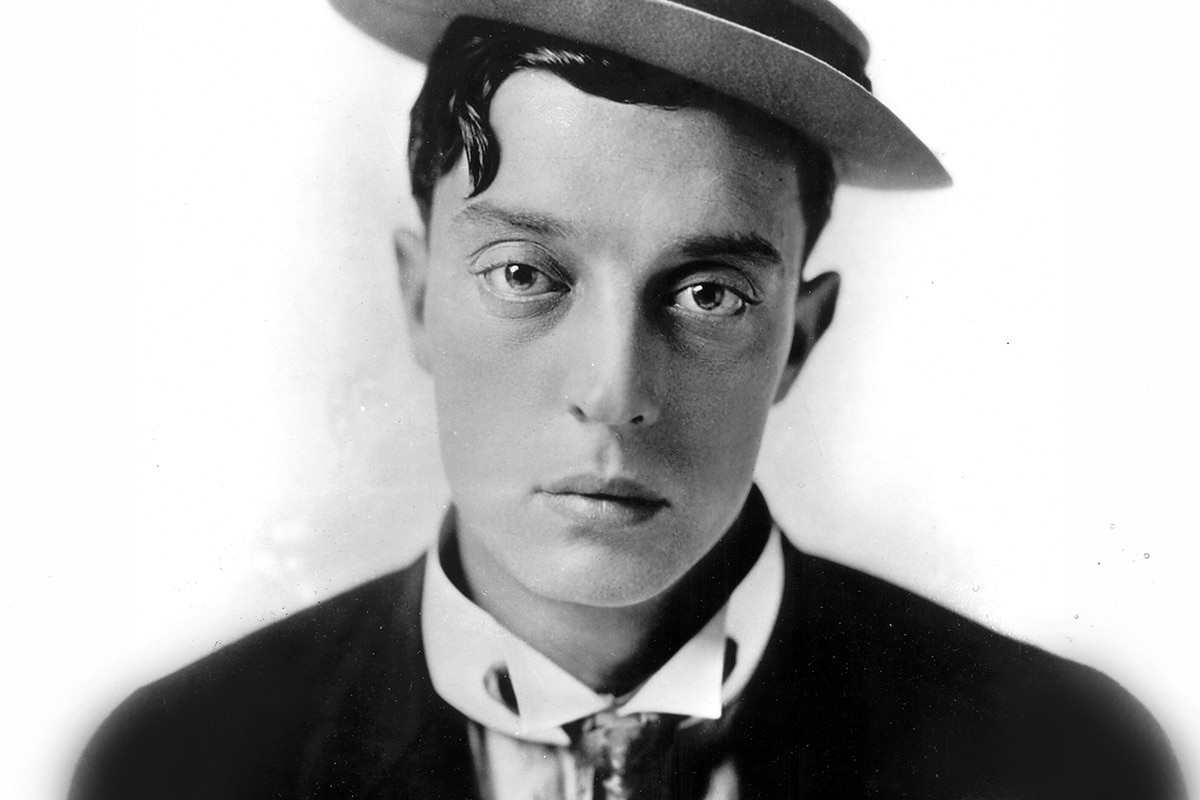
A vaudeville star before the age of 10, Buster Keaton was preparing to make his Broadway debut in 1917 when a meeting with Roscoe "Fatty" Arbuckle changed both the course of his life and the history of cinema forever. Coming into prominence at the same time as Charlie Chaplin and Harold Lloyd, Keaton—whose deadpan expressions to the onscreen comic disasters that befell him earned him the sobriquet "The Great Stone Face"—became one of the most popular and successful comic actors of the silent era. In fact, his daring comic stunts, which he performed himself without camera trickery, quickly became the stuff of legend in films like One Week (1920), The Three Ages (1923), Sherlock, Jr. (1924) and The Navigator (1924). Keaton directed and starred in his greatest achievement, The General (1927), which was panned by critics at the time and was a major box-office flop, but later gained a reputation for being one of the best films made during the silent era. He made the transition to talkies with The Hollywood Revue of 1929 (1929) but suffered bouts of alcoholism and other personal problems that eventually relegated him to little more than a gagman. Keaton made a resurgence decades later after numerous attempts at a comeback, starring opposite Chaplin in Limelight (1952) and becoming a frequent guest star on a several popular shows, which helped keep his name alive and assure his place in cinema history.
Born October 4, 1895, in Piqua, KS, Keaton was raised by his father, Joseph, and his mother, Myra, both of whom were vaudeville performers. By the age of three, Keaton had joined his mother and father in their traveling show, rechristened The Three Keatons, although keeping him working earned the constant scrutiny of the Gerry Society, the turn-of-the-century child labor authorities. According to legend, the great Harry Houdini, seeing the youngster take a fall down the stairs, remarked, “That's some buster your kid took.” True or not, the nickname stuck, and Houdini took credit for coining it throughout his life, though other sources indicated actor George Pardey made the comment, as the Keatons had not yet met Houdini. Whatever the origins, the Keatons struggled prior to Buster coming on board but became a success soon after he joined the show. Tossed about by his father in the most physical of acts, he soon developed a knack for falling coupled with his signature impassivity, a theatrical contrivance—very much in contrast with his off-stage demeanor—which he maintained throughout his life. Keaton worked with his parents for nearly 20 years until his father's excessive drinking led to the breakup of the act.
Now on his own, Keaton earned $250 a week in the Broadway show “The Passing Show of 1917,” but he broke his contract upon meeting Fatty Arbuckle and appearing in his first film, The Butcher Boy (1917). He and Arbuckle became fast friends, though their collaboration was delayed when Keaton was drafted into the army during World War I and posted in France with the 40th Infantry. Keaton failed to see any action, but he suffered an ear infection that permanently damaged his hearing. Upon his return to the States, Keaton resumed his career with Arbuckle and appeared in such silent comedies as Out West (1918), Back Stage (1918), The Hayseed (1919) and The Garage (1920). From his first days before Arbuckle's camera, Keaton understood that film demanded a more subtle acting style than the stage, and in contrast to his fellow performers' extravagance, he was quiet, controlled, unhurried, economical and accurate.
After appearing in shorts like One Week (1920) and Convict 13 (1920) without Arbuckle, who had left to make features at Paramount, Keaton made his first feature, The Saphead (1920), which launched his career and turned him into a star. By this time, he had developed his patented deadpan whenever chaos exploded around him and took to donning his signature pork pie hat that he would wear in most of his films for the rest of his career. As with many top stars of the day, Keaton began directing most of his shorts, including The Haunted House (1921), The Playhouse (1921), My Wife's Relations (1922) and the three-reeled Daydreams (1922). He made his feature directing debut with The Three Ages (1923), a spoof of D.W. Griffith's Intolerance from 1916. With Our Hospitality (1923), a beautiful period piece, Keaton revealed for the first time his love for trains while clearly demonstrating how his work stood apart from the conventions of the period— no wild mugging for the cameras, the use of locations instead of studios sets, minimal title cards and long shots that proved his extravagant stunts were indeed real. He followed quickly with Sherlock, Jr. (1924) and The Navigator (1924), assuring his place in film history before churning out his next three films: Seven Chances (1925), Go West (1925) and Battling Butler (1926).
Returning to his love of trains gave Keaton the greatest prop of all for his masterpiece, The General (1926), his best film and widely hailed as one of the greatest from the silent era, if not of all time. Set during the Civil War, the feature-length comedy depicts Keaton as a railroad engineer who must save his beloved Annabelle Lee (Marion Mack) from Union spies. Uncompromising as ever, Keaton refused to use a model for the film's climax, shooting instead at the unheard-of cost of $42,000 for a real train to crash through a burning bridge; the frame included men on horseback moving on the riverbank as proof it was no camera trick. He also performed his own stunts, which included stepping out onto the engine of the speeding train. Following this unprecedented work, Keaton mysteriously tried playing it safe with the disappointing College (1927), which he modeled after Harold Lloyd's successful The Freshman (1925). But Keaton returned to form with the brilliant Steamboat Bill Jr. (1928), choreographing its phantasmagoric cyclone sequence as if it were ballet. Though he spun, slid, tumbled and eventually gained flight while apparently solid buildings collapsed and vanished magically, the public failed to appreciate his artistry, and the film was a commercial failure.
Because of the box-office failures of The General and Steamboat Bill Jr., Keaton was persuaded by brother-in-law and studio executive Joseph Schenck to abandon his own studio and join MGM. Both Chaplin and Lloyd urged him not to give up his independence, but family pressure— particularly troubles with his wife, Natalie Talmadge—led him to accept $3,000 a week for the new arrangement. The studio insisted on completed, plot-heavy scripts in advance, nixing his working method of developing a narrative through improvisation. It was not long before he was drinking heavily. Keaton battled for every gag on The Cameraman (1928), a film comparable to his pre-MGM features, and made his final silent—and by general agreement the last authentic Keaton film—Spite Marriage (1929), before making the transition to talkies with The Hollywood Revue of 1929 (1929). But mediocrity soon set in with Free and Easy (1930), Parlor, Bedroom and Bath (1931), Speak Easily (1932) and The Passionate Plumber (1932). By 1933, both MGM and his wife had dropped him as a hopeless alcoholic. He retreated to France, where he made Le roi des Champs-Elyses (1934), before signing a contract to make two-reelers for Educational Films. After making Grand Slam Opera (1936), his favorite short for the company, Educational closed down and Keaton was again set adrift.
Though he was able to control his drinking during his time with Educational, Keaton fell on hard times again and was reduced to working as a gagman for MGM, appearing in the Marx Brothers' At the Circus (1939) and Go West (1940). In the late 1930s, he directed his final films for MGM— Life in Sometown, USA (1938), Hollywood Handicap (1938) and Streamlined Swing (1938)— before he was hired by Columbia Pictures to make 10 two-reel comedies. He did have something of a triumph with the series' debut, Pest from the West (1939), which proved he had not yet lost his audience appeal. But by the time he made the last one in the series, She's Oil Mine (1941), Keaton vowed to never again make another short. From there, he found some peace in his personal life through his marriage to dancer Eleanor Norris, while professionally he appeared in a few features like Forever and a Day (1943), That's the Spirit (1945) and Boom in the Moon (1946), while making his first appearance at the Cirque Medrano in Paris.
At the end of the decade, Keaton found renewed interest in his forgotten career when a LIFE magazine essay detailed the silent era's classic comedies, featuring his work alongside contemporaries like Chaplin, Lloyd and Harry Langdon. He made a memorable cameo as one of Gloria Swanson's bridge partners in Billy Wilder's Sunset Boulevard (1950), before he acted for the first time opposite Chaplin in the classic comedy, Limelight (1952). Keaton also began appearing frequently in the new medium of television, where he demonstrated his stunts on shows like “I've Got a Secret” (CBS, 1952-1976) while maintaining interest in his silent films. Though many were considered lost, actor James Mason—who bought the house Keaton built for his first wife—found a treasure trove of canned silent films made by Keaton in a vault and promptly went about preserving them. After an appearance in Around the World in 80 Days (1956), Keaton's revival of sorts reached new heights with The Buster Keaton Story (1957), which starred Donald O'Connor and allowed the real Keaton to end his perpetual poverty. Two years later, he received an honorary Academy Award for his contributions to film while staying happily married to Eleanor. He lived modestly and worked steadily, earning nearly as much money in the last decade of his life as during his time at the top.
Keaton continued to appear on screens large and small for the next several years, guest starring as a hospital janitor who acts as Santa Claus for sick kids on an episode of “The Donna Reed Show” (ABC, 1958-1966) and playing a lion tamer in his final movie for MGM, an adaptation of Mark Twain's The Adventures of Huckleberry Finn (1960). He was the mute King Sextimus the Silent in the successful 1960 tour of the Broadway hit, “Once Upon a Mattress,” and was a time traveler in a partially silent episode of “The Twilight Zone” (CBS, 1959-1964). He maintained a steady presence on television with episodes of the short-lived sitcom “Mr. Smith Goes to Washington” (ABC, 1962), “The Greatest Show on Earth” (ABC, 1963-64) and “The Lucy Show” (CBS, 1962-68), and he had a small role in the ensemble comedy It's a Mad, Mad, Mad, Mad World (1963). With his appearance in the 22-minute short movie, Film (1965), written by Samuel Beckett, Keaton received a long standing ovation at the Venice Film Festival, which allowed the silent comedian to take a final bow in his career. Following his last appearance on film in A Funny Thing Happened on the Way to the Forum (1966), Keaton died from lung cancer on February 1, 1966, in Woodland Hills, CA. He was 70 years old and left behind a legacy as one of the greatest comics of the silent era.
(Edited: July 2026 by Quatoyiah Murray)