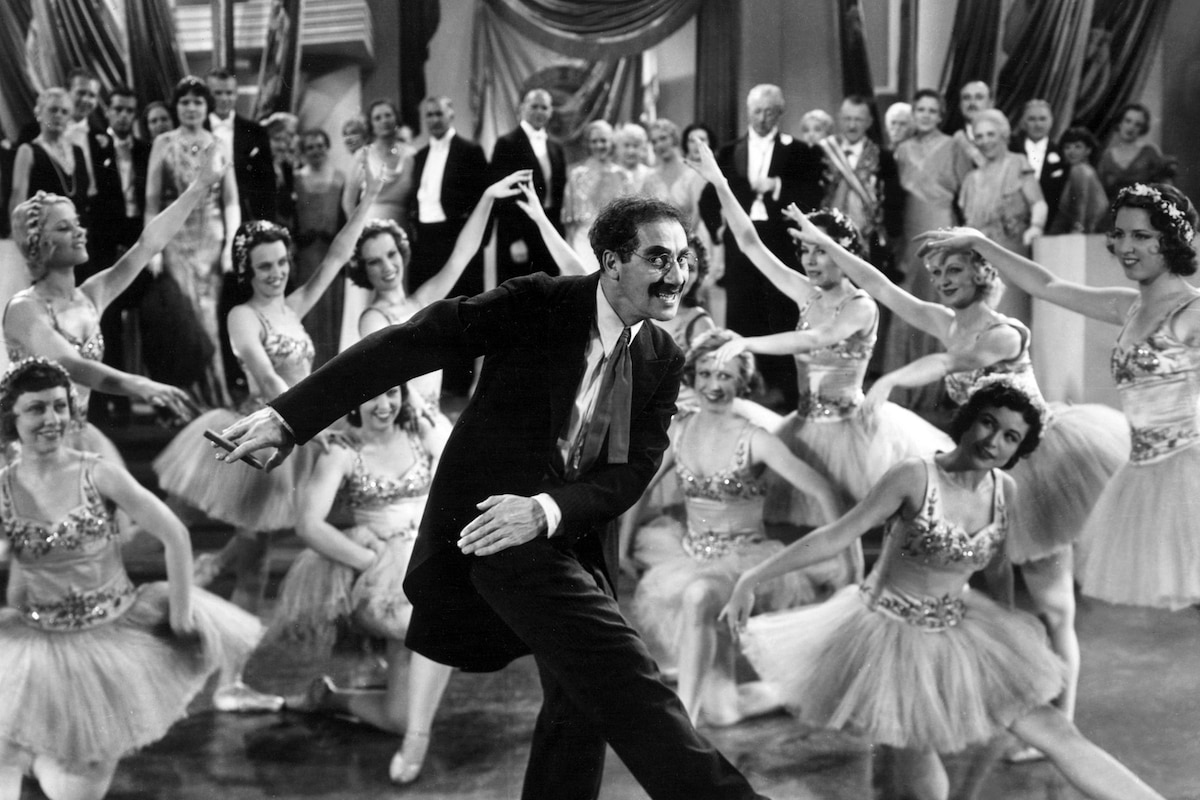

The fifth and final film in the Marx Brothers' five-picture contract with Paramount, Duck Soup (1933) is considered by many to be the Marx Brothers' singular achievement in film. On its release, however, the picture was a critical and commercial failure. Duck Soup is notable in that it contains no harp solo for Harpo, no piano solo for Chico and no romantic subplot for Zeppo. These familiar elements, while entertaining in their other films–The Cocoanuts (1929), Animal Crackers (1930), Monkey Business (1931) and Horse Feathers (1932)–often took away from the atmosphere of general anarchy. It is their absence in Duck Soup that has helped make it the most critically praised of all the Marx Brothers' films. Nevertheless, the absence of such elements disappointed moviegoers. A theater owner in Pierre, South Dakota said that Duck Soup was an example of "how dumb smart people can be. Would any exhibitor have made a picture with the Marx Brothers in it and kept the harp and piano out?"
Leo McCarey directed and was the only top-notch comedy director to take control of the Marx Brothers. He first worked as an assistant for Tod Browning and then established himself as one of Hollywood's best comedy directors. McCarey was instrumental in bringing together Stan Laurel and Oliver Hardy and had recently directed Eddie Cantor in The Kid From Spain (1932). McCarey would go on to direct The Awful Truth (1937), Going My Way (1944) and An Affair to Remember (1957), a remake of his earlier film, Love Affair (1939). In addition to his classical directing style, McCarey also borrowed the film's title from an earlier Laurel and Hardy two-reeler he directed in 1927.

Duck Soup marked the return of Margaret Dumont as the eye in the Marx Brothers storm, and it features the only musical number with all four brothers, "Freedonia's Going to War." As far as Groucho Marx was concerned, Dumont, playing the matronly Mrs. Teasdale, was practically the fifth Marx Brother. She always played her scenes with the Brothers as if they were the most serious and dignified scenes ever put to film. Her ramrod, straight and sincere acting make the picture's madcap humor and satire that much more effective. For instance, in the final scene, Dumont truly sings her heart out as the Brothers pound her mercilessly with custard pies. Groucho later said of her, "She was a wonderful woman. She was the same offstage as she was on it – always the stuffy, dignified matron. She took everything seriously. She would say to me, 'Julie, why are they laughing?'" Apparently, Dumont truly did not get most of the Marx Brothers' brand of humor.
Many of the film's gags and routines were recycled from “Flywheel, Shyster & Flywheel,” Groucho and Chico's radio show from 1932-1933. Some critics have even found traces of old Laurel and Hardy routines, which McCarey, assumedly, brought along. One of the great gags in Duck Soup is also one of the most uncharacteristic because Groucho barely speaks. It is, of course, the famous mirror sequence, which Harpo reenacted with Lucille Ball on her TV show many years later.
The film's depiction of the absurdities of two-bit dictators was so insulting to Mussolini that he banned the film in Italy. American critics were also dissatisfied with the film, saying it was either "impossible to follow" (“The New York Times”) or that it provided no "social comment" (“New York Herald-Tribune”). In later years, though, the critics saw the film's anarchic strain, its satirical take on politics and war and its absurd, almost surreal ending as a scathing criticism of fascism and nationalism. One needs to be careful, though, in ascribing too much (or too little) to the film.

As Arthur Sheekman, one of the screenwriters, said, "Comedy works best when you upset stuffy people or notions, but that doesn't mean that you start out with social criticism." Groucho's quip as Harpo is going off to battle, "While you're out there risking life and limb through shot and shell, we'll be in here thinking what a sucker you are," is best thought of as a criticism of politics and government in general and not as an attack on a specific ideology. As Groucho later said, "We were trying to be funny, but we didn't know we were satirizing the current condition. It came as a great surprise to us."
Screenwriters Harry Ruby and Bert Kalmer were standing on the set one day when an extra standing next to them said, "I don't know who wrote this stuff but they ought to be arrested...they should be in a different business." Kalmer, who was known as a rational and calm man, said to Ruby, "I'm going over to hit him. Who does he think he is? He's just an extra!" But before fisticuffs erupted, Kalmer and Ruby were informed that Chico Marx had paid the extra to rib the screenwriters, just for the hell of it. Some screenwriters did not survive the Marx Brothers long enough to be ribbed at all. Two Paramount contract writers, Grover Jones and Kean Thompson, were both eager and willing to be assigned to Duck Soup. They were each hired at different intervals, but both had disappeared from production after two weeks of work. They simply did not have the stamina and perseverance to deal with the Marx Brothers.
Duck Soup is a crucial chapter in the Marx Brothers' oeuvre because it marked the best and last opportunity for them to be at their most outrageous. But more than them running amok in front of the camera (and they had plenty of experience being let loose in front of an audience in vaudeville and Broadway), the Marx Brothers made a comedy that was cinematic. Their comedy avoided the stagey aspects of their early pictures like Animal Crackers (1930). The Duck Soup plot was absurd, but it was not so ridiculous that the audience didn't care what was going to happen to the characters. This was one aspect that Irving Thalberg did not abandon when he produced their next picture, A Night at the Opera (1935), at MGM.

But Duck Soup was a flop with the public. According to Andrew Bergman, author of “We're in the Money: Depression America and Its Films,” after a "year of Roosevelt's energy and activism, government, no matter what else it might be, was no absurdity. The New Deal would breed its own myths in film, but in 1934 it seems to have utterly cut the ground from under Groucho as prime minister." In “The Comic Mind,” film critic Gerald Mast writes that "The Marxes' Paramount writers and producer enjoyed destroying the very conventions of their craft and the aesthetics of their employers, creating films with deliberately irrelevant plot twists, incongruous sight gags, inconclusive conclusions, red herrings, faceless and forgettable supporting players." If Bergman is right, in 1934, audiences were still enamored with Roosevelt's "Happy Days Are Here Again," and weren't in the mood to have all their conventions destroyed.
After Duck Soup, Zeppo retired from acting and became a Hollywood agent while the other brothers moved on to MGM. There, under the watchful eye of Thalberg, the Marx Brothers went on to their biggest commercial successes, but they were achieved, in part, by reining the brothers in and giving them more likable personas. Ranked Number 5 on the American Film Institute's "List of the Funniest Films," Duck Soup is one of the greatest and most influential comedies ever made (to see its impact on Woody Allen, see Hannah and Her Sisters, 1986). "I could dance with you till the cows come home. On second thought, I'd rather dance with the cows when you came home."
Producer: Herman J. Mankiewicz
Director: Leo McCarey
Screenplay: Bert Kalmar, Nat Perrin, Harry Ruby, Arthur Sheekman
Cinematography: Henry Sharp
Film Editing: LeRoy Stone
Original Music: Harry Ruby, Bert Kalmar
Cast: Groucho Marx (Rufus T. Firefly), Chico Marx (Chicolini), Harpo Marx (Pinky), Zeppo Marx (Bob Rolland), Raquel Torres (Vera Marcal), Margaret Dumont (Mrs. Teasdale), Louis Calhern (Trentino), Leonid Kinskey (Agitator), Edgar Kennedy (Street Vendor).
BW-69m. Closed Captioning.