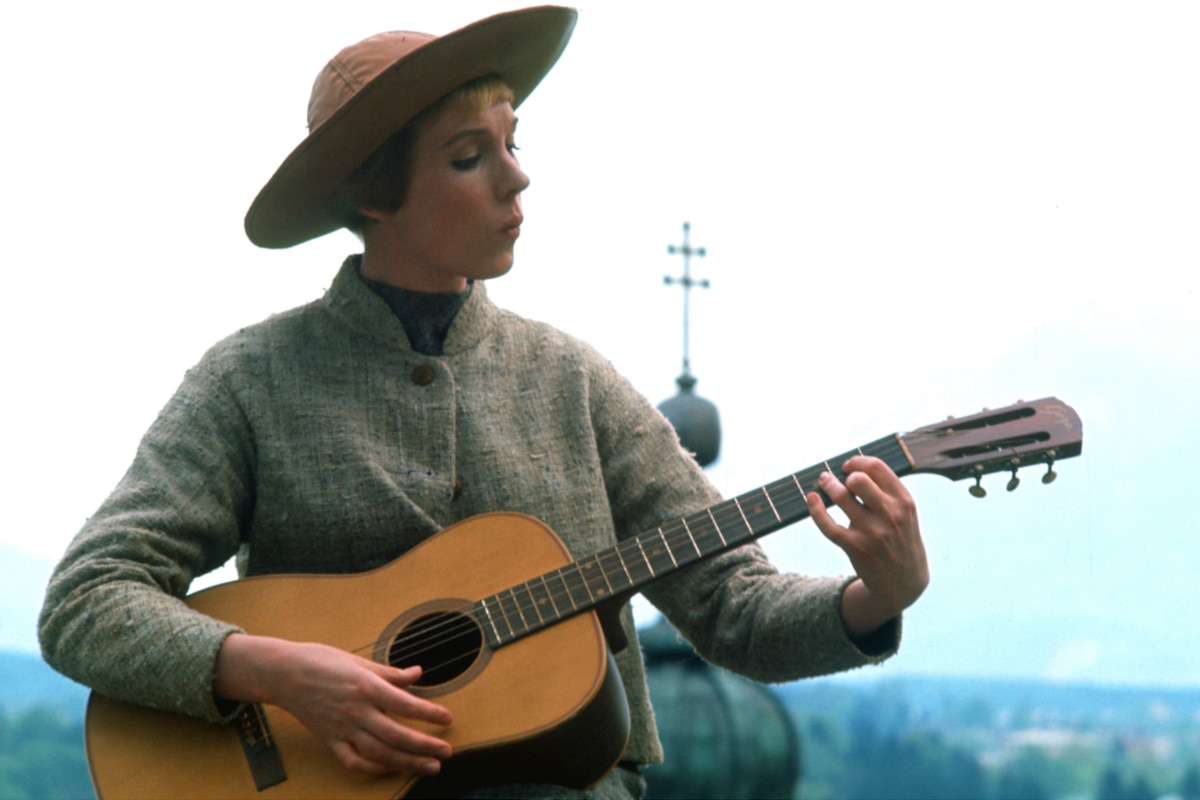

After the disastrous cost overruns and poor box-office performance of the epic Cleopatra (1963) brought 20th Century-Fox to the brink of bankruptcy, the studio would continue production on the one film that would be credited with single-handedly saving Fox from ruin: the visually sumptuous film version of one of Rodgers and Hammerstein's most modest musicals, The Sound of Music, which tells the highly fictionalized story of the real life Von Trapp family.
Julie Andrews climbed into screen immortality in the role of Maria, a young postulant whose antics leave her fellow nuns wondering how to cope with her. Doubtful that Maria is cut out to be a nun, the Mother Abbess (Peggy Wood) decides that Maria should spend some time away from the convent to consider her calling, and she secures a position for her as governess in the sprawling mansion of dour widower Captain Von Trapp (Christopher Plummer), a retired officer of the Imperial Navy, and his seven children.
The children have been suffering from the Captain's neglect since the death of his beloved wife: a constant reminder of his loss, he evades the children by spending most of his time away from home, and when he is there, he virtually ignores them. Maria comes onto the scene like a breath of fresh air and instantly bonds with the children, eventually winning over the Captain as well. But when she finds herself falling in love with him and believes those feelings to be reciprocated, Maria flees to the safety of the convent. At the prompting of the Mother Superior, she returns to the Von Trapps to truly discover what path her life is meant to take. Of course, that path naturally leads to marriage, and their union is cemented just as the Nazis move into Austria. The Captain's resistance to being "drafted" into the Navy of a people he hates leads to the family's decision to flee the country.
For better or for worse, The Sound of Music became the most popular movie musical of all time, copping five Academy Awards, including Best Picture, and becoming an enduring hallmark of wholesome family entertainment, though it remains a film in which form triumphs over substance. Acclaimed screenwriter Ernest Lehman (North by Northwest, West Side Story) was brought in to adapt Howard Lindsay and Russel Crouse's treacly stage play, and though he adds some bite to the story, he was unable to completely eradicate the already heavily applied sugar-coating. But Lehman greatly improved on the stage version with some judicious re-arranging of the songs so that they have more dramatic impact in the context of the story (and discarding the songs done by characters other than the Von Trapps). For example, “My Favorite Things” was originally sung by Maria and the Mother Abbess at the convent and “The Lonely Goatherd” was used in the thunderstorm scene. Lehman's replacement of “My Favorite Things” gives the song more meaning, as Maria comforts the children, while “Goatherd” is placed later and demonstrates the growing solidity of the relationship between Maria and the children. Lehman and director Robert Wise (who also picked up an Oscar) also take the song “Do Re Mi,” which on stage simply showed Maria teaching the children to sing, and transforms it into a full-fledged production number that accomplishes the original task while also conveying the passage of time.
With this film, Wise would prove again why he was one of our greatest directors: his brilliant use of locations and his understanding of the powerful melding of music and images is clearly established in the opening sequence, with the joyful Maria striding up the mountain and into the title song, which immediately became one of the most indelible images in the history of film. Wise and Oscar-nominated cinematographer Ted D. McCord frame every shot as if it were a painting, bathing the love scenes between the Captain and Maria in softness and shadows, and drawing a sharp contrast with the later scenes, drenched in earth tones as the Nazi menace enters the picture.
Although The Sound of Music would enjoy a successful run on Broadway, on the big screen it became a legend, and a rare case in which the film version far outstripped the original, winning its way into the hearts of millions. The true story of the Von Trapps was far less dramatic than what is depicted in the musical. In real life, Maria Von Trapp was a difficult woman who had sprung from a troubled childhood, the Captain was neither domineering nor reluctant for his children to embark on a singing career, and the family calmly left Salzburg by train, rather than dramatically escaping the Nazis in the nick of time by hiking over the alps. But perhaps the reason the film has endured for four decades is because this is the story as we would have liked it to have been.