
Many critics consider The Treasure of the Sierra Madre, released in 1948, to be director John Huston's finest cinematic offering, a gritty depiction of the cancerous effects of gold lust upon a man's soul. Yet there are countless films that deal with the subject matter of money and greed and the deadly combination the two can create. What makes this film stand out is the artistry behind the camera. From the direction of Huston to the performances of Humphrey Bogart and Huston's father, Walter, to the stellar camera work of Ted McCord, The Treasure of the Sierra Madre achieves an uncompromising look into the dark side of human nature.
Huston had first read the novel of the same name by B.Traven in 1936, and thought it would make a good film. He would have to wait 10 years, however, due to World War II. But Warner Bros. held the project for him at the insistence of producer Henry Blanke. Pre-production began promptly upon Huston's return to Hollywood, with a meeting arranged in Mexico between the director and the reclusive author B.Traven. Not much is known about Traven, other than an obsession with personal privacy, and this held true for the meeting in Mexico. A man calling himself Hal Croves appeared with a letter from the author instructing Huston to employ Croves as the film's advisor. Huston did so, and it readily became apparent that Croves and Traven were likely the same man; for whatever reasons, Traven was determined to protect his identity.
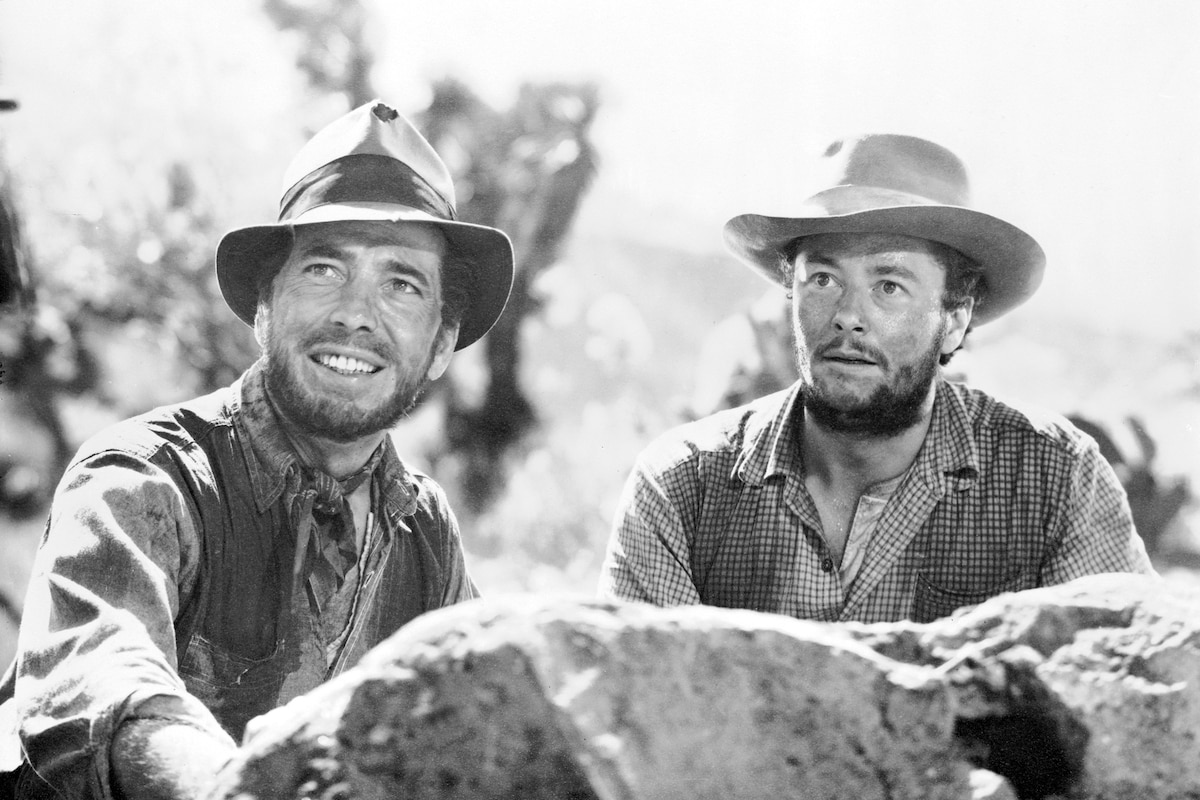
The action centers upon three men with one goal in mind but three different minds about it. The pursuit of gold in the hills of Mexico prompts these Americans to band together: two hard-luck cases, Dobbs (Humphrey Bogart) and Curtin (Tim Holt), and a sage old-timer, Howard (Walter Huston). As their dreams start to materialize, human nature begins to tear the men apart. Bogart, in what many consider his greatest performance, gets an opportunity to shed his suave leading man image created seven years prior in The Maltese Falcon. His character undergoes a moral metamorphosis - from a congenial, average guy to a murderous monster gripped by paranoia. The elder Huston, having been a matinee idol for the last 20 years, was unsure of his ability to play the crusty prospector. It took heavy prodding by his son and the removal of his false teeth to produce the character for which Huston would capture the Best Supporting Actor Oscar of 1948. His son also collected Best Director and Best Screenplay Oscars, making it the only time in Academy history for son and father to win in the same year.
The Treasure of the Sierra Madre was one of the first American films to be made entirely on location, around the village of Jungapeo, Mexico. It was also expensive; the ever-growing budget topped out at three million, much to the consternation of Jack Warner. Insistent upon perfection, Huston plowed through his budget and slipped further behind schedule, prompting the first argument between the director and Bogart, now on their fourth collaboration. During this spat, Bogart, eager to wrap the film in order to attend a boat race in Honolulu, complained yet again to Huston. In response, Huston reached across the table, grabbed Bogart's nose between his two fingers and twisted hard. Tears came to the actor's eyes, but not one word was spoken, and Bogart never complained about the film schedule again. Huston knew he had a masterpiece on his hands and he would not be rushed.
But there were plenty of laughs on set. Huston and Bogart did have a high-old time playing practical jokes on the set of The Treasure of the Sierra Madre. One of their favorite victims was Alfonso Bedoya, the Mexican actor who plays the villainous bandit Gold Hat. Bedoya seemed to have a hollow leg when it came time for meals, gorging himself at every occasion with the food that Warner Bros. provided for the cast and crew. Bedoya took his meals very seriously, always being first when it came time to eat. Huston and Bogart took notice of this and decided to fix Bedoya by affixing strong glue to his saddled and stationary stuffed horse. Just before the lunch bell rang, Huston called Bedoya over to shoot some close-up takes. He hopped into the saddle, Huston shot a few scenes, and dinner was called. Everyone but Bedoya hit the food spread. Bedoya struggled to get off the horse but was held firmly in place by the glue. Bedoya's subsequent barrage of frantic sobbing and caterwauling so annoyed Huston that he soon ordered Bedoya's pants cut away from the saddle and the actor rushed off to stuff his face.
Bedoya was not the only victim. Huston pulled a good one on Bogart in a scene where he has to reach under a rock for hidden gold and is told by another character that an extremely venomous Gila monster had crawled there. Little did Bogie know that Huston had put a mousetrap where he had to reach. Bogie, acting appropriately as if a Gila monster actually was under the rock, jumped several feet backwards when the mousetrap snapped on his finger.
It took 12 years, a spooked author, a toothless father and a vicious tweak to Bogey's nose, but The Treasure of the Sierra Madre opened to massive critical success and easily made its money back in its release and re-releases. Huston's dream was realized in an expertly crafted fable of desire and greed; plus, it achieves film history with the immortal quote by Gold Hat, "Badges? I don't have to show you any stinkin' badges!" Movies just don't get any better.
Director: John Huston
Producer: Henry Blake
Screenplay: John Huston, B. Traven (novel)
Cinematography: Ted D. McCord
Music: Max Steiner
Principle Cast: Humphrey Bogart (Fred C. Dobbs), Walter Huston (Howard), Tim Holt (Bob Curtin), Bruce Bennett (James Cody), Barton MacLane (Pat McCormick), Alfonso Bedoya (Gold Hat).
BW-127m. Closed captioning. Descriptive Video.