
For many critics and fans, Singin' in the Rain is simply the finest musical ever made. And they may be right. Everyone was at the top of their game on this film from the choreographers to the co-directors to the actors and the songwriters. Singin' in the Rain epitomizes everything that made the musical genre such an exciting form of entertainment during the heyday of the studio era. It's also a great cure for the blues. Take a look at Singin' in the Rain and the clouds will disappear, every time. Don Lockwood (Gene Kelly) is a famous silent screen swashbuckler coping with the changing times that have brought sound to movies thus threatening his career. His boss gives him a few short weeks to turn his upcoming silent picture into a top-notch musical, so Don enlists the help of his friend Cosmo (Donald O’Connor) and chorus girl Kathy Selden (Debbie Reynolds) while avoiding the ire of his poorly pitched co-star who believes their publicity romance to be reality.
One crucial ingredient needed to guarantee the success of Singin' in the Rain was the right cinematographer. John Alton, who had won an Oscar for his color photography on An American in Paris (1951), had been assigned to the picture, but co-directors Kelly and Stanley Donen soon had him replaced with Harold Rosson, who had worked with Kelly and Donen in On the Town (1949). Rosson's lighting and mobile camera are very evident in the "Singin' in the Rain" number. The title song was shot out of doors on one of the permanent streets built on the studio backlot – the East Side Street. The area was blacked out with tarpaulins (rather than shooting "day-for-night") and had to be lit from behind so that the rain was visible to the camera but without the carbon arc lights reflecting in the shop windows.
While the film is chock full of musical highlights, Gene Kelly's "Singin' in the Rain" number is the genuine showstopper. Regarding his immortal solo number, Kelly later commented, quite graciously and modestly, on what made the scene work so well: "The concept was so simple I shied away from explaining it to the brass at the studio in case I couldn't make it sound worth doing. The real work for this one was done by the technicians who had to pipe two city blocks on the backlot with overhead sprays, and the poor cameraman who had to shoot through all that water. All I had to do was dance." The technicians' efforts are all the more remarkable since there was a severe water shortage in Culver City, California, the day the sequence was shot.
Kelly was at his peak in Singin' in the Rain and not only poked fun at himself as a swashbuckling matinee idol but also served as co-director and choreographer with Donen during production. Kelly first made a name for himself in the film industry with Cover Girl (1944) in which he revolutionized the Hollywood musical with his innovative and free-flowing dance routines. He topped that success with an Oscar nomination for Best Actor in Anchors Aweigh (1945), but he really hit his stride with On the Town (1949), the first of three successful collaborations with Donen. While there are many other high points in Kelly's later career–An American in Paris (1951), It's Always Fair Weather (1955) and Invitation to the Dance (1956)–Singin' in the Rain will probably remain his signature film.
The role of the ditzy movie diva Lina Lamont was written with Judy Holliday in mind. Holliday was a close personal friend of Betty Comden and Adolph Green, and the married couple even modeled the character on routines they had worked up with Holliday back when they were part of a satirical group called The Revuers in New York. But timing was everything and the idea of casting Holliday was vetoed after she hit it big in Born Yesterday (1950). Everyone figured she'd be uninterested in the supporting part but, as it turned out, the lovely Jean Hagen, Holliday's understudy on Broadway for “Born Yesterday,” got the part.
Debbie Reynolds was only 19 when she was cast as Kathy Selden. Her relative inexperience in musicals concerned the MGM brass, but Kelly and Donen convinced the executives that the young starlet could hold her ground. Reynolds always stated that Kelly and Donen really didn't want her either because she was not a good enough dancer. But Donen maintains that the co-directors wanted her from the very beginning, even though Judy Garland and June Allyson were once considered as possibilities. Reynolds later remarked that she was "being thrown to the lions." But since she was planning to be a gymnastics instructor, Reynolds was already a natural athlete and a hard worker. She abandoned the physical fitness field though after being discovered by a talent agent at a beauty contest in Burbank, California.
Reynolds had to train rigorously for her role so she could keep up with Kelly and O'Connor. This meant mastering the art of tap dancing and other complicated steps. After they finished the "Good Morning" number, Reynolds had to be carried to her dressing room because she had burst some blood vessels in her feet. Reynolds later stated that she "learned a lot from [Kelly]. He is a perfectionist and a disciplinarian – the most exciting director I've ever worked for. And he has a good temper. Every so often he would yell at me and make me cry. But it took a lot of patience for him to work with someone who had never danced before. It's amazing that I could keep up with him and Donald O'Connor." Kelly later commented on her work, "Fortunately, Debbie was strong as an ox...also she was a great copyist, and she could pick up the most complicated routine without too much difficulty...at the university of hard work and pain." But despite her hard work on the "Good Morning" number, Kelly decided that someone should dub her tap sounds, so he went into a dubbing room to dub the sound of her feet as well as his own.
The character of Cosmo Brown was penned with songwriter and pianist Oscar Levant in mind. But once Kelly became involved in the project, effectively turning the film from a strictly song-centered film to one that emphasized dancing, it was agreed that O'Connor was a better choice for the part. O'Connor's background in the circus (his father was an acrobat for Ringling Brothers and his mother was a tightrope walker) enabled him to bring an immeasurable athleticism to his part. But while O'Connor matched Kelly step for step, he also suffered physically for his art, just like Reynolds.
The "Make 'em Laugh" sequence was created because Kelly felt that O'Connor needed a solo number. As O'Connor noted in an interview, "Gene didn't have a clue as to the kind of number it was meant to be." The two of them brainstormed ideas in the rehearsal room and came up with a compendium of gags and "shtick" that O'Connor had done for years, some of which he had performed in vaudeville. O'Connor recalled, "Every time I got a new idea or remembered something that had worked well for me in the past, Gene wrote it down and, bit by bit, the entire number was constructed."
The real highpoint–the scene where O'Connor runs up a wall and completes a somersault–was one that O'Connor had performed years before in vaudeville. To give himself confidence for the sequence, O'Connor invited his brother over to help him rehearse the stunt with a rope. However, the number was so physically taxing that O'Connor, who was smoking four packs of cigarettes a day at the time, went to bed for a week after its completion, suffering from exhaustion and painful carpet burns. Unfortunately, an accident ruined all of the initial footage so after a brief rest, O'Connor, ever the professional, agreed to do the difficult number all over again.
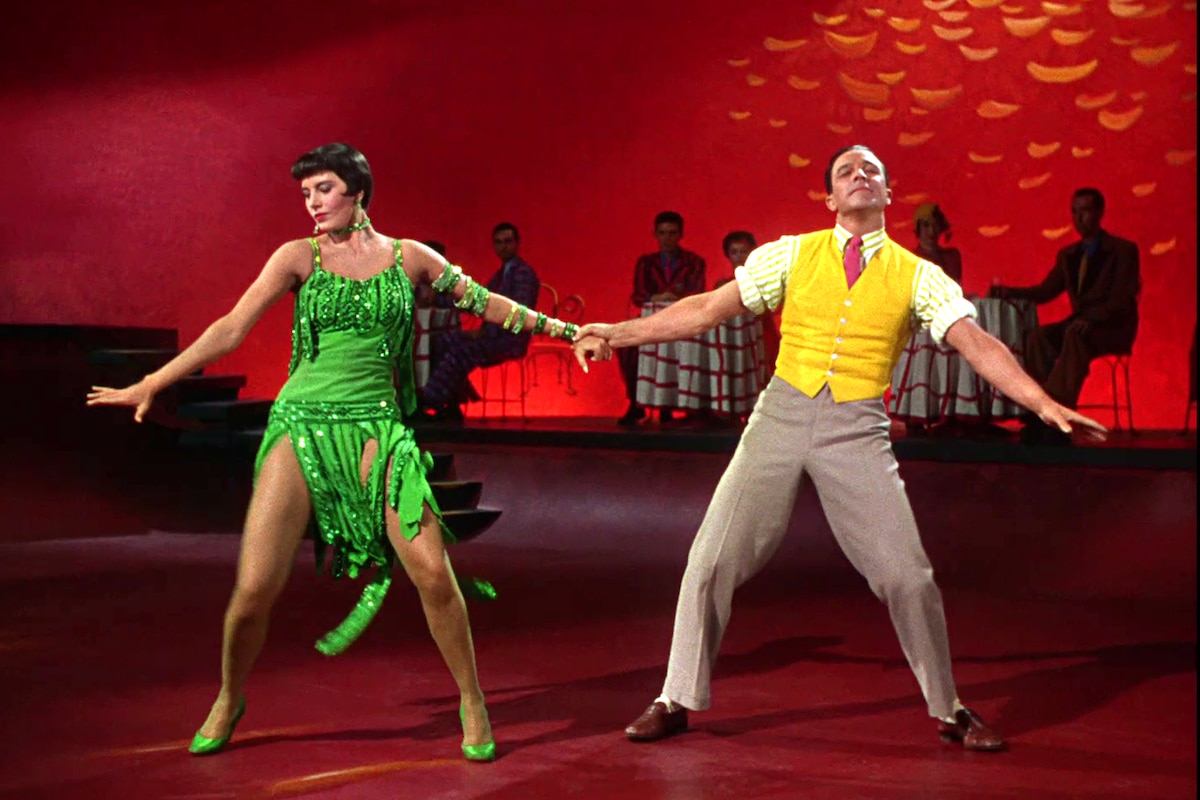
Cyd Charisse, who plays Gene Kelly's dancing partner in the "Broadway Ballet" number, had studied ballet in Los Angeles with Adolph Bolm and Bronislawa Nijinska and then danced with Ballets Russes under the name of Siderova. After World War II, she was given a dancing role in Gregory Ratoff's Something to Shout About (1943). This role brought her to the attention of choreographer Robert Alton, and she was soon hired by Arthur Freed to be the resident ballet dancer at MGM.
Charisse lucked into her small but star-making role in the film when O'Connor was not available for the climactic "Broadway Melody Ballet," providing an opening for a female dance partner for Kelly. Charisse had been hovering on the edge of stardom at MGM for some years. The unforgettable moment, when one of those long legs shot up with Kelly's hat balanced on her foot, turned the trick. Within a year Charisse was starring in her first musical lead in The Band Wagon (1953), opposite Fred Astaire.
For the dream segment within the "Broadway Ballet" sequence, Kelly choreographed a scarf dance, using an enormous 50-foot veil of white China silk attached to Charisse's costume. A strong wind was created using airplane motors but Charisse could hardly stay on her feet because of the pressure of the wind. The "Broadway Ballet" sequence took a month to rehearse, two weeks to shoot, and cost $600,000, almost a fifth of the overall budget.
Singin' in the Rain (1952) rang up a final price tag of $2,540,800, $157,000 of which went to Walter Plunkett's costumes alone. Although the final price overshot MGM's budget by $665,000, the studio quickly realized the wisdom of their investment when the film returned a $7.7 million return upon its initial release. Ironically, in view of the fact that many feel Singin' in the Rain is the greatest of all screen musicals, it earned only one other Oscar nomination for Best Scoring of a Musical Picture. It lost to Alfred Newman's score for With a Song in My Heart.