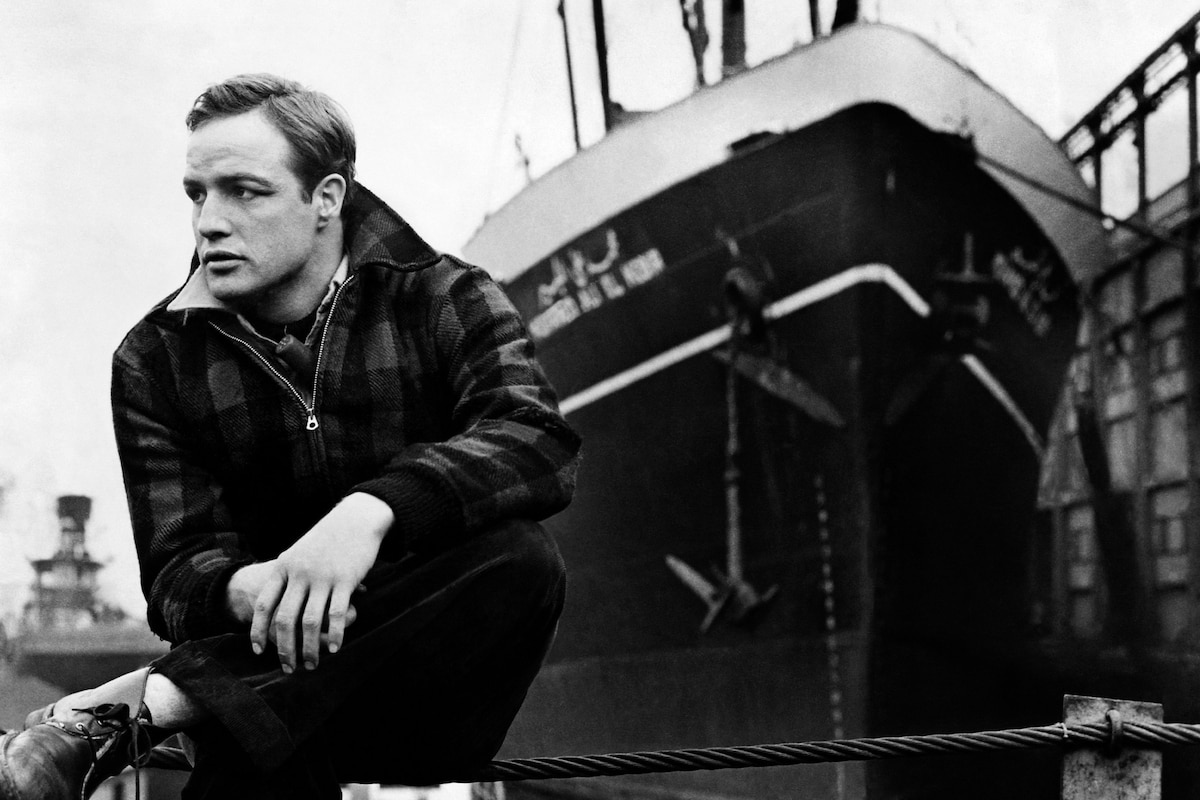

"The finest thing ever done by an American film actor" was how director Elia Kazan characterized the performance of Marlon Brando in On the Waterfront (1954), the classic tale of crime and corruption among unionized dock workers in New York and New Jersey. Brando plays washed-up, ex-boxer Terry Malloy, who earns an inconsequential living working for waterfront crime boss Johnny Friendly (Lee J. Cobb). But when Terry unwittingly lures a rebellious dockworker to his death, he suffers the pangs of guilt. Through the love of Edie Doyle (Eva Marie Saint), the murdered man's sister, and the support of Father Barry (Karl Malden), a crime-fighting priest, Terry finds the moral courage to stand up to Friendly and his goons and accept the violent consequences of his decision.
In developing the film from Malcolm Johnson's Pulitzer Prize-winning 1948 articles “Crime on the Waterfront” published in the “New York Sun,” Kazan originally asked playwright Arthur Miller to write the screenplay. When Miller refused, reportedly because of Kazan's testimony before the House Committee on Un-American Activities that had implicated others as Communist sympathizers, Kazan turned to novelist/screenwriter Budd Schulberg, who also had "named names" for the Committee. Having just earned an Oscar and a professional comeback in the Columbia picture, From Here to Eternity (1953), Frank Sinatra was all set to play the character of Terry Malloy when producer Sam Spiegel convinced Elia Kazan, after several heated discussions, to hire Marlon Brando instead.
Brando had already turned down the role several times. He was extremely reluctant to accept the lead role since he harbored ill feelings towards the director for cooperating as a friendly witness before the House on Un-American Activities Committee just a year earlier. Brando later wrote in his autobiography, “Songs My Mother Taught Me,” that On the Waterfront "was really a metaphorical argument" by Kazan and Schulberg: "They made the film to justify finking on their friends. Evidently, as Terry Malloy, I represented the spirit of the brave, courageous man who defied evil." Producer Sam Spiegel and screenwriter Schulberg convinced him otherwise. Frank Sinatra was extremely bitter about being passed over for the lead role in On the Waterfront and his hard feelings only increased when Spiegel offered him the Father Barry part instead (despite the fact that Karl Malden had already been cast in the role). Kazan, however, refused to dump Malden, and Sinatra settled the matter with a $500,000 lawsuit against Spiegel. Sinatra retained bitter feelings for Brando that surfaced when the two co-starred a year later in Guys and Dolls (1955) — with Brando once again in a role that Sinatra coveted.
Kazan had considered Grace Kelly and Rosemary Clooney for the role eventually filled by Saint in her film debut. Rod Steiger, who plays Terry's weasel-like brother, shares Brando's famous "I coulda been a contender" scene in the taxicab. Steiger also felt a certain bitterness toward Brando because the latter bolted from the set when his portion of that scene was completed, leaving Steiger to play his close-ups to a stand-in. Brando revealed his initial thoughts about his performance in his autobiography: "On the day (Elia Kazan) showed me the completed picture, I was so depressed by my performance I got up and left the screening room. I thought I was a huge failure, and walked out without a word to him. I was simply embarrassed for myself."
Kazan originally intended to shoot the famous taxicab scene in an actual cab. But Spiegel opted instead to use a shabby old taxicab shell. When the crucial rear-projection equipment was not available to shoot the scene, cameraman Boris Kaufman had to put a small venetian blind across the window and small, flickering lights on the side of the cab to create the illusion of movement. Nearly every scene of On the Waterfront was shot on location in Hoboken, New Jersey, much to the dismay of Columbia Studios' mogul, Harry Cohn, who thought he could exercise tighter control over the picture if it was filmed in Hollywood. One advantage to filming on location was the brutal reality of the cold, harsh winter weather which lent the production a verisimilitude that could not have been recreated on a Hollywood soundstage.
In his autobiography, Kazan admitted having uneasy feelings about shooting on location near Mafia operated businesses and hangouts. Local hoods connected to the Costa Nostra were constantly watching the production from the sidelines and would occasionally intimidate Kazan and his crew. Kazan eventually employed an armed bodyguard, Joe Marotta, the brother of the local chief of police. Upon completion, Harry Cohn predicted that the $900,000 production would tank, but On the Waterfront grossed more than $9,000,000 upon its initial release.
On the Waterfront won eight Oscars - for Best Picture, Director (Kazan), Actor (Brando), Supporting Actress (Saint), Screenplay (Schulberg), Black-and-White Cinematography, Art Direction/Set Decoration and Editing. No less than three of the film's supporting actors–Cobb, Steiger and Malden–were nominated, but the Oscar in that category went to Edmond O'Brien for The Barefoot Contessa. Leonard Bernstein also was nominated for the film's score, his first. Kazan's testimony for the HUAC remained a controversial issue in 1998, when he was presented with a Lifetime Achievement Oscar.
Producer: Sam Spiegel
Director: Elia Kazan
Screenplay: Budd Schulberg, from articles by Malcolm Johnson
Cinematography: Boris Kaufman
Art Direction: Richard Day
Editing: Gene Milford
Original Music: Leonard Bernstein
Principal Cast: Marlon Brando (Terry Malloy), Karl Malden (Father Barry), Lee J. Cobb (Johnny Friendly), Rod Steiger (Charley "The Gent" Malloy), Pat Henning (Timothy J. "Kayo" Dugan), Leif Erickson (Glover, Crime Commission), James Westerfield (Big Mac).
BW-108m. Letterboxed. Closed captioning.