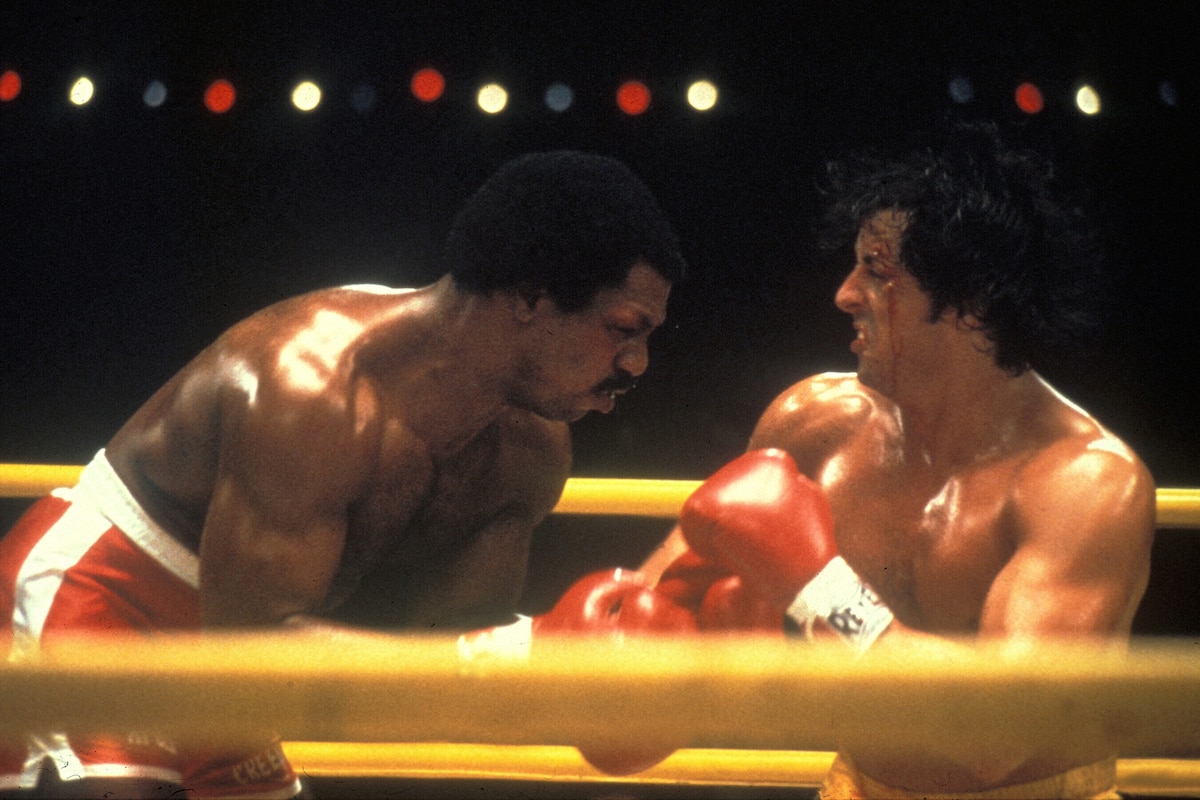

In an Academy Award year which included such strong titles as All The President's Men and Network, this underdog title surprisingly garnered three Academy Awards in 1976, including Best Picture (the other two were for editing and direction). Written by and starring Sylvester Stallone in his breakout role, Rocky (1976) successfully took an old story of the life of a marginal prizefighter and turned it into a relatively new phenomenon of the time – a low-budget blockbuster. Made for very little money, and essentially produced with little belief that it would ever be a financial success, Rocky became a poster child for the sleeper box-office success, an example of what rewards a studio could reap if they came up with the right creative formula. The legacy the film left behind in terms of both talent and its numerous sequels and spin-offs has achieved their own successes, but the quality of the original–a gritty little film with a mixture of special ingredients born from the determination of the film's writer/star and the unique climate of movie going in the 1970s–remains. Rocky now stands today as a classic of both the boxing genre and one of the seminal films of its decade.
The genesis of Rocky is now Hollywood lore. Stallone, flat broke and his wife pregnant, took his script (which he had supposedly written in three days) to the producers Irwin Winkler and Robert Chartoff at United Artists. They offered $75,000 to Stallone to make the film with a star and director of their choice. Stallone held out, hoping to star and direct the film himself. A struggling actor for many years, Stallone had slowly moved up the scale of Hollywood acting gigs, from a notorious softcore porno film (where the nickname "Italian Stallion" in Rocky is derived) to supporting bits in lesser films like The Lords of Flatbush (1974). His script was more than just a tale of a Southpaw boxer who gets a shot at the title; it reflected very strongly Stallone's own aspirations toward becoming a success in Hollywood. After accepting that Stallone wouldn't budge (the producers offered up to a quarter million dollars, but Stallone withheld), UA rolled the dice and gave up a percentage of the film's gross and the lead role to the young actor versus a small fee for the screenplay and the need for a larger budget. The film was shot in one month with a budget of just one million dollars. Rocky ended up grossing more than 50 million dollars in its theatrical run, making Stallone a wealthy man and a national star.
Although Rocky was produced by a major studio in 1976, the fact that it was made for such a relatively small sum of money, starred a virtually unknown actor, included no "stars" widely known to popular audiences, did not tap into weighty historical or political storylines and yet achieved such financial success was a sign of a notable change in the ways popular audiences and the Academy were recognizing new filmmakers. In many ways, Rocky represented the small scale humanist drama later championed by the independent film movement. Rocky opened the eyes of studios and audiences to new artistic and creative achievements not necessarily created by big-budget and big-star blockbusters.
The supporting cast were equally strong actors (all the principal actors were nominated for Academy Awards, but none won) and were generally recognized as greater stand-outs than the film itself. Talia Shire, who plays Rocky Baloa’s wife, Adrian, received perhaps the highest praise from critics at the time, giving a difficult role credibility, subtle understanding and warmth. Burgess Meredith received his first Academy Award nomination for his leathered treatment of Mickey, the 76-year-old trainer. A scene in which Mickey must humbly ingratiate himself to Rocky at his apartment after a bitter estrangement is a typically poignant, sensitive, well-crafted scene often found throughout the film and delivered with tremendous skill by the veteran actor. Even Burt Young, now with a poorly dated role, adds touches of authenticity with a mix of bombastic excess and improvised understatement. Poor Carl Weathers received the villain role, a slight which was noted by some critics for its racial tone and what was later rectified in sequels and it’s popular spin-offs.
The story of Rocky's success combines the elements of a Cinderella tale very close to it's own sentimental story. One of the film's important legacies is the birth of the box-office superstar. The film launched its lead into an orbit of stardom, allowing Stallone to replicate his no-odds hero persona soon after in the Rambo films. In hindsight, Rocky was made shortly after Steven Spielberg's Jaws (1975) and just before George Lucas's Star Wars (1977), two films which would change the way we have since watched films at the theater. As this transformation was just beginning, the Academy took a brief moment in 1976 to glance back on this film from much more humble origins, but one which resonated warmly with audiences far and wide.
Producer: Gene Kirkwood
Director: John G. Avildsen
Screenplay: Sylvester Stallone
Production Design: Bill Cassidy
Cinematography: James Crabe
Costume Design: Robert Cambel, Joanne Hutchinson
Film Editing: Scott Conrad, Richard Halsey
Original Music: Bill Conti
Principal Cast: Sylvester Stallone (Rocky Balboa), Talia Shire (Adrian), Burt Young (Paulie), Carl Weathers (Apollo Creed), Burgess Meredith (Mickey), Thayer David (Jergens), Joe Spinell (Gazzo).
C-120m. Letterboxed. Closed captioning.