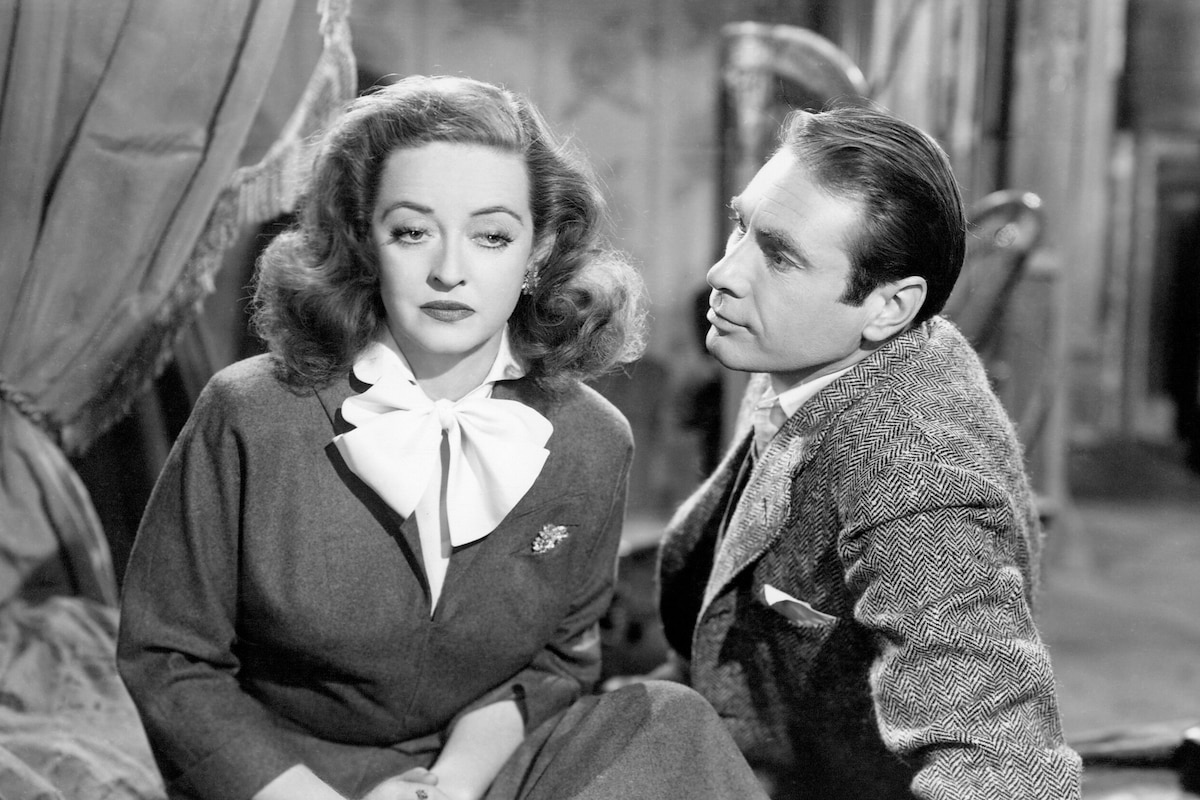

Twentieth Century-Fox’s All About Eve (1950) set a record for Oscar nominations which wouldn’t be challenged until over 40 years later by Titanic in 1997. It continues to be ranked among Academy Award record holders for nominations and wins. The witty 1950 drama set in the New York theatre scene was greeted with almost universal acclaim upon its initial release. It has since become a classic whose lines, characters and story elements are now firmly entrenched in popular culture.
At 40 years old, Broadway star Margo Channing (Bette Davis) can no longer pass for ingénue parts. She is unmarried and fears facing the second part of her life alone. When her most devoted fan, the mousy young Eve Harrington (Anne Baxter), begins to show up to the theater every night just to watch Margo perform, the older actress takes pity on her and invites her into her life. Before long, however, it is clear that there may be more to Eve than meets the eye. A conniving schemer, Eve is an aspiring actress who longs for the spotlight herself. Her unyielding ambition will stop at nothing to get what she wants and take everything away from Margo, including her career, her man and her life.
All About Eve originated with Austrian actress Elisabeth Bergner. She was appearing on Broadway in the hit melodrama “The Two Mrs. Carrolls” in 1942 when she noticed a fan waiting outside her dressing room door after every performance. When Bergner finally approached the young woman, she was so moved by her tale of misfortune and her apparent devotion that she gave her a place in her apartment and her life, only to discover that the stories were lies. The young woman was really trying to advance her own career. Bergner confided all of this to her director's fiancée, actress Mary Orr, who fictionalized the account in the story "The Wisdom of Eve," which she sold to “Cosmopolitan” magazine in 1946. Although her agent shopped the story around Hollywood, there was little interest until three years later, when Orr wrote and co-starred (as Karen Richards) in a radio adaptation that caught the attention of someone at 20th Century-Fox. She sold the studio the rights for $5,000.
Writer-director Joseph L. Mankiewicz had been mulling over an idea for a film about the theatre and the ease with which people can use each other to advance their careers. When he read the studio synopsis of Orr's story, it fit his own ideas so well that he proposed it to studio head Darryl F. Zanuck as his next film. With Mankiewicz coming off a triumph with A Letter to Three Wives (1949), which would bring him Oscars for Best Director and Best Adapted Screenplay, he was in a very favorable position at the studio and didn’t have trouble getting the story approved. He pitched it as a possible vehicle for Susan Hayward, then under contract at Fox, who would have played “Margalo,” the actress taken advantage of in the original story.
As Zanuck read his treatment for what was originally titled Best Performance, he realized that Mankiewicz's emphasis on how the theatre star, now named Margo, was adjusting to the aging process made the character inappropriate for Hayward who was much younger. Among the actresses he considered for the role were Barbara Stanwyck, Joan Crawford and Katharine Hepburn before he concluded that the script's comic possibilities would make the role perfect for Claudette Colbert. Other actors considered for the film included Jeanne Crain and Elizabeth Taylor for Eve, William Holden and John Garfield for Margo's director fiancé, Jose Ferrer and Clifton Webb as critic Addison De Witt and Angela Lansbury as aspiring actress Miss Caswell. Eventually, Crain, Gary Merrill, George Sanders and Marilyn Monroe were signed for those roles, respectively. Only Hugh Marlowe as playwright Lloyd Richards, Celeste Holm as his wife and Thelma Ritter as Margo's dresser, Birdie, were the original choices for their roles. Shortly before production began, Crain became pregnant, forcing the hurried substitution of Anne Baxter.
Production on All About Eve was due to begin principal photography in San Francisco in April 1950, the only time the studio could book the Curran Theater for location scenes set in a classic Broadway theatre. Colbert was finishing work on Three Came Home (1950), the story of a woman confined to a Japanese POW camp during World War II. While performing a fight scene, she fell and broke her back. Suddenly All About Eve needed a new leading lady. Zanuck's first choice was Marlene Dietrich, but Mankiewicz thought she was too artificial to bring Margo to life. His choice was stage star Gertrude Lawrence, but her agent made several unrealistic demands, including cutting any shots of Margo smoking and drinking (even though Lawrence did both herself) and the addition of a song in the party scene. In truth, Lawrence was heavily involved in turning another Fox film, Anna and the King of Siam (1946), into the musical The King and I (1956) and didn't want to put that project on hold.
In desperation, Zanuck called Bette Davis, then considered box-office poison after a string of flops. The two had not spoken in years, the result of a feud when she resigned as president of the Motion Picture Academy in 1942. When he called her on the set of her current film, Payment on Demand (1951), she thought it was a prank. After convincing her he was, in fact, Zanuck and was offering her a role, he told her that she would have to have her costumes fitted and be ready to shoot on location in 10 days. Once she read the script, she was more than happy to oblige. As soon as word of her casting got out, Mankiewicz got calls from directors who had worked with Davis warning him that she would try to take over the picture. The one exception was William Wyler – who had directed her in Jezebel (1938), The Letter (1940) and The Little Foxes (1941). He congratulated Mankiewicz on his good fortune and assured him that he'd enjoy working with her, a prediction that proved correct.
Davis was a model of professional behavior on the set, although, during the early stages of filming, she seemed ready to quarrel when she brought out a cigarette while running a scene and expected her co-star, Merrill, to light it. Both the actor and Mankiewicz suggested that his character wouldn't do that, and Mankiewicz added that Margo wouldn't expect that kind of treatment either. Davis readily agreed. When Mankiewicz finally told her about the warnings he had gotten about her, she conceded that she could be difficult if she had no confidence in the script or the director. With All About Eve, however, she knew she had one of the best scripts of her career. She also had full confidence in Mankiewicz.
It may have also helped that during the first days of filming, Davis and Merrill fell in love. He started out entertaining her young daughter Barbara between scenes and quickly became Davis's confidante during her messy divorce from artist William Grant Sherry. By the time production was finished, Merrill and Davis were lovers. By the time All About Eve opened, they were married. Davis's marital break-up brought the film an unexpected boon, though it would help lead to confusion about the story's source. Before leaving for San Francisco, she had a screaming battle with Sherry. The morning she was to shoot her first scene, she woke up with no voice. After hot oil treatments, she could speak in her lowest register, which made her sound like stage star Tallulah Bankhead. She had to keep that voice throughout filming.
Edith Head had designed and fitted all of Davis' costumes before location filming started, but the costumes she needed for scenes shot in Hollywood weren't finished until later. The day shooting began in Hollywood for the cocktail party, Head arrived on set to discover that the square-necked cocktail gown she had designed for Davis had been made incorrectly. Although the skirt and waistline were right, the bodice was too large. Head went to report the mistake to Mankiewicz and take responsibility for delaying production when Davis called her back. By pulling the bodice down so the neckline rode low on her shoulders, she made the gown look even better than the original design.
There were relatively few sour notes during the production, although Celeste Holm claimed to have stopped speaking to Davis when she mocked Holm’s politeness the first morning of shooting. Holm also stated that many in the cast felt shut out by the closeness that developed between Davis and Merrill. Marilyn Monroe, then a newcomer actress who had only won the part because of heavy campaigning by her agent, Johnny Hyde, was completely intimidated by the acclaimed star. It took her 11 takes to get through the scene in the theatre lobby after Miss Caswell's failed audition, and when Davis snapped at her, Monroe ran off to throw up.
Zanuck was so pleased with All About Eve that he decided not to conduct any previews. The only advanced screening was for the Hollywood press, a group of hardened entertainment journalists who gave the film an enthusiastic standing ovation and began spreading the word about Davis' amazing comeback. The film opened to glowing reviews and fared exceptionally well in the end-of-year awards, with Davis capturing the New York Film Critics Award for Best Actress and the film taking Best Picture. When the Oscar nominations were announced All About Eve had set a record with 14 nominations, including Best Picture, Best Director, Best Adapted Screenplay, Best Supporting Actor (Sanders), Best Supporting Actress (Holm and Ritter) and, for the first time in Academy history, two nominations for Best Actress. The latter, however, would prove a disadvantage.
Zanuck had originally intended to run Baxter in the supporting category, even though she played the title character. Feeling it was time to acknowledge her rise to stardom, Baxter convinced him to put her up for Best Actress. Many in the industry felt that the decision hurt both Baxter's and Davis's chances in that category. On Oscar night, All About Eve captured seven awards, including Best Picture, Supporting Actor and Costume Design. Mankiewicz won for both directing and writing, making him the only person in Academy history to win both awards in two consecutive years. Best Supporting Actress, which could have easily gone to Baxter, went to Josephine Hull in Harvey (1950). And though Davis had hoped to win a third Oscar for the film, the award went to Judy Holliday for Born Yesterday (1950).
In later years, Baxter would concede that she had probably pulled votes from her co-star, though in fairness, it should be conceded that Davis' temperamental behavior during her final years at Warner Bros. probably cost her votes too. In addition, she had to face stiff competition from Gloria Swanson, who had scored a comeback of her own in Sunset Boulevard (1950). A national critics poll named Holliday the best actress, with Davis and Swanson close enough behind to suggest that they had split the majority of votes.
The legend of All About Eve didn't end with the Oscars. Not only did it remain popular in theatrical re-issues and later on television, but it eventually became a cult film, particularly among gay fans who identified with Margo Channing's larger-than-life personality. Her warning, "Fasten your seat belts, it's going to be a bumpy night" became the most quoted of the film's many famous lines. The story of an understudy scheming to replace the star has been referenced in everything from the hilariously excessive Showgirls (1995) to Pedro Almodovar's Oscar-winner All About My Mother (1999), while the entire plot was recycled, with an all-male cast, for the 1995 gay porn video All About Steve. The script itself was set to music for the hit 1970 Broadway musical Applause, starring Lauren Bacall as Margo Channing. Eve finally got to take over for Margo when Anne Baxter stepped into the lead role after Bacall left the show.
The experience of making All About Eve was a fond memory for most of the cast and crew. "I suppose the best film I have been in was All About Eve," said George Sanders in his autobiography. Davis said in her autobiography, "I can think of no project that from the outset was as rewarding from the first day to the last. It is easy to understand why. It was a great script, had a great director, and was a cast of professionals all with parts they liked. It was a charmed production from the word go." As for Joseph Mankiewicz, Davis forever credited him for reviving her career at a crucial time. "He handed me the beginning of a new life professionally and personally," she said. "I also say thank you to Claudette Colbert for hurting her back. Claudette's loss was my gain."
Producer: Darryl F. Zanuck
Director-Screenplay: Joseph L. Mankiewicz
Based on the story "The Wisdom of Eve" by Mary Orr
Cinematography: Milton Krasner
Art Direction: Lyle Wheeler, George W. Davis
Music: Alfred Newman
Cast: Bette Davis (Margo Channing), Anne Baxter (Eve Harrington), George Sanders (Addison De Witt), Celeste Holm (Karen Richards), Gary Merrill (Bill Sampson), Hugh Marlowe (Lloyd Richards), Thelma Ritter (Birdie Coonan), Marilyn Monroe (Miss Caswell), Gregory Ratoff (Max Fabian), Barbara Bates (Phoebe), Walter Hampden (Aged Actor).
BW-138m.
Note: Additional research from Andrea Passafiume