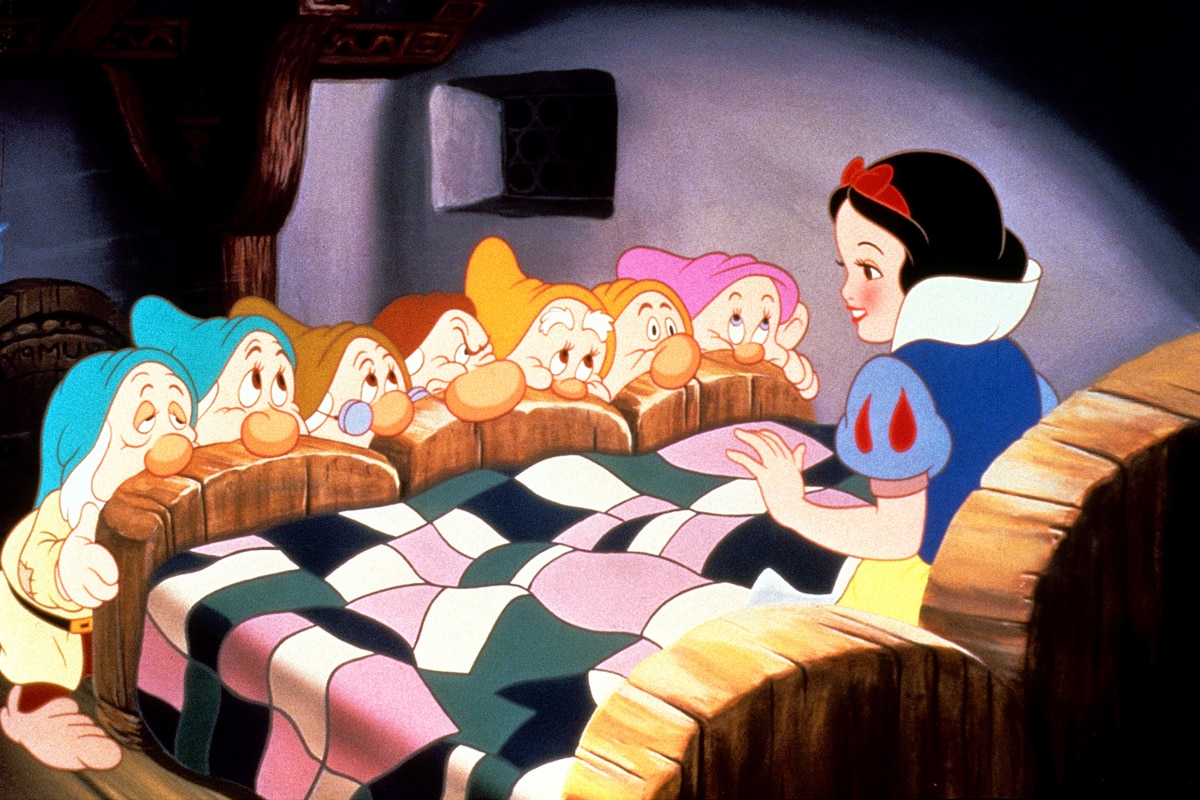

Walt Disney had a lot riding on Snow White and the Seven Dwarfs (1937), his whimsical take on the famous Brothers Grimm fairy tale about a princess (voiced by Adriana Caselotti) forced to take refuge from her jealous, evil stepmother, the Queen (voiced by Lucille La Verne), in a woodland home owned by seven dwarfs. It was a grand experiment in production and distribution, fraught with hesitations inside and outside Disney’s studio; for starters, industry insiders questioned whether audiences would sit through a feature-length cartoon. But reservations vanished with the movie’s long-awaited debut and euphoric reception. Critics were swift to acknowledge the film’s cultural impact, from The Hollywood Reporter terming it a “milepost of motion picture progress” to The Los Angeles Times calling it a “miracle” that will “enrapture audiences” and every accolade in between.
By the early 1930s, Walt Disney’s name was synonymous with animated short subjects, particularly those starring Mickey Mouse and the “Silly Symphonies” series. To sustain his studio long-term, Disney knew he had to branch out. Most sources point to 1933 as the year he settled on producing a feature animation, and the news officially appeared in The New York Times and other publications in June 1934. While Quirino Cristiani (1917’s El Apóstol) and Lotte Reiniger (1926’s The Adventures of Prince Achmed) had already directed full-length animated films, Snow White and the Seven Dwarfs would be Hollywood’s first animated feature and the first Technicolor cel-animated full-length film. Anticipation was high, and the pressure was on.
Other tales were floated to Disney, including “Alice in Wonderland,” pitched by Mary Pickford, but Disney chose “Snow White.” Not only was he a fan of the 1916 silent Paramount adaptation, he also felt audiences knew the story well enough, and the narrative, full of fanciful characters, humor and emotion, would lend itself well to the medium. Disney realized his team couldn’t rely solely on the comedic gags their shorts previously did, since a feature required a more complex script—so much so that eight writers were ultimately credited. In the fall of 1934, Disney began conducting weekly story meetings, welcoming ideas from all, which accounts for how visual and narrative flourishes from German expressionist films, Hollywood cinema and more made their way into the finished product. In late October, Disney famously gathered the whole studio and acted out the tale; the melodramatic recital ran over three hours.
Disney poured everything from his growing studio into the picture, with over 400 craftspeople contributing their talents. The process for producing Snow White and the Seven Dwarfs was fundamentally an expansion of the studio’s shorts system. The entire story was separated into parts, each helmed by a sequence director, and David Hand oversaw the whole movie as the supervising director. Such a pioneering production demanded resourcefulness and ingenuity. For instance, teenage Marge Belcher was brought on to film her movements as Snow White, which the artists utilized to imitate human motions.
Color-wise, Snow White appeared too pale on the cels, a problem solved by adding subtle red dye to her cheeks, which blended with the color on her face when absorbed into the material. Disney technicians also engineered the multiplane camera (first used for the 1937 short “The Old Mill”), a towering structure that captured separate cels detailing foreground, middle ground and background action at varying distances to create the magic of a three-dimensional world. Additionally, the Disney team developed a successive-exposure camera to allow for all three primary colors to be photographed on a single strip through different filters, which was significantly lighter and smaller than three-strip Technicolor equipment. The film’s use of music broke ground, too, integrating tunes into the narrative and creating hits like “Heigh-Ho” and “Whistle While You Work.” Snow White and the Seven Dwarfs’ score accounts for the film’s only competitive Oscar nomination; in fact, the picture became the first American movie to have its songs released in conjunction with the film, effectively making it the first original soundtrack album. And the list of innovations goes on…
Sequence director Wilfred Jackson recalled in a 1988 interview that Disney was “right in on everything that was done, right down to what color a character was painted.” His commitment, along with his high standards and insistence on quality, contributed to the film’s prolonged production schedule and skyrocketing budget, which ballooned to over one million dollars. (Several loans were secured, with one late in the game requiring a screening of the unfinished picture for a Bank of America executive.) Even with an army working day and night, Disney faced a mad dash to the finish line, with tweaks being made mere days before the film’s star-studded Carthay Circle Theatre premiere in December 1937.
Disney, whose shorts were distributed by United Artists in the mid-1930s, signed a lucrative distribution deal with RKO in 1937. RKO’s 1937 short documentary, “A Trip Through Walt Disney Studios,” piqued exhibitors’ interest, while marketing ranging from department store displays to a “Good Housekeeping” serial drummed up enthusiasm. The publicity paid off; the film received record bookings and set attendance records at theaters around the world. Disney also issued licenses for over 2,000 products, ranging from toys and storybooks to silverware and even flower seeds. By mid-1939, Snow White and the Seven Dwarfs raked in over six million dollars, briefly crowning it as the highest-grossing film of all time. And of course, over the last several decades, it has inspired everything from theme park attractions and a Broadway play to theatrical remakes and TV show adaptations.
Reviews were near unanimous, applauding the movie’s high quality, groundbreaking animation and inspired use of music. “For the first time, cartoon characters achieve flesh and blood quality… But the most startling fact of all is that the picture is so effective that you will forget it’s a cartoon,” Paul Denis raved in The Billboard. Disney reached a new level of stature in the industry; the National Board of Review ranked the movie among the year’s 10 best films, Walt Disney graced the cover of Time, and he received an honorary Academy Award consisting of one Oscar and seven mini statuettes to mark his “significant screen innovation.” Disney’s success spurred his competitors into action, most notably Fleischer Studios, responsible for the Betty Boop and Popeye shorts. They learned firsthand how hard the process was with their first two—and only—animated features: Gulliver’s Travels (1939) and Mr. Bug Goes to Town (1941).
With Snow White and the Seven Dwarfs, Disney showed the world what the medium of animation could achieve—and set the formula for his future hits to come. “They realized that with this Snow White feature, Disney was taking them into another dimension,” story artist Otto Englander’s wife Erna remarked in a 1990 interview. “He had opened all possibilities because when it comes to imagination, there is no limitation where the mind can take you and your creativity.” Disney and his team certainly proved that, blazing a trail for their follow-up Pinocchio (1940) and scores of others up through recent hits like Frozen (2013) and beyond.
Sources:
Arnold, Gordon B. Animation and the American Imagination: A Brief History, Praeger, 2016.
Denis, Paul. “Motion Pictures: ‘Snow White and the Seven Dwarfs.’” The Billboard, January 22, 1938.
“Great Disney Masterpiece: ‘SNOW WHITE.’” Kinematograph Weekly, January 20, 1938.
Hahn, Don and Tracey Miller-Zarneke. Before Ever After: The Lost Lectures of Walt Disney’s Animation Studio. Disney Editions, 2015.
Johnson, David. Snow White’s People: An Oral History of the Disney Film Snow White and the Seven Dwarfs, Volume 1. Edited by Didier Ghez. Theme Park Press, 2025.
Kaufman, J.B. The Fairest One of All: The Making of Walt Disney’s Snow White and the Seven Dwarfs. Aurum Press, 2012.
Pryor, Thomas M. “’SNOW WHITE SIDELIGHTS: CENSORS TOPPLED AND BUSINESS BOOMED AS THE DWARFS WENT ROUND THE WORLD.” New York Times, February 5, 1939.
“SNOW WHITE AND THE SEVEN DWARFS.” The Hollywood Reporter, April 1, 1938.
“’SNOW WHITE’ DELIGHTFUL FAIRY TALE FOR ALL AGES: MASTERPIECE OF TECHNICAL SKILL.” The Hollywood Reporter, December 22, 1937.