This article was originally written for the Star of Month programming in the TCM Now Playing newsletter in November 2025.
Tuesdays in November | 20 Movies
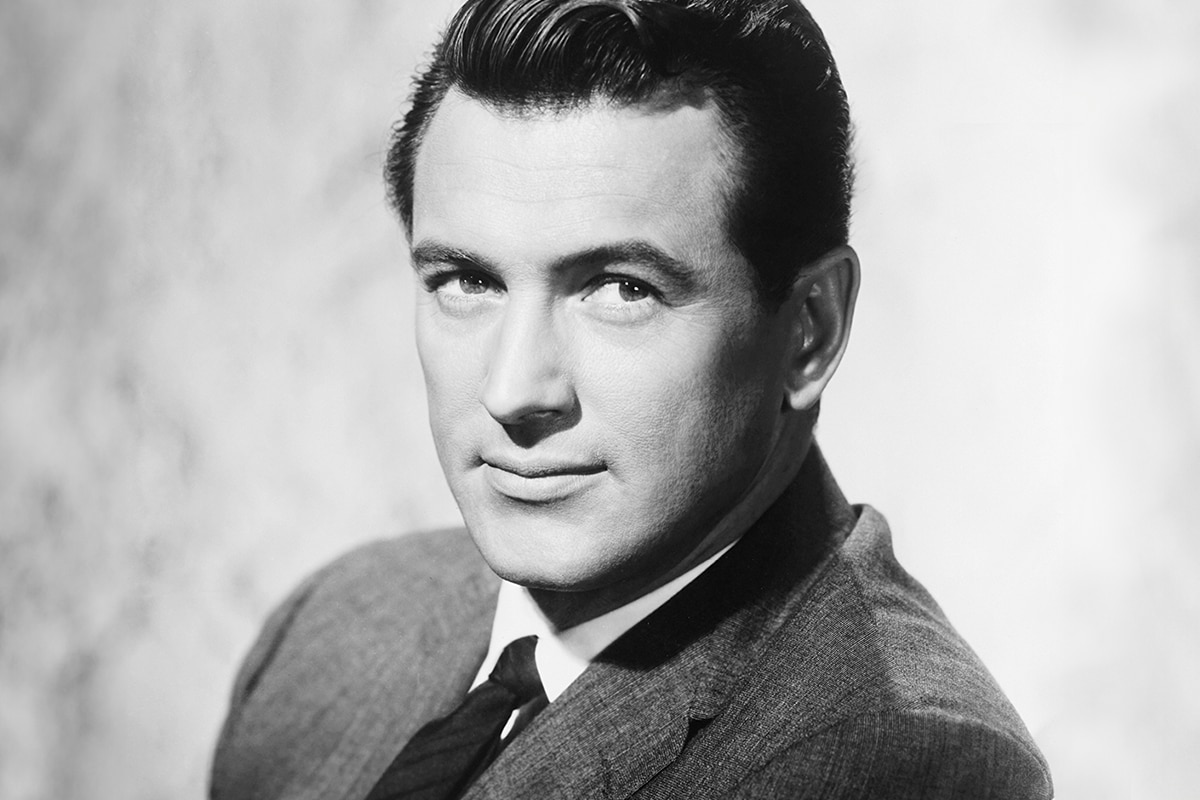
In celebration of his centennial, TCM will be honoring Rock Hudson with a month-long tribute every Tuesday in November. Born November 17th, 1925, in Winnetka, Illinois, Rock Hudson started out life as Roy Harold Scherer Jr. He was a shy, unassuming Midwestern boy. After serving in the Navy, Hudson returned as a strapping young man whose good looks, athletic build and 6’4” frame started turning heads. This was one of many transformations he would go through in his lifetime.
Still in his early twenties, Hudson moved to Hollywood to pursue an acting career. His ascension to stardom was bolstered by the early connections he made in Hollywood. He met talent agent Henry Willson, who took him on as a client. Willson gave him his new name: Rock Hudson, a geographical amalgamation of the Rock of Gibraltar and the Hudson River. In addition to the name, Hudson’s transformation included lowering his high-pitched voice, fixing his posture, getting caps on his teeth and adjusting his mannerisms.
According to Hudson biographer Mark Griffin, “[Willson] knew that if he could get his client in front of the right individual, one who could see beyond the awkwardness and inexperience, they would be going places.” That individual was director Raoul Walsh, who took the young actor under his wing. Walsh cast Hudson in his WWII action movie Fighter Squadron (1948).
Hudson was incredibly nervous about his screen debut, and his one scene required almost 40 takes. Despite this, Walsh saw something in Hudson and put him under contract. Soon studios took interest in Hudson as well, and Walsh sold his contract with the actor to the highest bidder: Universal-International.
This was a pivotal time in the history of the studio when it was building a roster of reliable contract players. Hudson joined at the perfect time. They took care of all the essentials so he could concentrate on his performance. Looking back at those early days, Hudson said, “I had it lucky. Any kinds of lessons you chose were free—drama, diction, voice, horseback riding, ballet, sword fighting, gymnastics.”
He got small roles playing detectives in Undertow (1949) and I Was a Shoplifter (1950), a truck driver in One Way Street (1950) and a football player in Peggy (1950). It was in the latter that Hudson had his first romantic scene, which garnered him a new fan base of teenage girls. His first part in a major production was Anthony Mann’s Western Winchester ’73 (1950) starring James Stewart. Hudson received 10th billing for his role as Young Bull. Eager to please his studio, Hudson would take whatever roles were thrown at him. He appeared in other Westerns like Bend of the River (1952), historical pictures like The Desert Hawk (1950), radio adaptations that included Here Come the Nelsons (1952) and war movies such as Bright Victory (1951).

The turning point for Hudson was his performance as a prizefighter in Joseph Pevney’s drama Iron Man (1951). Not only did he impress Pevney, but he also caught the eye of two other directors: Douglas Sirk and George Stevens, who would both go on to direct Hudson in some of his best work. Watching Iron Man also made an impression on a young Robert Osborne. Reflecting on Hudson, the late TCM host said, “…he didn’t seem to push the performance further than his talents allowed him to. So, he never came off as dishonest in what he did. There was always a sincerity there.”
Now that Hudson was garnering more attention, he took great care to craft his public persona.
It was an open secret in Hollywood that Hudson was gay but coming out of the closet was not an option at the time. Hudson was publicized as an eligible bachelor and then as a happily married man. He had several PR romances with actresses, including Vera-Ellen and Piper Laurie, with whom he worked with on Has Anybody Seen My Gal (1952) and The Golden Blade (1953). When Hudson was nearing 30, he married Phyllis Gates, his agent’s secretary. Their marriage was short-lived.
Hudson was now entering the next phase of his career as a leading man. He worked with Raoul Walsh on The Lawless Breed (1952), Sea Devils (1953) and Gun Fury (1953). While it was Walsh who gave Hudson his start in the industry, it was Douglas Sirk who would guide him to stardom. Sirk directed Hudson in nine pictures, including a pair of soap operas that cast Hudson with Jane Wyman. In his first role in a major A-list production, Hudson starred as Bob Merrick, a handsome playboy who falls for a widow whose husband’s death and her subsequent blindness are his fault in Magnificent Obsession (1954). Audiences took notice of Hudson as a romantic leading man. His All-American look was all the rage in post-WWII America. Hudson also paired well with his leading ladies, playing a romantic partner in tune with his emotional side.

Magnificent Obsession was a huge hit, and the following year Wyman and Hudson were paired in another Sirk-Ross Hunter production, All That Heaven Allows (1955). It followed a similar formula to the previous film in which a handsome young man falls in love with an older widow. Hudson plays his character Ron Kirby, a free-spirited arborist who defies social norms, to great effect. Hudson garnered a reputation as a generous colleague. In Sirk’s drama Written on the Wind (1956), he swapped parts so Robert Stack could have the more interesting role and guided Dorothy Malone in her performance. Furthermore, actress Lauren Bacall only agreed to be in the film so that she could work with Hudson. Stack, Malone and Hudson were reunited in Sirk’s The Tarnished Angels (1957), an adaptation of a William Faulkner novel with a part expanded to give Hudson more screen time.
The apex of Hudson’s acting career came with a plum role in George Stevens’ sprawling epic for Warner Bros., Giant (1956). Hudson plays Bick, the patriarch of a Texas ranching family. According to scholar Don Graham, in casting the role of Bick, Stevens considered many actors, including Robert Mitchum, William Holden and Sterling Hayden. Stevens “believed it was easier to age a younger man than to make an older man younger” and ultimately went with Hudson. He made friends with his co-star Elizabeth Taylor but butted heads with James Dean, personally and professionally, as Dean’s method acting style was vastly different from his own approach. His performance earned Hudson his first and only Academy Award nomination for Best Actor.
The next phase of Hudson’s career would put him in a new sub-genre of movies for which he would become synonymous: the sex comedy. After repeatedly turning down a role in a movie that he worried would be too risqué, Hudson finally agreed to a leading role in Pillow Talk (1959). This was his first of three pairings with Doris Day, one of the biggest talents working in the industry. Pillow Talk set up the formula for sex comedies: a charming man falls for a headstrong woman, and a series of misunderstandings drive the pair together, apart and then together again. Hudson and Day had instant chemistry and became forever linked as one of the great movie couples. They were paired again, along with Tony Randall as their third wheel, in Lover Come Back (1961) and Send Me No Flowers (1964).
Wanting more control over his career, Hudson took advantage of his star power to start his own production company, 7 Pictures, later known as Gibraltar Productions. He co-produced several more sex comedies, riding the wave of his continued success. Hudson starred in Come September (1961), an escapist comedy set in Italy that paired him with Gina Lollobrigida, along with rising stars Bobby Darin and Sandra Dee. He reunited with Lollobrigida a few years later in Strange Bedfellows (1965). Later, he co-produced Howard Hawks’ modern reimagining of Bringing Up Baby (1938) with Man’s Favorite Sport? (1964), casting Hudson with Hawks’ new protégée Paula Prentiss.
After a few more films with Universal, Hudson decided to part ways with his home studio. Hudson began to enjoy his freedom as an independent player and started taking more risks with his career. He made a bold choice in taking on the lead role in John Frankenheimer’s psychological thriller Seconds (1966). Audiences at the time weren’t ready to see Hudson in such a different role. However, it’s arguably Hudson’s best performance and gave us insight into his range as an actor. The film has since sparked renewed interest and found a fanbase.
Hudson went on to star in a pair of dramas starring Claudia Cardinale: Blindfold (1966), which he co-produced, and A Fine Pair (1968). Afterwards, he tried to keep a finger on the pulse of what was trending in the industry. Taking a chance on different genres, Hudson appeared in John Sturges’s big-budget Cold War movie Ice Station Zebra (1968), Roger Vadim’s sexploitation film Pretty Maids All in a Row (1971) and Corey Allen’s disaster film Avalanche (1978). As his movie career declined, he pivoted to television, starring in the hit detective show “McMillan & Wife.” Hudson was thriving in his television career until his health started to take a turn for the worse.
In 1984, Hudson was diagnosed with AIDS. He kept the diagnosis secret, but his frequent hospital stays and increasingly gaunt appearance caused alarm. He was compelled to announce his diagnosis to the public in July 1985. In doing so, he was outed as a gay man and became one of the most public, recognizable faces of the AIDS epidemic. In the years after his passing, Rock Hudson’s legacy has become cemented, and he is remembered not only as a gay icon but as one of the most beloved movie stars of the 20th century.
