This article was originally written for the TCM Spotlight programming in the TCM Now Playing newsletter in June 2025.
French director Jean-Luc Godard once famously said, “Cinema is truth 24 times a second, and every cut is a lie.” Austrian filmmaker Michael Haneke put it a different way: “Film is 24 lies per second at the service of truth.” However one phrases it, cinema has long been considered the art of illusion, a complex blend of reality and artifice. Perhaps that is why moviemakers have often relished fraudsters and con artists as the actual subjects of their stories. TCM’s June Spotlight, “The Art of the Con,” showcases 20 such films every Friday in June, starting with one of the greatest: A Face in the Crowd (1957), directed by Elia Kazan and written by Budd Schulberg from his own short story.
One of the most prescient American films ever made, Andy Griffith stars as an Arkansas jailbird named Lonesome Rhodes, who becomes a populist hero through radio and then television. (Schulberg drew inspiration for the character from TV host Arthur Godfrey and humorist Will Rogers.) Lonesome ascends to the heights of media, celebrity and political culture by fooling untold numbers of Americans who believe him to be an honest man of the people—and not a corrupt charlatan who is only interested in, as he puts it, “Mr. Me, Myself, and I.” While the movie did not find success and vanished quickly in 1957, its chilling predictions of television helping to blur the roles of entertainer, populist, influencer, pitchman and politician have long since come true.
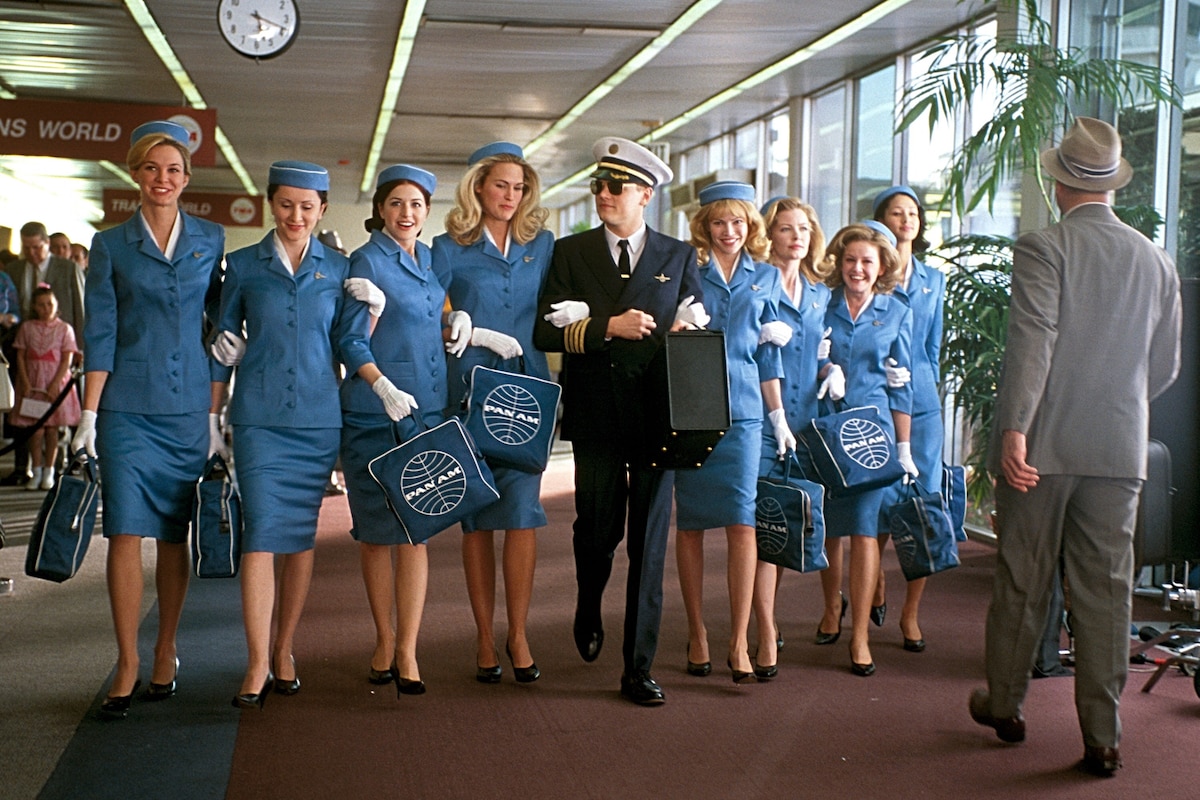
In a lighter vein, Steven Spielberg’s Catch Me If You Can (2002), a TCM Premiere, is a bright and entertaining telling of the exploits of a real-life fraudster, Frank W. Abagnale Jr., who became a virtuoso con artist and forger in the swinging ’60s. He cashed millions in fake checks while impersonating an airline pilot, a doctor, prosecutor and much more. One of Spielberg’s most scintillating blends of comedy and suspense, the film makes perfect use of Leonardo DiCaprio’s charisma and talent in the role of Frank, with Tom Hanks as his foil Carl Hanratty, the strait-laced F.B.I. agent who pursues Frank with a Javert-like tenacity. A major hit of the 2002 holiday season, it also scored two Oscar nominations for John Williams’s score and Christopher Walken’s supporting performance.
A different kind of imposter can be found in the lesser known When in Rome (1952), an MGM production directed by Clarence Brown on picturesque Roman locations in beautiful black-and-white, one year before Roman Holiday (1953) did the same. Here, Van Johnson plays Father John X. Halligan, an American priest traveling to Rome for its 1950 Holy Year celebration. Aboard ship, he shares a cabin with Joe Brewster (Paul Douglas), a con man and escaped criminal. After docking in Italy, Joe steals Father Halligan’s robes and identification to get ashore safely, only for the police to quickly figure out what has happened and chase him to Rome. Father Halligan does the same, but with the goal of sanctifying Joe and turning him into an honest soul. Douglas is especially winning in his “role” as fake priest, getting away with saying blessings when asked but not exactly prepared to hear a woman’s request for confession!
Con men in Italy disguise themselves as priests in another film, too, on the second night of this series in The Swindle (1955), or Il bidone in its native Italian. The fifth feature film directed by Federico Fellini, it is one of his most underrated works. Three small-time swindlers played by Broderick Crawford, Richard Basehart and Franco Fabrizi target the poorest and most gullible Italians by posing as priests and claiming that there is buried treasure on the peasants’ land, among other scams. But Fellini is more interested in probing the circumstances and psyches of the three scammers themselves, revealing deep currents of frustration, sadness and loneliness, with Crawford especially poignant as the grifter who tries for redemption. As “Variety” declared, “It is a bitter picture on a bitter subject.” The film was not well received at the Venice Film Festival, after which Fellini cut it down to 90 minutes. Released commercially while his previous film La Strada (1954) was still enjoying its lap of honor around the world, The Swindle was roundly rejected and was not seen in the United States until 1964. It has since been restored to its full runtime and reappraised as a much more consequential work.
In The Flim-Flam Man (1967), filmed in Kentucky, grizzled con man and good-hearted rogue George C. Scott teaches the tricks of the trade to young army deserter Michael Sarrazin as they scam their way through the South—where “flim-flam” means swindle. Pursuing them is a sheriff played by Harry Morgan, with Sue Lyon of Lolita (1962) fame as the girl whose car they steal, only for her and Sarrazin to fall for each other. Blended with the comedy are well-timed action and chase scenes that are the work of second unit director and legendary stuntman Yakima Canutt. “The Hollywood Reporter” deemed The Flim-Flam Man “one of the best and most American comedies of recent years... a comedy with serious overtones about individualism and personal loyalties.”
A pair of veteran and new grifters also anchor one of the most satisfying and joyful of all con-artist films: The Sting (1973). An enormous hit, it took home seven Oscars and kicks off night three of the series. Robert Redford and Paul Newman’s chemistry is so winning that it is remarkable the picture wasn’t actually conceived as a vehicle for them, after their previous pairing in Butch Cassidy and the Sundance Kid (1969). Newman only came on board as the master grifter Henry Gondorff after director George Roy Hill decided to lighten up David Ward’s script and turn Gondorff into a much more amiable fellow. Ward’s witty, ingenious plotting incorporates many cons, big and small—not just on various characters but on the audience itself. The result is seamless and lightning-fast pure entertainment that fools the audience fairly, without cheap tricks or outright lies in the storytelling. The extraordinary use of Scott Joplin’s ragtime piano music, adapted and arranged by Marvin Hamlisch, is also a vital part of The Sting’s charm.
Another TCM Premiere, Nine Queens (2000) was a major hit in its native Argentina and drew acclaim for its first-time director Fabián Bielinsky, who had spent 20 years as an assistant director. (Sadly, he would direct only one more film before dying of a heart attack.) Once again, it’s about a pair of scam artists, one a rookie and the other a seasoned pro, in Buenos Aires. They have less than 24 hours to pull a perfect con, with the prize being a forged set of rare stamps known as the Nine Queens. Filmmaker Bielinsky said, “I have been interested in the idea of the street swindler my whole life. The idea of delinquents that, instead of using weapons, use their ingenuity and subtle psychological mechanisms to get over on their victims—it always seemed an extraordinary space within which to tell a story.” He spoke to many people who had been victims of swindlers or knew someone who had, and several of their anecdotes resonated and influenced his screenplay, which he tried to get produced for two years to no avail before winning a script contest that enabled him to finally make it. “Variety” film critic Todd McCarthy wrote, “David Mamet might kill for a script as good as the one that fuels Nine Queens. A seductively structured and superbly acted suspenser that breathtakingly piles swindle upon scam without giving away the game until the very end... In every respect Bielinsky reveals the instincts of a filmmaker keen to please through clever dramatic manipulation that respects rather than insults the audience’s intelligence.”
F for Fake (1973), Orson Welles’s last full-length theatrical film, is difficult to categorize. Often labeled a documentary or docudrama, Welles himself said he considered it “a new kind of film,” which critic Jonathan Rosenbaum later likened to an “essay.” Welles opines on the art of fakery, illusion, forgery and deception. “A magician is just an actor playing the part of a magician,” says Welles, who performs magic onscreen and relates the history of Hungarian art forger Elmyr de Hory, who in the movie wonders why his forgeries are considered inferior given that they were lauded by experts who believed them to be genuine. Welles’s film considers these types of philosophical questions throughout, as it presents a nonlinear, brilliantly edited puzzle for the audience.
“Let us be crooked but never common,” declares Charles Coburn to his daughter Barbara Stanwyck in The Lady Eve (1941) — a delightful refrain that shows the wit of writer-director Preston Sturges, who created not just father-and-daughter con artists but principled ones. The pair set out to fleece naïve millionaire Henry Fonda, only for Stanwyck to fall in love with him —resulting in one of the finest romantic comedies ever made, equal parts funny, romantic and sexy. Sturges’s ability to blend moods fluidly keeps The Lady Eve unpredictable; Stanwyck and Fonda can be having a perfectly romantic scene, for instance, when all of a sudden, a horse will butt its nose into the frame, changing the tone instantly. Sturges was a long-established screenwriter who in 1940 had grown tired of seeing his scripts turned into what he considered subpar films. He sold his script for The Great McGinty (1940) to Paramount for 10 dollars and a provision to direct, thereby becoming the first major Hollywood screenwriter to take a “written and directed by” credit. That film’s success launched what is arguably still the most remarkable streak of comedy hits that any director has ever achieved, with The Lady Eve the third of seven masterful Sturges comedies.
The final night of the series kicks off with The Lady Eve but also includes a second all-time landmark of film comedy: The Producers (1967). One of Mel Brooks’s best, it centers on two Broadway producers (Zero Mostel and Gene Wilder) who devise a scheme to make money by intentionally producing a flop. They find the worst script ever written, a musical comedy called Springtime for Hitler: A Gay Romp with Adolf and Eva in Berchtesgaden. And they convince its Nazi writer that they will show the world the Hitler he loved, “the Hitler with a song in his heart.” But what they believe will be seriously bad crosses the boundary of comedy into hilariously bad. The opening-night audience sees it as pure satirical farce, and the show becomes a Broadway sensation. Mostel laments, “I picked the wrong play, the wrong director, the wrong cast. Where did I go right?” The film has long since worked its way into American popular culture with a hit 2001 Broadway adaptation and a 2005 movie musical based on that show. But the original remains as fresh and funny as ever. It also introduced Gene Wilder to the world as a major comic talent, with his nervous hysteria and growing panic a perfect complement to the brashness and confidence of Mostel. They are not just hilarious together but poignant and lovable, in the tradition of Laurel and Hardy, and their film is not to be missed.
