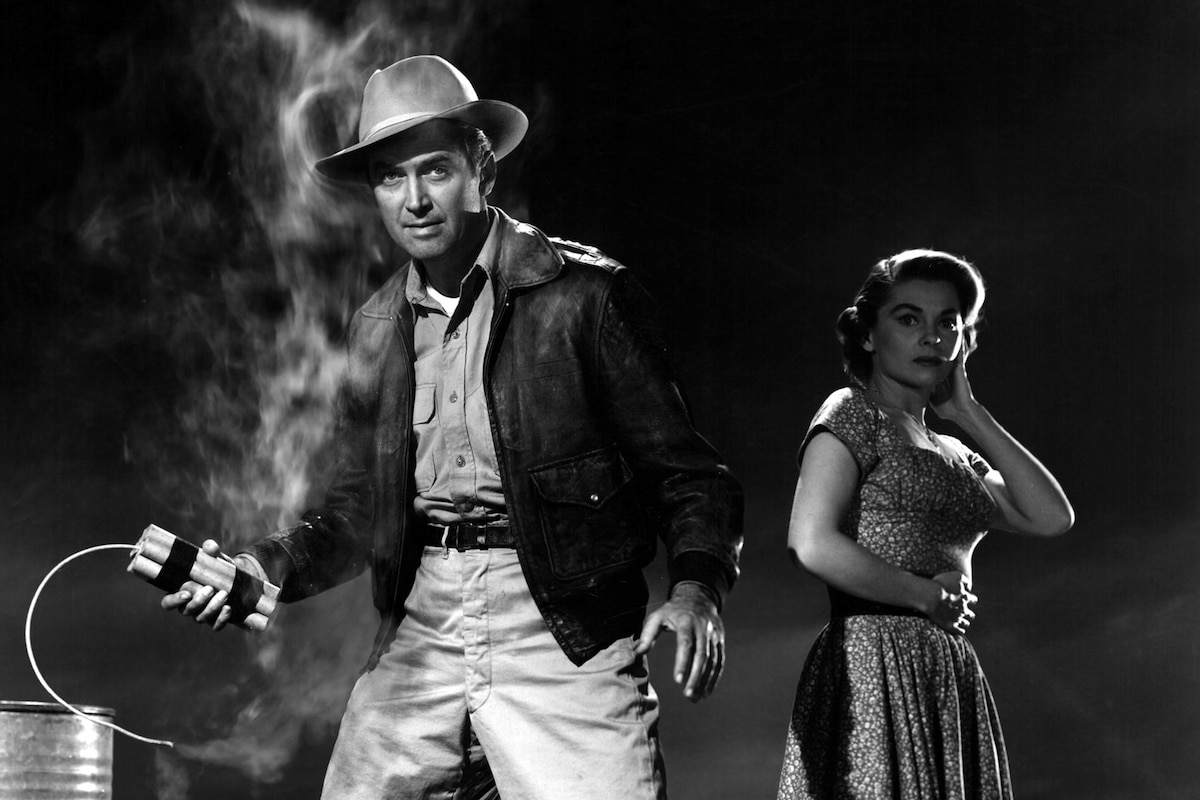
Thunder Bay (1953) was the first Hollywood movie to focus on the subject of offshore oil drilling. This may not sound like the most thrilling fact, but in 1953 offshore drilling was very topical indeed, with congressional hearings and controversies surrounding it. The movie is a brawny, testosterone-charged action flick, with James Stewart and Dan Duryea as oil riggers convinced there is black gold at the bottom of the Gulf of Mexico. They in turn convince Jay C. Flippen, a wealthy financier, who funds their risky, storm-proof oil platform. The construction of the rig, however, disrupts a local Louisiana fishing community, and tensions build to the breaking point.
This picture may be a minor credit for both Stewart and director Anthony Mann, but even a minor film from these artists is well worth watching. Stewart and Mann had just made three outstanding westerns together - two of them produced by Aaron Rosenberg, who also produced this one. Thunder Bay was described by many at the time (including Stewart) as a modern western with boats and oil standing in for horses and guns. Even Variety made the comparison in its review: "A modern plot that deals with offshore oil drilling, instead of being a costumed, western-localed story, gives this regulation outdoor actioner an interesting switch." Certainly Stewart's character of an obsessive entrepreneur is a variation on his edgy and neurotic cowboys in Bend of the River (1952) and The Naked Spur (1953). His costume may be different, but the character is fairly similar. Stewart's and Mann's next collaboration would be The Glenn Miller Story (1953), definitely not a western in any way, after which they returned to the genre they did best with The Far Country (1954).
Thunder Bay marked Universal Pictures' entry into the widescreen format craze of the day. The film's New York premiere featured the first use of 1.85:1 aspect ratio projection and a new three-speaker stereophonic sound system. Critics were impressed by these technical aspects as well as by William Daniels' outstanding color photography, shot on location in Morgan City, LA, and thirty miles out to sea on an oil barge. The movie itself, on the other hand, didn't cause any great shakes. "Sadly enough Thunder Bay does not appear to be the most impressive vehicle to launch sight or sound systems," wrote The New York Times. Nonetheless Thunder Bay did very well financially, no doubt helped by the topicality of its story. And of course, 1.85:1 eventually became the standard aspect ratio still used by the majority of Hollywood movies.
As for the new sound system, Variety offered an amazingly prescient warning which has been ignored far too often in recent years: "Exhibs will have to be careful of the stereophonic sound, however, because, as used at the preview, it can become a major distraction that greatly lessens a viewer's ability to stay with the story. The three-speaker setup shouldn't be used just as a noise-maker."
Producer: Aaron Rosenberg
Director: Anthony Mann
Screenplay: Gil Doud, George W. George, John Michael Hayes, George F. Slavin
Cinematography: William Daniels
Film Editing: Russell Schoengarth
Art Direction: Alexander Golitzen, Richard H. Riedel
Music: Frank Skinner
Cast: James Stewart (Steve Martin), Joanne Dru (Stella Rigaud), Gilbert Roland (Teche Bossier), Dan Duryea (Johnny Gambi), Jay C. Flippen (Kermit MacDonald), Marcia Henderson (Francesca Rigaud).
C-103m.
by Jeremy Arnold
Thunder Bay
by Jeremy Arnold | July 29, 2005
SIGN UP FOR OUR NEWSLETTERS

CONNECT WITH TCM