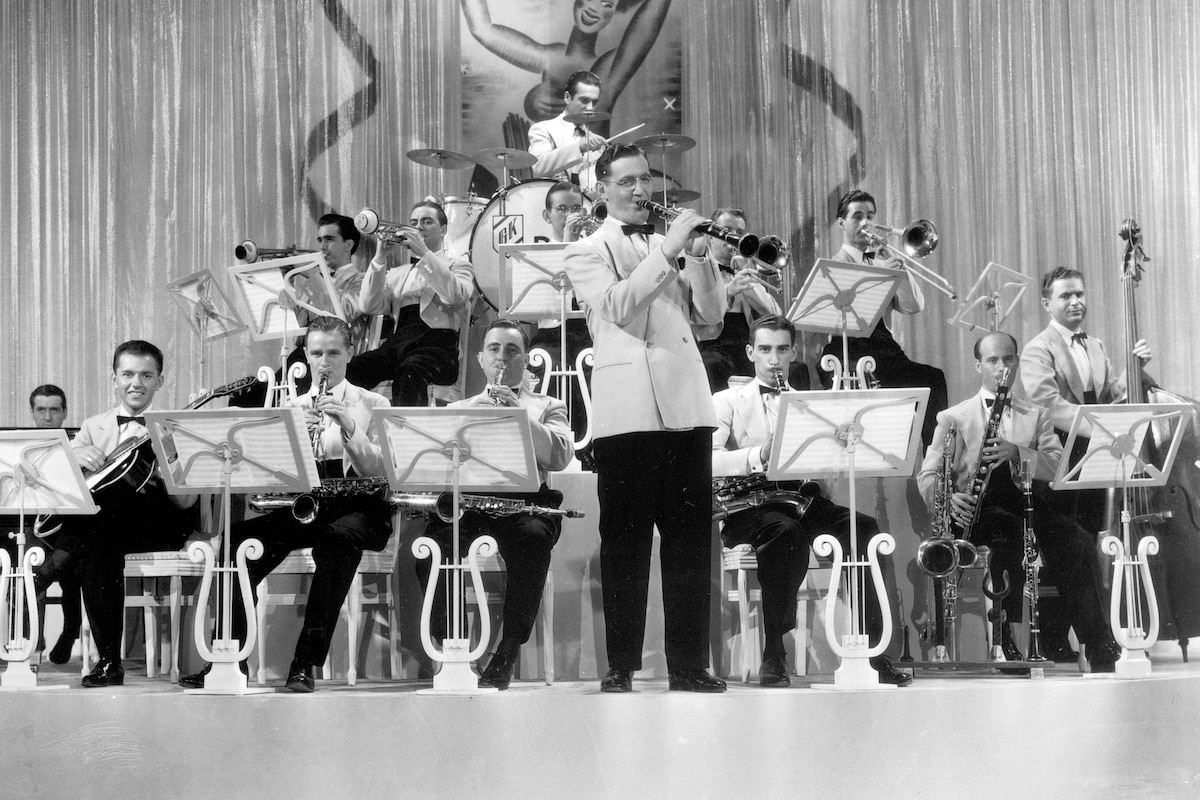
The Big Broadcast of 1937 was the third film in the popular music-comedy revue series of Big Broadcast movies and the first film that Jack Benny made under a new contract with Paramount Pictures. Benny had appeared in a dozen of so movies, dating back to his big screen debut as master of ceremonies in the early sound feature The Hollywood Revue of 1929, but he had made his fame on radio and The Big Broadcast of 1937 was, as the title suggests, built around the radio stars of the day. Benny plays Jack Carson, manager of a failing radio station desperate to find a hit show, and George Burns and Gracie Allen are the station's primary sponsors Mr. and Mrs. Platt. A regular variety show of co-stars show up to fill out the film, from comics Bob Burns and Martha Raye to singers Shirley Ross and Benny Fields to bandleader Benny Goodman and esteemed orchestra conductor Leopold Stokowski.
Paramount assigned the reliable contract filmmaker Mitchell Leisen to direct. A former art director and costume designer famed for his inventive and flamboyant creations for Cecil B. DeMille's Madam Satan (1930) and The Sign of the Cross (1932), Leisen moved into the director's chair in 1933 and became one of the studio's most reliable and versatile directors. He had a knack for musicals, comedies and romantic dramas, all made with a stylish elegance and light touch. "I loved working with Jack Benny and George Burns and Gracie Allen," he told biographer David Chierichetti. "Burns and Allen supplied a lot of their own gags and I just let them go." He was particularly charmed by Allen, who he says was nothing like the dizzy character she played in the comedy act: "She was thrilled with her dress for the wedding scene because it was the fist time she's ever been so glamorous," Leisen recalled. "As she came down the aisle in the wedding procession, she ad-libbed the line, 'Don't I look pretty?' It was not in the script but I used it anyway."
German animator and experimental filmmaker Oskar Fischinger was commissioned to create an animated abstract sequence for the film to be shot in Technicolor and set to an original jazz piece composed by Ralph Rainger. When the production was switched to black and white, the sequence was subsequently intercut in a montage with live-action footage. After Fischinger was released from his contract, he bought his film back from Paramount, repainted the animation cels, and made a color version as originally intended. Called Allegretto (1936), the three-minute abstract short became one of Fischinger's most famous and most popular films.
According to Leisen, he personally flew to New York to ask Stokowski to appear in the film and the conductor agreed, excited about the opportunity to try out sound recording. The entire Philadelphia Philharmonic Orchestra was flown out to Hollywood and the chosen piece, "Impregnable Fortress," was recorded in a studio that was ill-equipped for a ninety-piece orchestra. "Stoki was disgusted when he heard the tracks, so he went in and recorded all the instruments singly, mixed them, and brought the thing to life," says Leisen.
By Sean Axmaker
Sources:
Mitchell Leisen, Hollywood Director, David Chierichetti. Photoventures Press, 1995.
Jack Benny: An Intimate Biography, Irving A. Fein. Putnam, 1976.
IMDb
Wikipedia
The Big Broadcast Of 1937
by Sean Axmaker | April 01, 2014
SIGN UP FOR OUR NEWSLETTERS

CONNECT WITH TCM