One of the most well-known British film production companies ever,
Hammer Films became famous and wealthy in between the '50s and '70s
making Gothic horror films, from The Curse of Frankenstein (1957)
and Horror of Dracula (1958) onward. But the studio made many
other types of cinema as well, including noirish mysteries like Terence
Fisher's The Unholy Four (1954), a seethingly suspicious and very
stiff-upper-lip genre entry made on the cheap and starring a 44-year-old
Paulette Goddard, one more movie and a handful of TV appearances away
from retiring altogether. Her presence is more than a little odd - cast
because Hammer's US releasing partner Lippert Pictures demanded American
stars, the visibly aged, suddenly Crawford-esque Goddard is the
emotional-sexual hot spot of the movie, lusted and struggled after by
every other character, and yet she's actually in very little of it. An
American ex-beauty-queen trapped in these fake-mansion studio rooms
(modern, yet with a suit of armor in the corner) with a small army of
doughy-faced Englishmen - for whom a suspenseful plot point, with
"muhduh" on the line, means sitting down for breakfast, having another
Scotch, or, in one rich moment, spend an evening playing cards.
But of course the drinks are dosed. The film is so relaxed even the
fistfights seem polite and are abandoned as soon as someone takes a good
hit. Adapted from a novel credited to actor George Sanders but actually
written by genre doyenne and Howard Hawks script-mistress Leigh
Brackett, The Unholy Four is actually a literate, witty and
brooding tale, beginning when a man (William Sylvester, remembered best
as Dr. Heywood Floyd, the scientist visiting the Moon, in Kubrick's
2001: A Space Odyssey, 1968) drives up to a manor house in the middle
of the night, and approaches it as though it were a zoo cage full of
sleeping lions. Bound by bitterness and suspicion, Phil Vickers is
returning home from an unexplained four-year absence - unexplained least
to Vickers himself. Fisher's film takes its sweet time in peeling the
artichoke, as he reenters a posh landscape populated by a wife he
considers faithless (Goddard), a pair of business partners (Patrick Holt
and Paul Carpenter) with whom he was vacationing in Portugal when he was
assaulted and suffered amnesia, his wife's vengeance-seeking and
potentially gay social secretary (Alvys Maben), and a frivolous demimonde
of hangers-about and devious postwar partiers, who gather virtually
every night at various mansions, and at which drunken get-togethers, it
is implied, marriages collapse and people sometimes die.
Vickers' primary suspect, one Harry, a fourth corner of the men's
uneasy quad, becomes one of these corpses before we even meet him, and
the police up the tension all around, tracking Vickers as he himself
rather testily investigates everyone else as to what had happened in
Portugal. No one seems broken up about Harry, but then nobody gets too
worked up over much in The Unholy Four (an alternate title,
The Stranger Came Home, makes a good deal more sense), and its
clamped-pot-lid personality is one of its most beguiling features,
beginning with Sylvester's snake-eyed, contemptuous coolness. "I don't
like people very much," says another, far more sociable type early on,
in a classically Brackettian bit of dialogue, "not even the people I
like." Nobody's to be trusted, clearly, but even in this snake pit, it's
not hard to believe everybody when they inform the police more than once
that Vickers was and is almost universally loathed. Walking around like
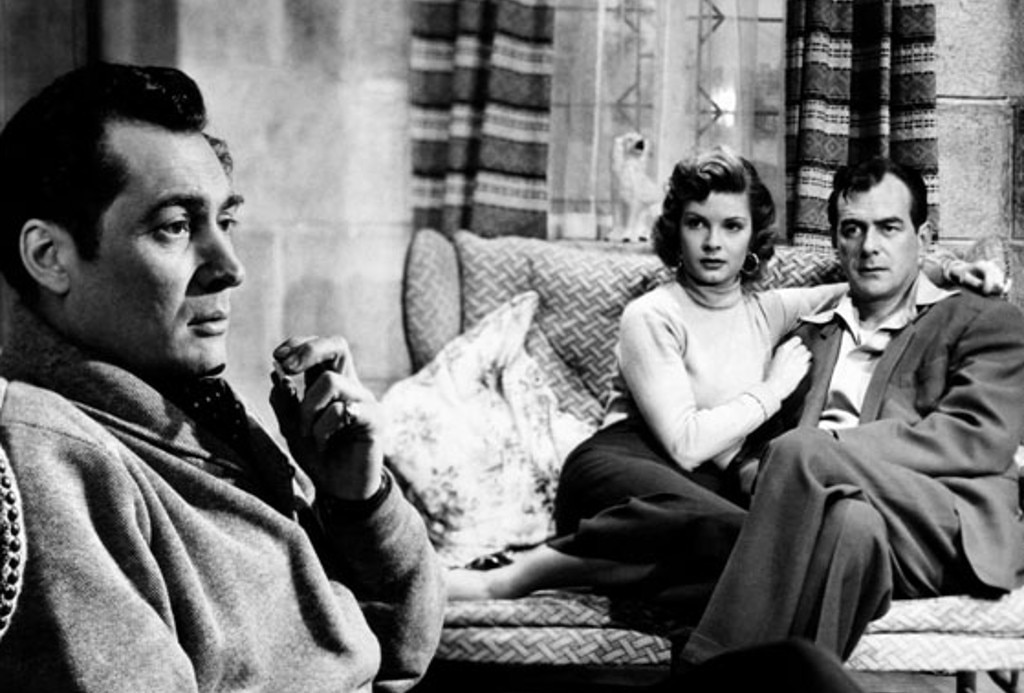
an imperious ghost, putting every other character on the defensive,
Vickers seems volatile and dangerous thanks only to his stillness. What
happened to you in Portugal?, his ostensible friends ask. "You were
there," he replies. "You tell me."
Fisher was already one of the most reliable and prolific journeymen
in British B pictures, and though he became Hammer's top-line ace after
the horror films hit big, his style was always predicated on efficiency
and simplicity. (You can't make five films a year, as Fisher commonly
did in the '50s, and be an innovative craftsman, too.) Here, his job
consisted mostly of letting Sylvester's seething boil chill every scene,
and letting the cast have quiet fun with Brackett's dialogue (courtesy
of the screenplay by Hammer producer Michael Carreras, who was not noted
for his writing). Lines are just tossed away, in a prototypically
British manner - when evidence mounts in Vickers' favor, Russell
Napier's hawk-nosed inspector just mutters, "I had such a beautiful case
against you." The story itself becomes tangled in false confessions,
fatal accidents, and mysterious motivations - we never do learn what
"firm" the four men were in control of, or how its finances figured into
the plot - and before long the list of corpses gets long enough to make
everyone, even Vickers, sweat.
Sometimes, a brittle, calm, terribly British approach to melodrama
can be a tonic - just what one needs after a steady diet of American
hyperbole and make-'em-feel-it moviemaking. Compared to a
contemporaneous American noir, The Unholy Four capitalizes on
that British sense of crime unfurling amongst the privileged, and at
home - and it also resonates with a concern for personal and marital
relationships, and how they can be poisoned by duplicity and secrecy. In
the States, noir usually means greed and fate have caught up with you.
In England, you could only be betrayed by those whom you loved and
thought loved you.
By Michael Atkinson
The Unholy Four
by Michael Atkinson | April 01, 2014
SIGN UP FOR OUR NEWSLETTERS

CONNECT WITH TCM