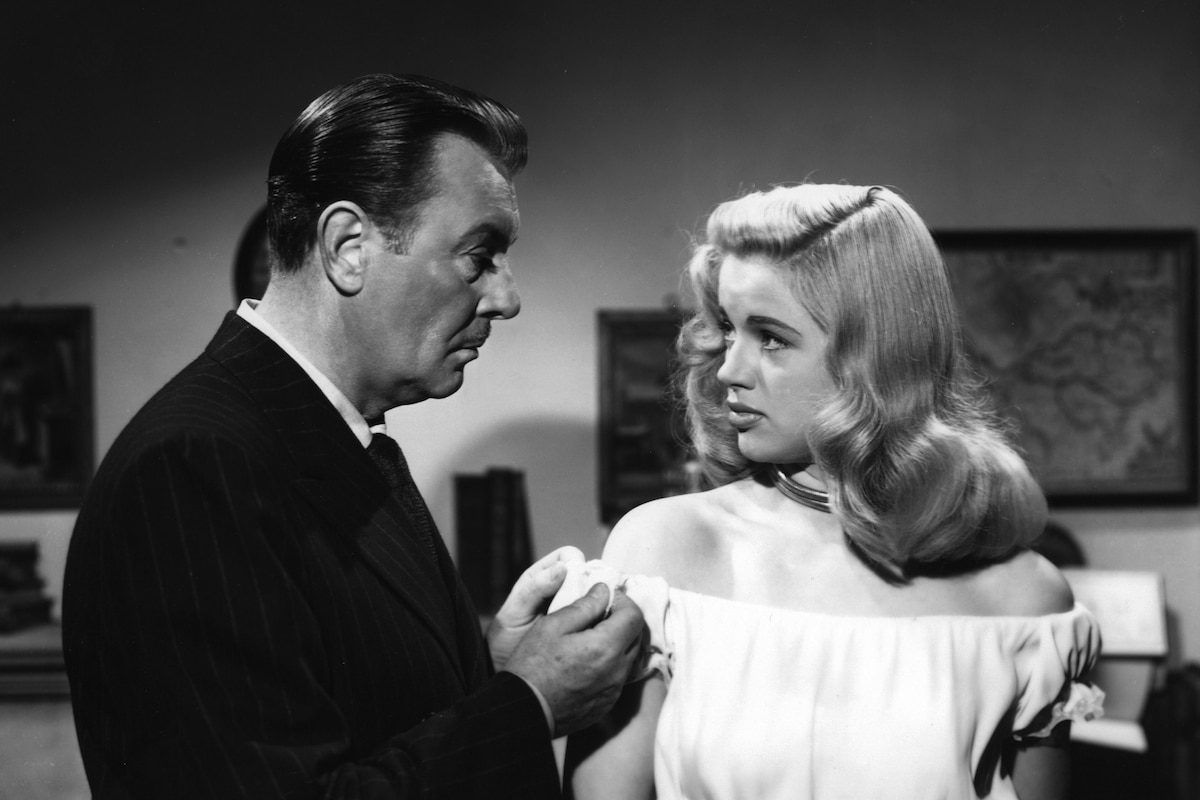
Originally released in Britain as The Last Page, the title Man Bait makes this 1952 British crime drama sound like a femme fatale film noir, an aspect that director Terence Fisher emphasizes even as the script has other ideas. The "man bait" of the title refers to Diana Dors, a curvy young blonde promoted as Britain's blonde bombshell, but top billing goes to American actor George Brent, who plays John Harman, the proprietor of a London bookstore that specializes in rare books and collectible volumes. He's married and faithful to his invalid wife, oblivious to the adoring looks of his assistant Stella (Marguerite Chapman). The 19-year-old Dors is the store's receptionist Ruby, a party girl who is constantly late for work and only keeps her job thanks to the paternal affections of Mr. Harman. Those affections take a rather dangerous turn when a close-quarters work session after hours erupts in a passionate kiss. While Ruby is content to shrug it off after he pays to replace her ripped blouse (not torn by him, mind you, but on the corner of a file cabinet), Ruby's conniving boyfriend sees the potential for a big payoff and his mercenary scheming leads to blackmail and murder. Peter Reynolds plays the seductive and ruthless Jeff, the ne'er do well who pushes the young and easily-manipulated Ruby, and Raymond Huntley is memorable as the fussy clerk with an unrequited crush on Stella.
The low-budget crime drama was produced by Hammer Studios for American independent producer and distributor Robert Lippert. A quota law in Britain mandated that a British production play as the second feature to American films released in Britain. Lippert, who distributed his films in Britain through Exclusive (the parent company of Hammer), contracted Hammer to produce a series of thrillers to get a piece of the British market. Lippert supplied scripts and bargain-rate American stars to headline the productions and distributed the films in the U.S. Man Bait was the first film in the partnership and Lippert delivered stars Brent, who was a leading man in the 1930s but well past his prime by 1951, and Chapman, a talented leading lady who never made it into the top ranks. The script was adapted from an original story by James Hadley Chase, author of No Orchids for Miss Blandish, by playwright Frederick Knott, author of the original play Dial M for Murder. It was shot in Hammer's new studio, a temporary home built in a former country club in Essex that studio head James Carreras thought was "ideal for whodunits."
Man Bait was also the first Hammer production directed by Terence Fisher, who graduated from film editor and proved his facility with mystery and suspense with So Long at the Fair (1950), which he co-directed for the respected Gainsborough Pictures. Man Bait, a much more modest production, began an association with the studio that lasted over 20 years. "It was excellent for me in the early days because I was feeling my way, I was young in the game," recalled Fisher in an interview years later. "Being in a small studio one got to know everyone connected with it. The crews didn't change from picture to picture." After directing the Lippert-produced crime films, Fisher went on to forge the studio's signature Gothic style with The Curse of Frankenstein (1957) and Horror of Dracula (1958) and became Hammer's top director, helming their most important productions through the 1960s.
The credits read "Introducing Diana Dors" but in fact the 19-year-old actress was a veteran of numerous films, including David Lean's Oliver Twist (1948), and had a somewhat notorious reputation, thanks to films like Lady Godiva Rides Again (1951) and a calculating husband who kept her name in the papers. He made sure she maintained a starlet's image with stories of wild parties in the papers and arranged for her to be the youngest registered keeper of a Rolls Royce in Britain (despite the fact that she couldn't drive). In the film Ruby is immature rather than malevolent, an accidental seductress who is pressured into blackmailing her boss and becomes increasingly anxious and guilt-ridden as it spirals out of control, but Dors plays her as a young woman who can't help but flaunt herself in the company of men. She even makes taking off a jacket look like the first act of a striptease. Her image--the sleepy eyes, pouty lips, curvy figure, and cascade of blond hair--dominated the posters on both sides of the Atlantic.
By Sean Axmaker
Sources:
The Charm of Evil: The Life and Films of Terence Fisher, Wheeler Winston Dixon. Scarecrow Press, 1991.
The Hammer Story: The Authorised History of Hammer Films, Marcus Hearn and Alan Barnes. Titan Books, 2007.
IMDb
Man Bait
by Sean Axmaker | April 01, 2014
SIGN UP FOR OUR NEWSLETTERS

CONNECT WITH TCM