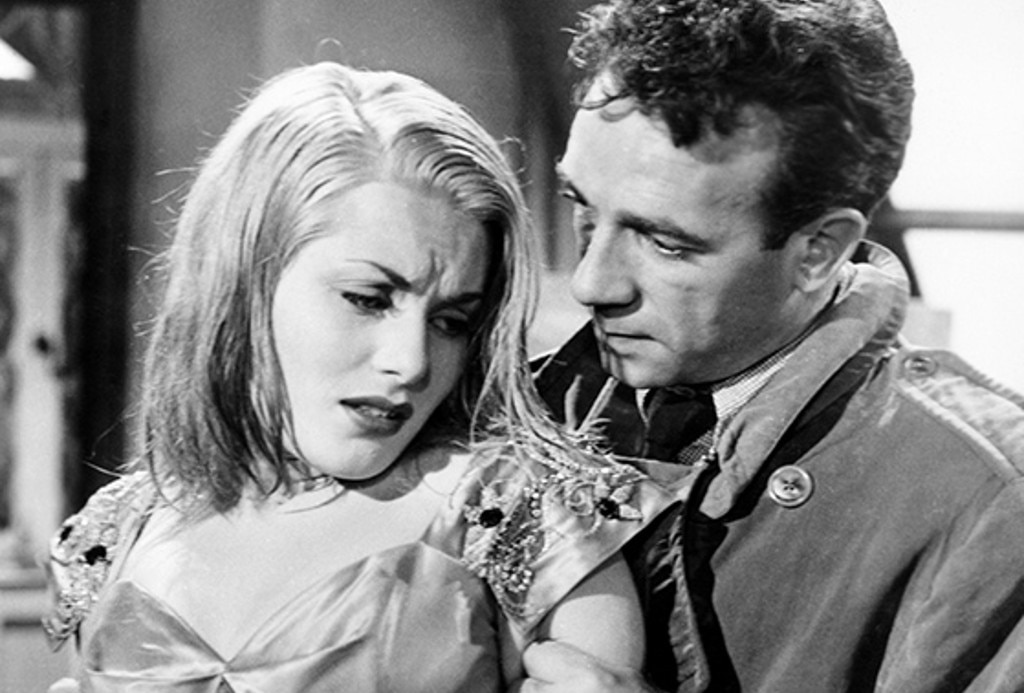
England's Hammer Films has been around since 1934, but it took the organization a while to figure out what it wanted to be. In the 1950s, the answer seemed at hand. Partnering with American producer Richard Lippert, the studio cranked out a steady supply of films noirs, with Lippert insisting on American actors playing the leads in order to maximize his U.S distribution rights. So it was that Dane Clark starred as an ex-GI adrift in London in Blackout (aka Murder by Proxy) (1954). Very often they filmed in borrowed or rented manor houses, saving on sets. Although it came from a novel by Helen Nielsen, it opens with a promising Cornell Woolrich-like setup. Clark's Casey Morrow, all but comatose in a hotel lounge, is approached by Belinda Lee's sleek blonde in a mink coat, who offers him 500 pounds to marry her that night. He agrees and staggers off with her help.
Next thing he knows he awakens in a Chelsea artist's studio with a hangover, 500 pounds in his pocket, proximity to an oil portrait of his possible new wife, and headlines proclaiming that the mysterious blonde has gone missing and that her wealthy father was found with his head bashed in by a fireplace poker, left at the scene, covered in blood. Casey's camel hair overcoat is also bloodstained. Not that this causes the hackles to rise on the neck of the artist who lives and works there, Eleanor Summerfield's Maggie Doone. She buys his protestations of innocence even before he voices them. She can't quite wash all the blood off the coat. But she gives him breakfast and offers to buy him a new one with part of his largesse. Then, with nothing to guide him but vagueness, he hits the streets to clear his name, starting with the vanished heiress' lawyer and fiancé (Andrew Osborn), who throws him out.
So far, so bad. Casey's luck doesn't improve when he visits the young woman's mother (Betty Ann Davies). It's about at this point that the film gets too convoluted for the essentially simple story it is. Nor is it particularly noirish. It hasn't the psychic darkness of noir, nor noir's patterns of fatefulness. It can go only so far with the lawyer, who starts to get the shakes, and has his chauffeur unsuccessfully try to run Casey down. It at least tells Casey he's on to something, and it probably involves money, but he's still not sure how. Nor is he much enlightened by the return to his life of Lee's mercurial load of trouble in a pretty package. Not even after she tells him that she wanted to marry Casey to thwart the plan of the lawyer and her mother to hitch her to him, are things much clearer.
When the film veers off into a tangent involving Casey's Slavic ancestry and his long-delayed return to his mother and her husband, who runs an ethnic-flavored pub, it seems like padding, especially when the cop investigating the case (Michael Golden) pops by for a pint. There just isn't enough to justify all the zigs and zags, although, to be fair, the killer's identity is not readily apparent. Brooklyn-born Clark (1912-1998) looks appropriately haggard, which perhaps explains why he didn't drop the bad-news heiress and take up with Summerfield's big-hearted painter, whose generosity extends to renting him a snazzy MG roadster to facilitate Casey's detecting. But there isn't that much detecting, or, for that matter, too much mystery in this little exercise, efficiently as Terence Fisher directed it.
Fisher was to prove a valuable asset for Hammer. Before the decade was over, Hammer signed off on noirs (as most studios did), and came into its own with horror movies, often looking surprisingly lush considering their modest budgets, making stars of Christopher Lee and Peter Cushing. Fisher directed many of the films that insured Hammer's pre-eminence among horror releases, often including emotional dimensions few others matched, deepening their impact. Fisher's The Curse of Frankenstein (1957), Horror of Dracula (1958) and The Mummy (1959) left Hammer's competitors in the dust, and Fisher was pressed into service to direct as well numerous sequels and spinoffs featuring those scary guys and their spawn. Hammer has been making less noise since the horror market shrank in the 1980s. But they released the contemporary vampire gem, Let Me In (2010), proving that where there are chills, there's hope.
By Jay Carr
Blackout
by Jay Carr | April 01, 2014
SIGN UP FOR OUR NEWSLETTERS

CONNECT WITH TCM