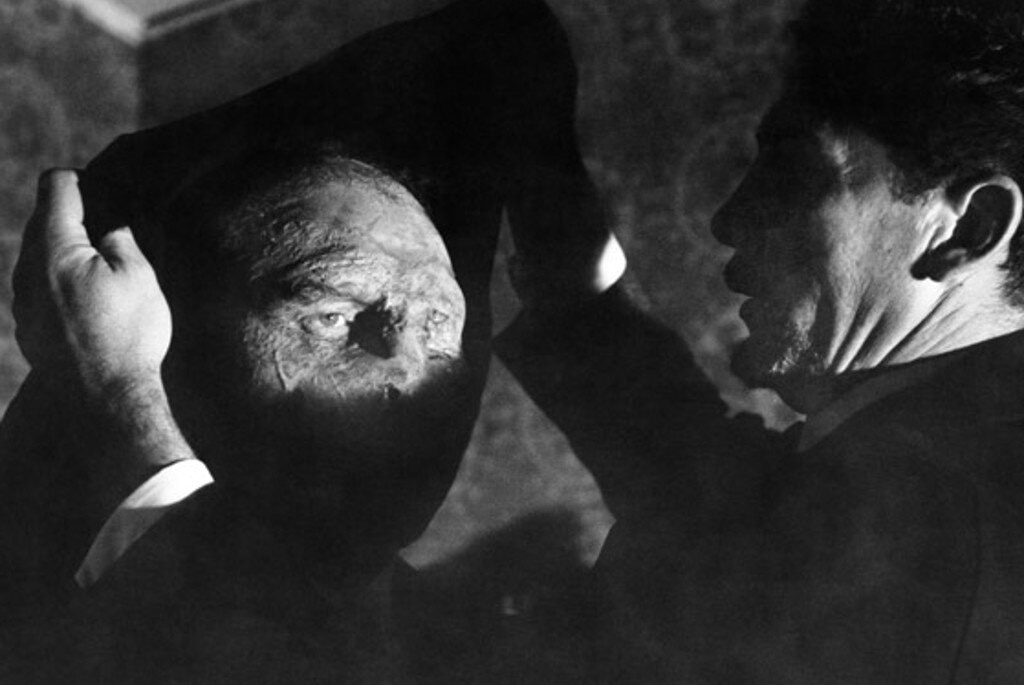
Face of Fire is a dramatic phrase, but it isn't quite accurate for the 1959 film of that title, since the main character's face is not fiery at all. Quite the opposite, in fact - fire has destroyed his face, leaving him a physical and psychological wreck at the mercy of his small-town environment and the small-minded people who dwell around him.
The story takes place in a quiet village called Whilomville around the end of the nineteenth century. James Whitmore plays the unfortunate Monk Johnson, a kind and conscientious man who makes his living as a helper and jack-of-all-trades for physician Ned Trescott (Cameron Mitchell) and his family. Although he was once a rascal who sewed lots of wild oats, Monk settled down to a respectable life years ago, and now he's a well-liked member of the community.
Then disaster strikes. On the very day Monk's lovely girlfriend accepts his marriage proposal, the Trescott house catches fire. Getting there just as the place goes up in flames, Monk heroically enters to rescue Jimmie, the Trescotts' only child. The little boy comes out unscathed, but Monk is so badly burned that no one expects him to live. Although he ultimately survives the ordeal, thanks to Dr. Trescott's dedicated efforts, his face is charred beyond recognition and his mind is traumatized beyond comprehension.
Adding insult to injury, the people of Whilomville refuse to honor Monk as a hero. Instead they shun him as a monster, as if his exterior wounds were signs of an evil nature within. Just as bad, they blame Dr. Trescott for allowing the deformed man to live. Now the doctor's medical practice is vanishing and his unyielding commitment to Monk is the only thing standing between the disfigured, demented man and homelessness, maybe even starvation. Will the good physician yield to pressure by his neighbors and put Monk out of his house? Or will he honor his obligation to do everything possible for the patient who risked everything to save his child?
Face of Fire begins with an on-screen text announcing that the story is taken from The Monster, a novella published by the great Stephen Crane in 1898. What the movie doesn't mention is that the main character of Crane's novella is an African-American man, not a dapper white gent like the one played by Whitmore in the film. Whitmore is a wonderful and versatile actor, and he obviously wasn't responsible for erasing the rescuer's blackness from the screenplay, but it's scandalous that a 1959 production didn't think it fitting to portray an African-American man as a courageous hero. Adding to the irony is the fact that in 1964, just six years after this film, Whitmore starred in Black Like Me, playing a thinly fictionalized version of an actual white author, scholar, and civil-rights activist who darkened his skin and traveled through the South in order to write about anti-black bigotry from the perspective of a victim, if only a temporary one. It's regrettable that Face of Fire couldn't muster that kind of courage.
The racial aspect aside, Face of Fire is an interestingly offbeat drama with an interestingly offbeat production history. Before making it, the young filmmaker Albert Band had been an assistant on John Huston's legendary 1951 misfire The Red Badge of Courage, also based on a work by Stephen Crane, and had gone on to produce and direct The Young Guns (1956) and I Bury the Living (1958), not prestige projects by a long shot. Hoping that a socially conscious problem picture would boost his career to a new level, he put together Face of Fire as a Swedish-American coproduction, shot in Sweden with a largely Swedish crew and cooperation from the state-supported Swedish film industry. This arrangement evidently gave Band some latitude to flex his artistic muscles, which had clearly been constrained in his low-budget Hollywood quickies, and he was able to bring a solid American cast along on the Scandinavian journey. Face of Fire did not particularly elevate his career, though, and his subsequent pictures were back on the level of his first ones, as titles like Grand Canyon Massacre (1964) and Dracula's Dog (1977) suggest.
Whitmore's contribution to Face of Fire is somewhat diminished by the fact that he disappears from the middle part of the story, when Monk is hidden from public view by Dr. Trescott, who takes over as the protagonist for quite a while. But the rest of the cast compensates for Whitmore's absence by doing solid work. Cameron Mitchell, who shares top billing with Whitmore, makes Dr. Trescott a believable figure of quiet integrity, and Royal Dano is equally strong as Jake Winter, a Whilomville citizen with mixed feelings about the Monk situation.
Special challenges confront the women in the cast, since the picture sometimes makes them seem more prejudiced against Monk than most of the men - especially after he scares a little girl by peering through a window at a birthday party - but Bettye Ackerman and Lois Maxwell make credible characters out of Grace Trescott and Ethel Winter, respectively. Capable work also comes from cinematographer and art director Edward Vorkapich, film editor Ingemar Ejve, composer Erik Nordgren, and writer Louis Garfinkle, who penned the screenplay with Band and must share the blame for turning Jimmie's rescuer from black to white, and tacking on a bogus happy ending to boot.
Critics have compared Face of Fire with everything from James Whale's Frankenstein (1931) and Elia Kazan's Pinky (1949) to David Lynch's The Elephant Man (1980) and Peter Bogdanovich's Mask (1985). While those are more ambitious pictures with more polished production values, the similarities show that Band and company were exploring terrain that has attracted many serious filmmakers before and since. To get a bolder reading of American prejudice and xenophobia, though, follow up Face of Fire by reading Crane's excellent novella The Monster.
Director: Albert Band
Producers: Albert Band and Louis Garfinkle
Screenplay: Albert Band and Louis Garfinkle; based on "The Monster" by Stephen Crane
Cinematographer: Edward Vorkapich
Film Editing: Ingemar Ejve
Art Direction: Edward Vorkapich
Music: Erik Nordgren
With: James Whitmore (Monk Johnson), Cameron Mitchell (Ned Trescott), Bettye Ackerman (Grace Trescott), Miko Oscard (Jimmie Trescott), Royal Dano (Jake Winter), Richard Erdman (Al Williams), Howard Smith (Sheriff Nolan), Lois Maxwell (Ethel Winter), Jill Donohue (Bella Kovac), Harold Kasket (Reifsnyder), Robert Simon (judge)
BW-80m.
by David Sterritt
Face of Fire
by David Sterritt | April 01, 2014
SIGN UP FOR OUR NEWSLETTERS

CONNECT WITH TCM