Five years after starring in Raoul Walsh's ambitious but unsuccessful The Big Trail (1930), John Wayne found himself mired in career doldrums, consigned to a contract with Poverty Row start-up Republic Pictures and making cheap western after cheap western. (Having been obliged to lip-synch his way as a singing cowboy through Monogram's Riders of Destiny in 1933, Wayne resolved that he would never again sink that low.) Turned down for the part of Wild Bill Hickock in Cecil B. DeMille's The Plainsman (1936) - the role went instead to Gary Cooper--Wayne lifted his game in a bid to improve his situation. Studying the technique of seasoned character actors (especially those hired as comic relief to learn how to deliver a laugh line), Wayne also worked with a vocal coach to lower the timbre of his speaking voice and retained the services of super-agent Charles Feldman to maximize his options. It was Feldman who secured for the actor a new contract from Republic that allowed him to work for other studios.
Following producer friend Trem Carr to Universal, Wayne scored a six-picture deal at the better equipped studio. Not one of the films Wayne made at Universal was a western, allowing him to play such change of pace roles as a Coast Guard commander running down smugglers (Sea Spoilers, 1936), a professional hockey player (Idol of the Crowds, 1937), and a lumberjack turned prizefighter (Conflict, 1936) - among others. Returning at last to Republic, Wayne was persuaded to climb back in the saddle to join the studio's popular "Three Mesquiteers" films, modern day westerns based on novels by writer William Colt MacDonald and influenced oh so slightly by the fiction of Alexandre Dumas. Republic bankrolled 51 "Three Mesquiteers" programmers between 1936 and 1948, eight of them starring Wayne. Though rife with horseback riding and gunplay, these films were usually set in modern times, or at the very least within the 20th Century.
Republic's Three Mesquiteers series had begun with Ray Corrigan as Tucson Smith, Robert Livingston as Stony Brooke, and Max Terhune as Lullaby Joslin - ranching partners turned prairie do-gooders. When personality conflicts arose between Corrigan and Livingston, Wayne was brought in as Livingston's replacement, joining the series with Pals of the Saddle (1938), directed by George Sherman. Wayne would reprise the character of Stony - the partner who invariably fell in love with the leading lady - seven more times. Resented by Corrigan for seeming to have trespassed on his territory (a bona fide star of B-westerns, "Crash" Corrigan's career was eclipsed by Wayne's, leading to bad blood between the costars), Wayne had a miserable time on the Three Mesquiteers films. His mood only worsened after he received a career boost playing the Ringo Kid in John Ford's majestic Stagecoach (1939), after which he was required to return to Republic to ride out the remainder of his contract.
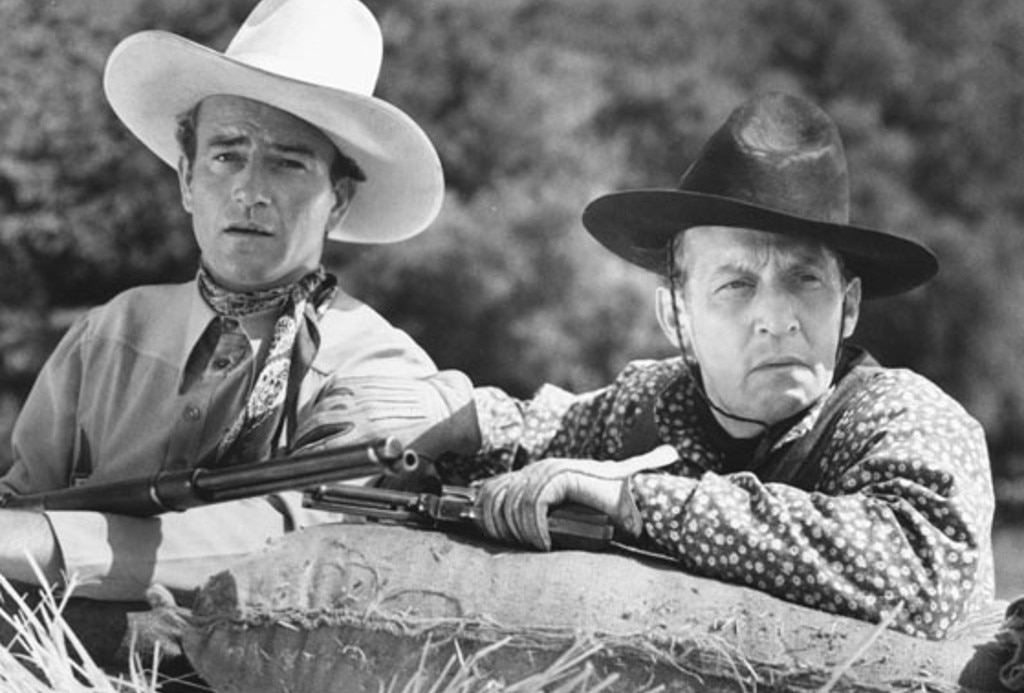
Frontier Horizon (aka New Frontier, 1939) was Wayne's last ride as Stony Brooke. (By this time Raymond Hatton had replaced Max Terhune as the trio's comic relief.) Set in 1914, the script by Betty Burbridge (principal writer for Gene Autry at Republic) and Luci Ward focuses on a dastardly plan to flood out an historic valley settlement by corrupt land barons - an intriguing mash-up of the historic Johnson County War of 1892 (which inspired such frontier dramas as George Stevens' Shane [1953] and Michael Cimino's Heaven's Gate [1980]) with the California Water Wars that culminated in the construction of the Owens Valley Viaduct (events that informed Robert Towne's script for Chinatown [1974]). Though the film was no more than a programmer, Frontier Horizon rates footnote status for providing Jennifer Jones with her feature film debut. Billed under her birth name of Phylis Isley, Jones plays a homesteader's daughter who falls in love with Wayne's strapping Mesquiteer. In 1961, Jones remembered the assignment with wistful brevity: "John Wayne was the star and I was the girl who waved goodbye." Both performers had brighter days ahead of them, including an Academy Award for Jones in 1944 for The Song of Bernadette (1943) and for Wayne in 1969 for True Grit (1969).
By Richard Harland Smith
Sources:
John Wayne: The Man Behind the Myth by Michael Munn (Penguin Books, 2005)
Jennifer Jones: The Life and Films by Paul Green (McFarland and Company, 2011)
Frontier Horizon
by Richard Harland Smith | March 31, 2014
SIGN UP FOR OUR NEWSLETTERS

CONNECT WITH TCM