Anyone unfamiliar with the name George Pal -- or who knows him only from the sci-fi films he produced, directed, or designed the effects for in the 1950s and '60s -- is in for a true discovery with the recent Blu-ray of The Puppetoon Movie (1987). The title is a bit deceptive, for while this sublime release does indeed contain a re-mastered hi-def version of The Puppetoon Movie, that movie is mostly made up of eleven of Pal's Puppetoon short films from the 1930s and '40s. The "extras" on this double-disc set actually contain far more material than The Puppetoon Movie itself: 19 additional Puppetoons, a feature-length documentary, interviews, featurettes, stills, home movies, a commentary, trailers, and even an entire additional feature. The net result is that The Puppetoon Movie comes across as simply one ingredient of many in what is really an extensive tribute to George Pal.
This is not to downplay the significance The Puppetoon Movie or of its director, Arnold Leibovit, in maintaining Pal's legacy. Leibovit deserves a huge amount of credit and gratitude for keeping this work alive; in fact, it's very possible that without Leibovit, Pal's Puppetoons would still be forgotten or even lost.
George Pal was a Hungarian animator who developed a groundbreaking technique of puppet animation similar to stop-motion. But instead of using single puppets and figures that could be manipulated ever so slightly from frame to frame -- as per usual in stop motion -- Pal laboriously and meticulously crafted thousands of wooden puppets (or parts of puppets, like attachable heads and limbs) in slightly different poses, so that for each frame of film, a separate, new puppet (or puppet part) would be used. This was called replacement animation, and the resulting short films were called Puppetoons, which Pal described as "color cartoons in three dimensions."
Working in Europe in the 1920s and '30s, Pal honed his techniques while working as a commercial artist before arriving in Hollywood in 1939 and securing a deal at Paramount. As animation authority Jerry Beck writes in his liner notes, Pal was immediately embraced by Hollywood's animation community, who knew instantly what a visionary artist he was: "His techniques were so different from what the traditional screen cartoonists had been doing that no one thought of him as a rival or competitor. He was simply a colleague, and a beloved one at that."
Pal's techniques were and still are incredibly significant, influencing luminaries like Ray Harryhausen (whose first job as an 18-year-old was at the Puppetoon Studio), Tim Burton and Henry Selick (whose A Nightmare Before Christmas [1993] was heavily inspired by Pal), and Steven Spielberg. Today's Pixar films continue the chain of influence.
In the 1950s, Pal moved into live-action science fiction and fantasy movies, working on classics like Destination Moon (1950), When Worlds Collide (1951), The War of the Worlds (1953), The Time Machine (1960), and The Wonderful World of the Brothers Grimm (1962).
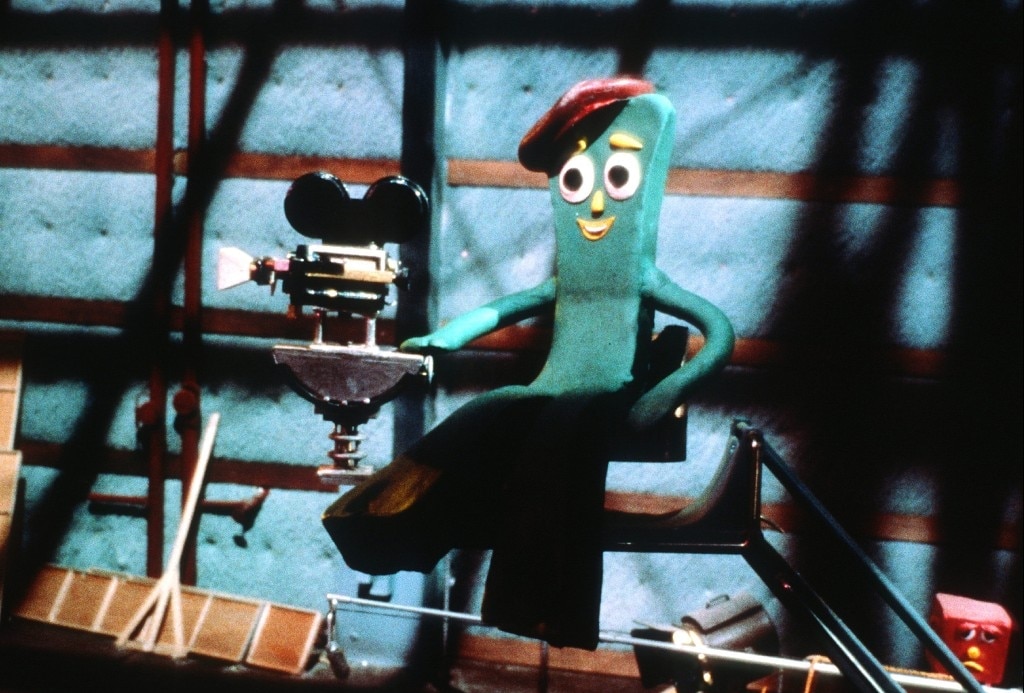
He died in 1980, but in 1987 director Arnold Leibovit worked with Pal's widow to compile eleven of the original Puppetoon shorts into a new tribute feature, The Puppetoon Movie. Leibovit created a framework to introduce and conclude the film, with animated characters Gumby, Pokie and Arnie the Dinosaur reminiscing over Pal's legacy, but the bulk of the movie is simply eleven of Pal's Puppetoons strung together, with no narrative through-line.
Among the best in the film are Philips Cavalcade (1934), Tulips Shall Grow (1942), Jasper in a Jam (1943), and Tubby the Tuba (1947), four shorts that demonstrate an impressive diversity of subject matter. Philips Cavalcade, full of puppet characters performing jazz music and dancing, boasts an astonishing amount of detail and multiple moving parts in every frame. Tulips Shall Grow is a powerful anti-Nazi parable in which a young couple survives wartime destruction of their windmill.
Jasper in a Jam is one of many Puppetoons featuring the character of Jasper, a young black boy who is usually steered toward naughtiness by a scarecrow. The Jasper shorts contain racial stereotyping that would not be acceptable in modern-day entertainment, but Jasper in a Jam is one of the finest Puppetoons of them all, with objects and musical instruments coming to life in a pawnshop to play jazz. The music of Charlie Barnet and the vocals of Peggy Lee join with incredible puppetry to make this a unique and moody piece.
Tubby the Tuba, Pal's last Puppetoon, is probably the best known and most beloved of them all. The story of a tuba who longs for the chance to play the melody for once in his orchestra (rather than just doing repetitive underscoring), it's so poignant and affecting that one wishes Pal had stuck with his Puppetoon-making for a few more years to come.
In addition to these eleven shorts, the Blu-ray package contains twelve more Puppetoons on standard definition (they still look very good), and seven more in hi-def, restored by the UCLA Film and Television Archive and released for the first time on home video. Among the best of these are the masterful Date With Duke (1940) and Rhapsody in Wood (1947), which feature Duke Ellington and Woody Herman in person, interacting with the animated puppets. In fact, many of the Puppetoons include a mix of live action, replacement animation, and traditional two-dimensional animation. Some also mix color and black-and-white, illustrating Pal's experimental and inventive mind. And of course, these two (and others) incorporate jazz and big band music in such a way that the music becomes the subject of the piece itself. Pal's instincts for combining image and music were pitch perfect, and do a great deal to keep these pieces feeling so timeless.
The "extra" shorts here also include two early adaptations of Dr. Seuss stories, The 500 Hats of Bartholomew Cubbins (1943) and And to Think That I Saw it on Mulberry Street (1944), as well as the great Jasper entries Jasper and the Beanstalk (1945) and Jasper's Derby (1946).
All seven of the hi-def entries were nominated for Academy Awards. None won, but Pal did receive a special Oscar in 1943 for his imaginative techniques. He promptly incorporated the statuette into the opening credits of all his subsequent Puppetoons, which is why some of the ones on this Blu-ray begin with that image.
It should be noted that Pal never intended for his Puppetoons to be consumed all at once. This collection is best seen slowly, a little bit at a time -- ideally as a prologue to seeing a feature movie. Watching the Puppetoons today, one marvels at the astonishing amount of work that went into their creation, as well as at the splendid Technicolor on display (which is beautifully served by the Blu-ray technology), but above all one is simply charmed by the pieces themselves. In their commentary for The Puppetoon Movie, Arnold Leibovit and Jerry Beck enhance one's appreciation by explaining Pal's animation techniques in great detail and with immense passion. In addition, Leibovit's 1985 documentary The Fantasy Film Worlds of George Pal explores Pal's entire career and includes interviews with Pal himself. There's also an interesting vintage interview with animator Bob Baker, who worked in Pal's studio.
On the second Blu-ray disc is a newly re-mastered print of Pal's first feature film as producer, The Great Rupert (1950), which is directed by Irving Pichel and stars Jimmy Durante, Tom Drake, Jimmy Conlin and Terry Moore, as well as a stop-motion-animated puppet squirrel devised by Pal. This little film is no great classic, but it does have some charming moments. The disc also contains a myriad of further extras: interviews with the likes of Disney animator Ward Kimball, Gene Roddenberry, Ray Harryhausen, Ray Bradbury and Roy Disney, among others; an entire (and fascinating) episode of an old Los Angeles TV show called City at Night, in which reporters visit the set of Pal's Destination Moon (1950); footage from a premiere of The Wonderful World of the Brothers Grimm (1962); and more. Through it all, a portrait emerges of George Pal not just as a visionary innovator but as a genuinely nice person.
The boutique distributor B2MP has done an outstanding job working with Leibovit and Beck to put this all together in such a comprehensive and loving way -- a fitting salute to an all-too-forgotten movie pioneer. The package is limited to a pressing of 3000 units and is available on Blu-ray only.
By Jeremy Arnold
The Puppetoon Movie on Blu-ray
by Jeremy Arnold | March 31, 2014
SIGN UP FOR OUR NEWSLETTERS

CONNECT WITH TCM