Foreign Correspondent (1940) gets its due in Criterion's splendid new dual-format release. A single package contains one Blu-ray disc and two DVDs, with each format containing identical material: a beautiful 2K digital restoration of Alfred Hitchcock's classic film, plus a wealth of interesting extras.
Foreign Correspondent is prime Hitchcock that has often been undervalued as a merely routine work in his career. But while it certainly isn't as seamless or sophisticated as, say, Rear Window (1954), Vertigo (1958), or Notorious (1946), it's still a tremendously exciting and visually witty movie -- perhaps just a step behind Hitchcock's very best. Some have argued that the film is underrated because it came out the same year as Hitchcock's Rebecca (1940), which won the Academy Award for Best Picture, but Foreign Correspondent itself was nominated for six Oscars including Best Picture and was a big box-office hit.
Whatever the reason, the film contains several scenes and moments that are among Hitchcock's all-time most famous, including the windmill scene, in which Joel McCrea notices one windmill turning the wrong way, a stunning assassination scene on a rainy Amsterdam sidewalk crowded with people and open umbrellas, and a climactic plane crash that still impresses with its visual effects.
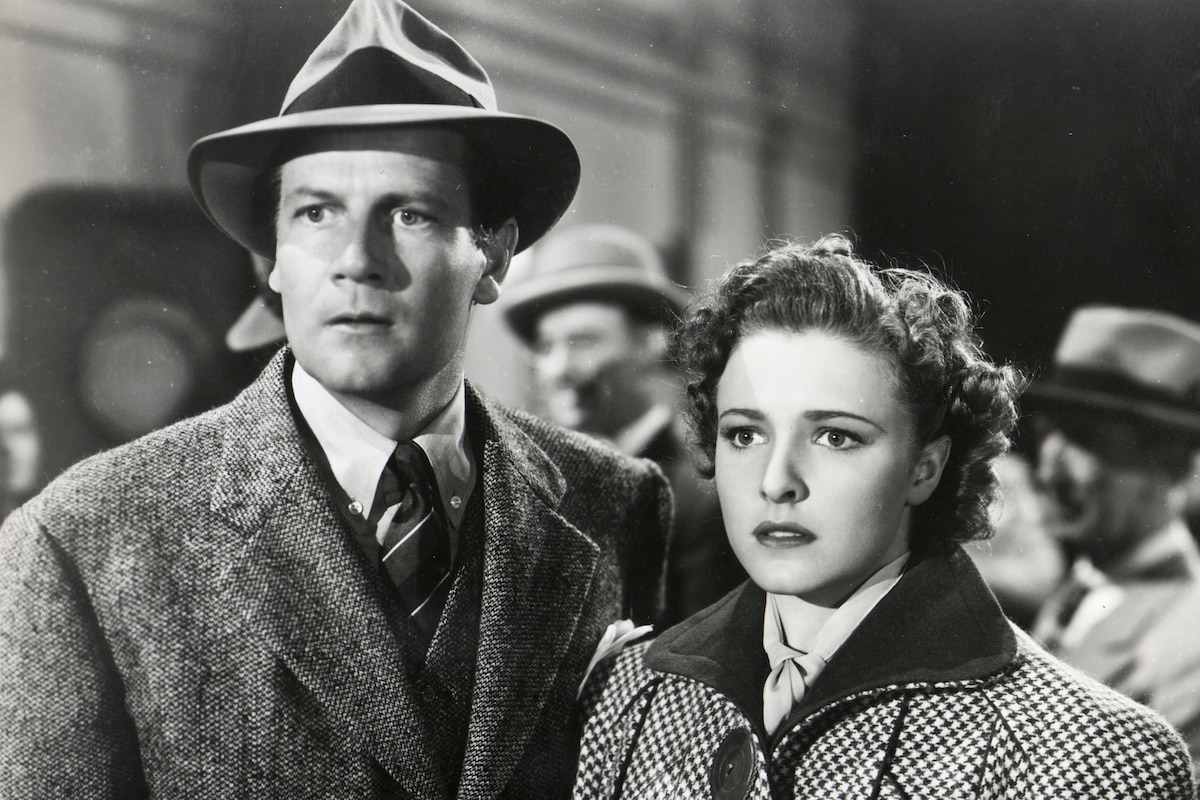
Foreign Correspondent is of a piece with Hitchcock's earlier The 39 Steps (1935) and his later North By Northwest (1959); all three involve an ordinary man getting swept up in some sort of an international spy drama, and all three contain plenty of suspense, romance, humor, and travel to visually exotic locations. Here, Joel McCrea plays all-American news reporter Johnny Jones, who adopts the name Huntley Haverstock when he is assigned by his New York paper to cover the political situation in 1940 Europe. After he witnesses the assassination of a Dutch diplomat, he starts to unravel a spy ring that could affect the outcome of the impending war. Along the way, he develops a romance with the daughter (Laraine Day) of a British peace broker (Herbert Marshall) and gets out of various scrapes ranging from a near-death by windmill gears to a precarious walk on a hotel ledge clad in his bathrobe, one of several scenes that prefigures North By Northwest.
Also along the way, the characters (and audience) are kept apprised of rapidly developing events in Europe. This makes Foreign Correspondent a bit of a mishmash --
primarily a smoothly exciting entertainment, but with moments of topicality and propaganda sometimes conspicuously mixed in -- and it also reflects the fascinating competing agendas of director Alfred Hitchcock and producer Walter Wanger.
The politically active Wanger had in 1936 acquired the screen rights to Personal History, an award-winning book by reporter Vincent Sheean that functioned as both memoir and firsthand reportage of international political events of the 1930s, including the Spanish Civil War. As development of the script churned along, Wanger's desire for topicality meant that the substance of the script was continually changing, as events changed rapidly in Europe. After some failed attempts to get the film going, Hitchcock came on board and the film finally headed toward production. Wanger allowed Hitchcock to shape the story the way he wanted, but still insisted on propaganda elements intended to sway the public toward war. Hitchcock's main desire was simply to produce a suspense drama. The final result is a mixture of both men's goals, but Wanger seems to have given Hitchcock more freedom than producer David Selznick had on Rebecca, and that's why Foreign Correspondent feels more like what we think of as a Hitchcock film.
Hitchcock told Francois Truffaut that in his mind Foreign Correspondent was "pure fantasy," but he was also absorbing (unfair) criticism in 1940 for staying in Hollywood while his home country of England was at war, so he probably didn't mind the obvious propagandizing at the picture's end.
Overall, Foreign Correspondent plays very well, with good pacing through its two-hour running time and some satisfying Hitchcock humor mixed in. The main flaw is probably that the romance subplot doesn't come off very convincingly. Pretty Laraine Day is sufficient in her role, but a bigger star would have added more oomph, and maybe more heat. Claudette Colbert was originally considered for the role (to play opposite Charles Boyer), but she went off instead to do Arise, My Love (1940), which ironically had a very similar storyline.
Criterion has given Foreign Correspondent a lavish treatment. The digital restoration looks superb, with dirt and blemishes cleaned up without making the film look unnaturally sharp. And the company has produced some intriguing extra materials. In the 19-minute "Visual Effects in Foreign Correspondent," effects expert Craig Barron breaks down the magic behind the windmill and plane crash scenes, among others. The windmill landscape is an impressive matte shot with moving parts (actual rotating windmill blades) protruding through the painted backdrop, creating a spellbinding illusion of reality. And the moment of impact of the plane crash, though already described by Hitchcock in the Truffaut interview book and other sources, is explained here in great detail and even illustrated via a mockup of the set. Footage of the ocean shot from a diving plane was projected on rice paper, and at the right moment, water was sent crashing through the rice paper screen -- and hence "from" the water imagery -- directly into the cockpit set, a brilliantly simple device.
"Hollywood Propaganda and World War II" is a fascinating 25-minute featurette, illustrated with gorgeous stills, in which author Mark Harris discusses the propagandistic elements of Foreign Correspondent and places the picture within the context of other, more overt propaganda films that followed after Pearl Harbor. He also delves into the transition from "propaganda" films to "message" films after the war. Harris goes into more detail on the different agendas of Wanger and Hitchcock, and on the difficulties Wanger had because of the Breen Office's enforcement of a rule that films had to stay politically neutral, since the United States was not yet at war. That's why Hitler and Germany are barely mentioned in this film, and the villains are not explicitly described as Nazis. They are drawn instead simply as sinister Europeans and even speak a nonsensical language, albeit one that sounds like German. (It's claimed that it is German, spoken backwards!) However, there is no doubt in the audience's mind that the bad guys are meant to be German, and most viewers probably don't even notice the lack of specific labels.
Harris says that Foreign Correspondent is the "closest thing [Hitchcock] ever made to a message movie," and "its message of moving from neutrality...to intervention, and from disengagement to engagement, was very, very on point for 1940."
A third supplement is called "Have You Heard?" It's a series of still photographs that Hitchcock personally created for a 1942 edition of Life Magazine, telling a story that illustrates the dangers of loose tongues where war secrets are concerned. It's quite fascinating, and Hitch even makes a cameo appearance in one of the photos, a la his movie cameos!
Criterion has also thrown in a one-hour 1972 episode of the Dick Cavett Show in which Hitchcock is interviewed. (The present-day Cavett provides a brief introduction.) The director explains the visual effects of the boat crash and talks about his entire career, including what was then his newest film, Frenzy (1973).
Rounding things out are a 1946 radio adaptation starring Joseph Cotten, the film's trailer, and well-written liner notes by film historian James Naremore. Fifteen very nice stills are included in the booklet. It's all placed in a sturdy cardboard case with attractive blue-and-white artwork -- details that underscore how lovingly this entire package has been put together.
By Jeremy Arnold
Foreign Correspondent on Criterion Blu-ray!
by Jeremy Arnold | March 10, 2014
SIGN UP FOR OUR NEWSLETTERS

CONNECT WITH TCM