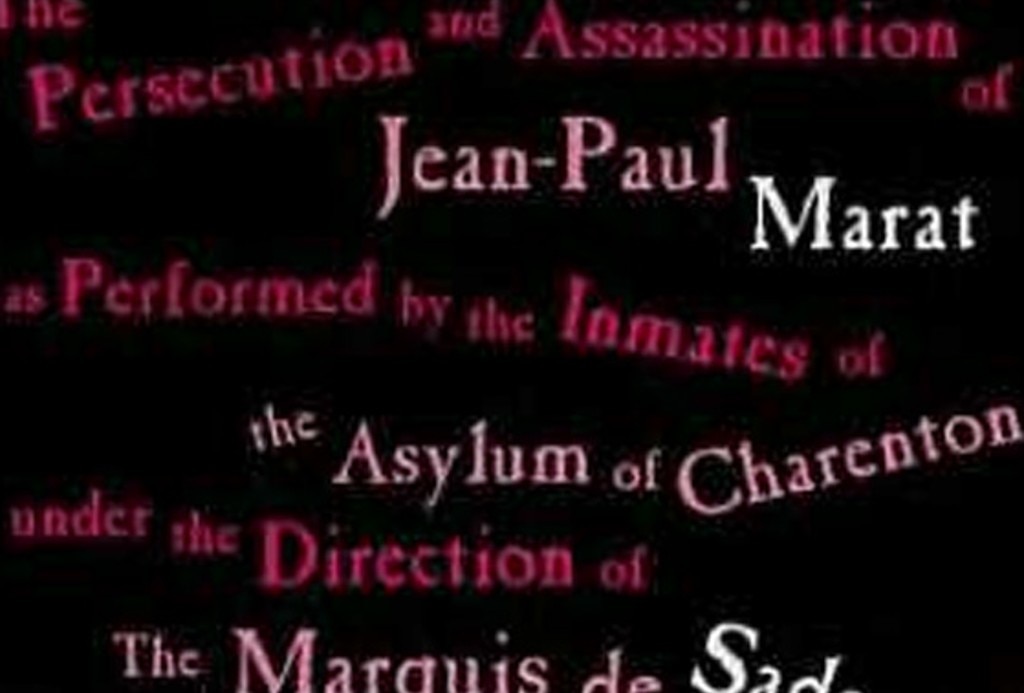
Boasting one of the longest titles in both theatrical and cinematic history, The Persecution and Assassination of Jean-Paul Marat as Performed by the Inmates of the Asylum of Charenton Under the Direction of the Marquis de Sade -- better known as Marat/Sade - originated in April of 1964 as a stage production by West Berlin's Schiller Theater. A smash hit, the play by Peter Weiss was staged in English by Peter Brook (translated by Geoffrey Skelton) with the Royal Shakespeare Company and made it to Broadway in late 1965.
These two popular English versions featured a trio of stars, Patrick Magee (as the Marquis de Sade), Ian Richardson (as Jean-Paul Marat), and Glenda Jackson (as Charlotte Corday), who would reprise their roles for the 1967 film along with many of the other RSC performers. Brook returned as director with a script adapted by Adrian Mitchell, retaining the audacious and sometimes abrasive staging of the live version.
One of the film's greatest assets proved to be its striking, experimental cinematography by David Watkin, who had recently worked on Help! (1965) and would go on to such films as Catch-22 (1970) and The Devils (1971), eventually winning an Academy Award for his work on Out of Africa (1985). On this film, he and Brook came up with the idea of shooting with just two cameras, one remaining static and the other roving handheld among the actors to capture the unstable nature of the performers themselves. Financed for under $500,000 by United Artists, the production was shot in a whirlwind 17 days (just two days over its original schedule) at Stage B of England's Pinewood Studios, stepping into the space just after the shooting of Charles Chaplin's A Countess from Hong Kong.
< BR>
Though you don't have to be a history major to follow the action of Marat/Sade, it certainly helps to have a grasp of the basic history behind it as the story involves two separate moments in history blurring together. In the Charenton Asylum during the rule of Napoleon after the French Revolution, the Marquis de Sade directs a staging of events fifteen years earlier in which the radical journalist Jean-Paul Marat was stabbed to death by Charlotte Corday in his bath in 1793. The asylum director, Coulmier, believes the production will reinforce his bourgeois political views and attends with his family, but de Sade's unorthodox methods and the obvious unreliability of the actors result in an increasingly disturbing experience for everyone involved.
With a Tony Award already under his belt for the play, Peter Brook was primarily known for his stage productions but had also proven his mettle as a filmmaker with his definitive film version of Lord of the Flies (1963). After this film his adventurous energy scarcely waned as he went on to a caustic black-and-white 1971 version of King Lear and the acclaimed Meetings with Remarkable Men (1979), not to mention an ambitious epic-length adaptation of his stage version of The Mahabharata (1989). The idea of turning Marat/Sade into a film actually occurred to him while he and the cast were in the midst of a seven-hour recording session for the cast album at Caedmon Records in New York, as he realized the close-knit relationship between them all could easily translate to the big screen.
Equally comfortable in the world of confrontational theater was Irish actor Patrick Magee, probably best known to general film fans for his roles in Stanley Kubrick's A Clockwork Orange (1971) and Barry Lyndon (1975). Boasting one of the most distinctive voices in any medium, Magee inspired Samuel Beckett to write for him and, after joining the RSC, was handpicked by Harold Pinter for The Birthday Party. However, he was no stranger to the more gothic side of European cinema either, accepting colorful roles in productions like Francis Ford Coppola's Ireland-set Dementia 13 (1963), Roger Corman's The Masque of the Red Death (1964), and scene-stealing turns in a pair of Amicus horror anthologies in 1972, Tales from the Crypt and Asylum.
Now cemented in pop culture for his leading role in the original BBC production of House of Cards, Ian Richardson originated the role of Jean-Paul Marat on the Broadway stage (after playing the Herald in the British production) and made history there as the first actor to appear nude on the New York stage, the subject of well-publicized publicity photos at the time. The majority of his screen and stage appearances have consisted of Shakespearean roles, with notable film appearances including Brazil (1985) and Dark City (1998). However, American TV viewers of a certain age will always remember him for asking one immortal line in a classic mustard commercial: "Pardon me, would you have any Grey Poupon?"
Already a seasoned veteran of the RSC's recent Theater of Cruelty experiments, Glenda Jackson had already won positive notices for her stage role in Separate Tables and was soon to become an international star in Ken Russell's Women in Love (1969), which netted her an Oscar for Best Actress. She returned to an insane asylum again at the end of her next film for Russell, The Music Lovers (1970), but the rest of her career has been more subdued thanks to a famous turn as Queen Elizabeth I on television and standing as a long-running member of Parliament.
In total, the cast of both the stage and screen versions of Marat/Sade totaled 41 including such familiar character actors as Freddie Jones, who also appeared in And the Ship Sails On (1983) and The Elephant Man (1980) among many others, and John Steiner, who enjoyed a very busy career acting in Italian films like Tenebre (1982) and Shock (1977) before becoming a real estate agent in Beverly Hills. In an unusual arrangement at the time, all of the cast members divided 33.3% of the profits among themselves in addition to their salaries, though the major players received a larger share than some of the others.
Upon its release, Marat/Sade was marketed heavily to universities and drama schools as well as the usual art house audiences. United Artists even mandated that the original full title be used in all newspaper ads and on theater marquees, though they finally hit an insurmountable obstacle when Beverly Hills ordinances prevented them from widening the marquee of the Fine Arts Theatre to accommodate it. Thus the shortened name was finally made official, and it has remained attached to the film ever since.
By Nathaniel Thompson
Marat/Sade
by Nathaniel Thompson | March 08, 2014
SIGN UP FOR OUR NEWSLETTERS

CONNECT WITH TCM