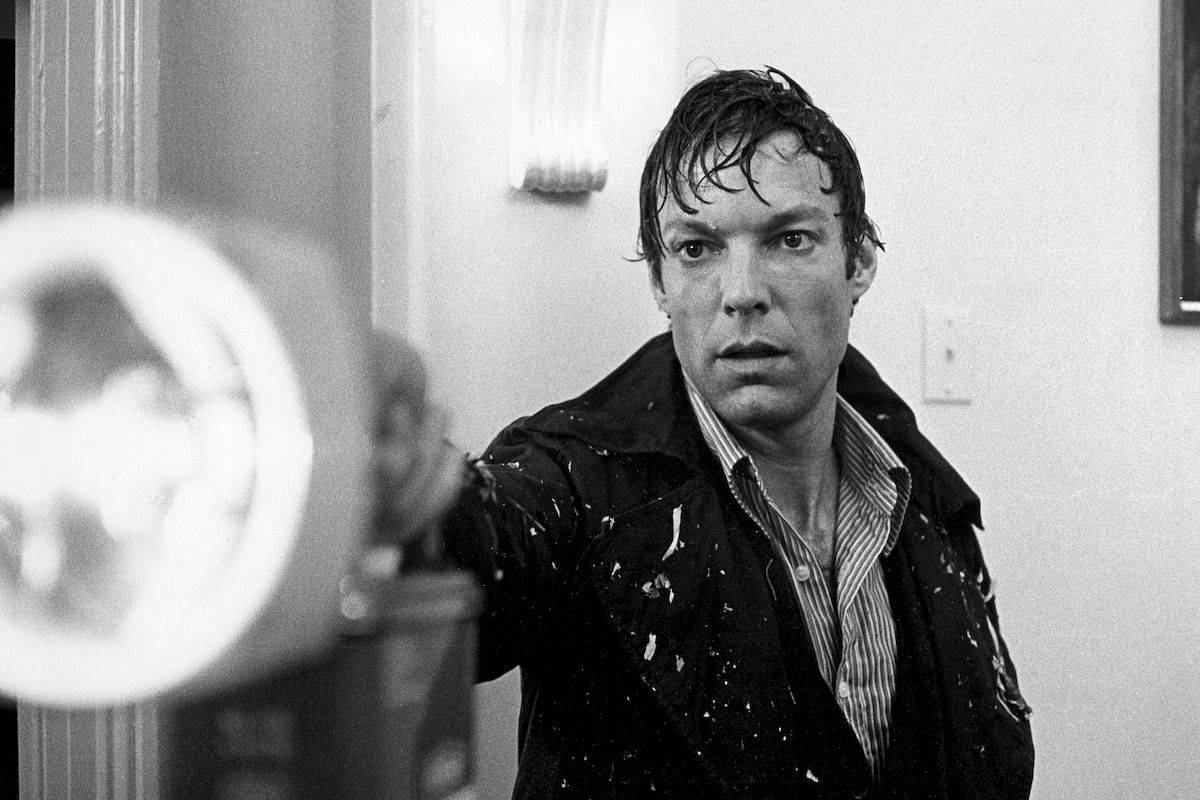
Peter Weir's The Last Wave (1977) is not exactly a horror film but like his previous film Picnic at Hanging Rock (1975), it explores irrational in the rational world, maintaining an atmosphere of mystery and magic as inexplicable events occur that modern science cannot explain. Set in contemporary Sydney, Australia, it stars Richard Chamberlain as an Australian lawyer who takes on the defense of a group of Aborigines accused of killing one of their own. As this rational lawyer is drawn into Aboriginal tribal religion, prophecy, and visions, the elemental dreams and nightmares that have tormented him since he was a child seem to manifest in unprecedented weather events across Australia, from torrential downpours flooding city streets to a sudden hailstorm dropping on a tiny desert town from a cloudless sky.
The initial inspiration for the story, according to the director, came from a trip that Weir made to Tunisia in 1971. "I was suddenly seized with this strange feeling I was going to find something, I even saw what I was going to see. And there it was, on the ground, a carving of a child's head. I brought it home and thought about it for ages afterwards. What was that experience? Why did I see the head in my mind before I saw it in actuality. And then I started to think, what if a very rational person - a lawyer, say - had had the same experience? How would he cope with it?"
Picnic at Hanging Rock had brought international attention to Weir and The Last Wave was an ambitious follow-up, with a budget twice the size of Picnic, due largely to the demands of the special effects. The Australian producers reached out to American studio United Artists to help with financing and Weir cast American actor Richard Chamberlain as the lawyer, David Burton, to give it international appeal. That was an important consideration given the specifically Australian subject of Aboriginal culture and mythology and the concept of "dreamtime," which the skeptical Burton has explained to him by his clients.
One of Weir's biggest challenges was getting tribal people involved in his film. He didn't think the film would work without their cooperation but acting was not a part of their tribal lives. An exception was David Gulpilil, a ceremonial tribal dancer who Nicholas Roeg cast in Walkabout (1971) and went on to appear in other films in the white world while continuing to preserve and perform the cultural rituals and dances of his people. Weir reached out to Nandjiwarra Amagula, a tribal elder and magistrate from Groote Eylandt community. Amagula agreed to participate - he played the role of Charlie, who is accused of killing a man in a pub fight - and brought other Aboriginal performers into the film. Even with such outreach, however, the project was controversial - the story is built on the idea of a fictional underground tribal group living in the city - and Aboriginal groups picketed production during location shooting.
Weir has repeatedly insisted that he was no expert on Aboriginal tribal culture, simply "a storyteller," but he made a point to learn as much as he could from Amagula, who was on the set through most of the film, and he incorporated observations, insights, and comments that Amagula and others made during the production. Anything that the Aboriginal characters said in the film was either contributed or cleared by them. When he asked Amagula if there was anything in the script that he didn't like, he requested that Weir make the point that the law was more important than the man: "For us, the law and for our culture the law is the most important thing and I would like you to add it to your story." Weir added it to a conversation in a dinner scene.
The use of authentic tribal symbols was forbidden by the culture so Weir's art director, Goran Warff, created an entire fictional array of art and symbols. Weir scouted tunnels under the city of Sydney for his underground society and shot in old subway tunnels and sewer lines, which Warff painted over with his signs and symbols. Rain plays a defining role in the film and Weir's team took pains to create different textures and qualities as the rains became more intense and the weather darker and more ominous over the course of the film. Weir cast it in a blue / gray light, in contrast to the golden, white light of the desert sun of Picnic at Hanging Rock.
The Last Wave became Weir's first film to get distributed in the United States, although ironically it wasn't through United Artists. Though they put up half of the production costs in exchange for distribution rights, they ended up passing on the finished film. World Northal, a company that specialized in martial arts imports, picked it up and retitled it Black Rain for its initial American release. The film was a commercial and critical success in Australia, winning Australian Film Institute awards for its eerie soundtrack and atmospheric cinematography and earning nominations for direction, screenplay, and Chamberlain's performance, but it would take Gallipoli (1981) for Weir to finally break through to American audiences.
By Sean Axmaker
Sources:
"Peter Weir on The Last Wave," interview recorded for the Criterion DVD, 2001.
Peter Weir: When Cultures Collide, Marek Haltof. Twayne, 1996.
35mm Dreams: Conversations with Five Directors about the Australian Film Revivial, Sue Matthews. Penguin, 1984.
The Films of Peter Weir, Jonathan Raynor. Cassell, 1998.
The Last Wave
by Sean Axmaker | March 08, 2014
SIGN UP FOR OUR NEWSLETTERS

CONNECT WITH TCM