It was, across the rambunctiously populated indie film landscape as it thrived in the late 1980s, virtually impossible to ignore Jane Campion's Sweetie (1989). A film designed to befuddle and bedazzle every complacent eyeball, it was also an Australian/New Zealand debut-shot heard round the world, and a vividly committed cataract of feminist filmmaking - we knew right then and there that Campion, whose turf has remained the rebelliously unpredictable psychosexual will of womanhood, was not going anywhere. It simply did not resemble anyone else's films, and came top-loaded with so much kitschy invention, and exuded such a confrontational attitude, that it seemed to autonomously correct the male-heavy indie film menu, dominated by the likes of Jim Jarmusch, Steven Soderbergh and Spike Lee, that had just begun to explode during the Reagan administration.
Campion has gone on to be an intensely mercurial voice, gaining global props by way of rather abstruse but torrential period melodramas (1993's The Piano and 1996's The Portrait of a Lady), then going screwy with incendiary gender-combat semi-satires like Holy Smoke (1999) and In the Cut (2003), and then returning to costume drama for perhaps her most fully realized film, the breathtaking (and unjustly neglected) Bright Star (2009). You never know where she'll head next, but you do know it'll be Campionesque, anthemic and wildly neurotic and swept into an estrogenic whirlwind.
Sweetie is this sensibility in molten form - it's a surreal family satire conceived and executed as though it's a nasty dream you're having after pigging out all night on Twizzlers, moonshine and mescaline. The whole movie feels as though it's on the autism spectrum. We begin with Kay (Karen Colston), a dowdy mega-nerdess with a phobic dread of trees and a catatonic social affect that just screams of a horrific upbringing and family life. But her parents - hilarious, helpless sub-bourgeois Aussie caricatures Flo (Dorothy Barry ) and Gordon (Jon Darling) - are self-delusional codependent idiots, but hardly malevolent. The real problem lurking behind the textural and behavioral weirdness is Sweetie (Genevieve Lemon), who returns home just as Kay finally snags (and immediately loathes) a boyfriend (choosing him for his mole and curly lock of hair, after a fortune teller warns her to keep an eye out for a boy with a question-mark on his forehead). Appearing with a doper boyfriend, Sweetie is the family's crucible, a shrill, preening, obese sociopath-cum-would-be-actress stuck in her spoiled, show-off preadolescence, and committed to inter-sibling combat as if she and Kay were still battling over toys and their parents' affections. Clearly, Sweetie always won every fight, always successfully manipulated the parents, and was never satisfied, and so the true if semi-hidden trajectory of the film is the dawning awareness we get of a sisterly relationship that bordered on the hellish and twisted both women on the insides for good.
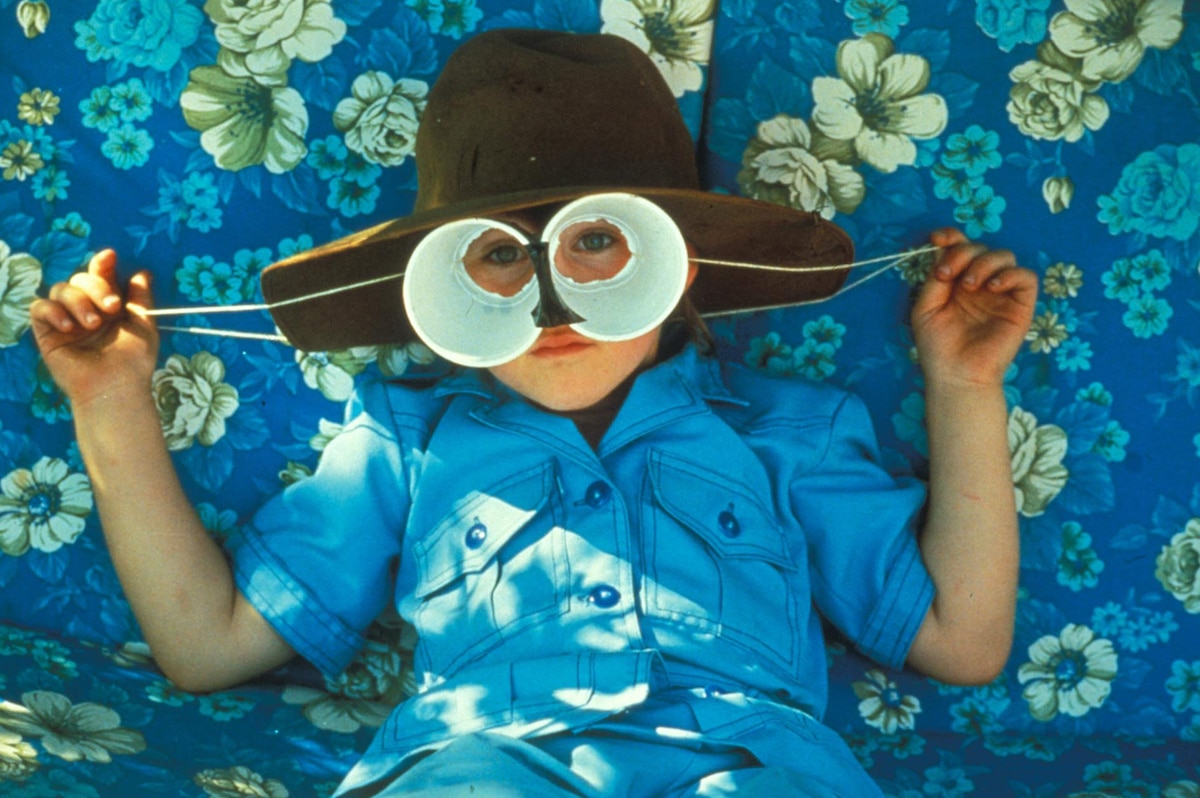
The delivery system for this wrenching dynamic is Aussie-stylized through the ceiling. Campion and cinematographer Sally Bongers have crafted an unforgettable visual assault, limning the shanty-suburbia of southeastern Australia in outrageous puppet-show tableaux, cheesy pastel colors, arch proto-punk posturing, cartoon-impossible compositions, bird's-eye-view perspectives, lens-distorted grotesqueries, animated interpolations, absurdist locations, deliberately disturbing fragmentations, and so on, all jumbled in an editing mix that defies categorization. In fact, the sheer welter of imagistic unpredictability serves to both comment on the action - painting these fringe-dwellers as ludicrous provincials - and give us distance from the intense and often unrelenting psychodramatic firefighting that ensues once Sweetie's pathological impulses are truly uncorked.
It's an authentically bruising film about a dysfunctional family that finds a visual and narrative vocabulary that never relies upon sheer Eugene O'Neill-Tennessee Williams verbosity, as so many films of the same species do. The wild style of Sweetie can also be carbon-dated to its day and age - these were the years of punk, post-punk, New Wave, No Wave and indie-everything, a broad cultural paradigm marked visually by tastelessness, bold colors, crass angularism, dimestore expressionist design, compressed theatrical images, campy voguing, tonal apathy, cellar-nightclub lighting, and so on, and it's a palette that Campion knowingly exploits, even as she converts it into something much less postured and far more psychological. As the years have pressed on, so many of that period's fashionably hip signature films from all over, from 1982's punk indieLiquid Sky to Luc Besson's Subway (1985), Alan Rudolph's Trouble in Mind (1985), Tim Burton's Pee-Wee's Big Adventure (1985), Julien Temple's Earth Girls Are Easy (1988), and even Pedro Almodovar's Women on the Verge of a Nervous Breakdown (1988), have dated and paled in the memory. Sweetie, if anything, has grown stranger, and more painfully acute in its observations.
Campion (she indeed has a competitive sister, Anna, who made one lame film, Loaded, in 1994, cowrote the rather harebrained Holy Smoke, and then more or less disappeared) was at once and remains one of our reliably feminist filmmakers, and Sweetie is still one of the best movies to pass the Bechdel Test with flying colors. (The Bechdel Test originated in a gay comic strip written by artist Allison Bechdel back in the '80s; to get a passing grade, a film's story must include at least one scene in which at least two named female characters talk to each other, and talk about something other than men. Needless to say, 99% of English-language films fail, badly.) In that alone, it's so distinctive it almost feels like a movie from another world, where men and their ideas of power don't run everything.
By Michael Atkinson
Sweetie
by Michael Atkinson | March 08, 2014
SIGN UP FOR OUR NEWSLETTERS

CONNECT WITH TCM