There are numerous ways to say "rubbish" in German. There are more ways to say it in Hollywood. A case in point: They Came to Blow Up America (1943). It's an anti-Nazi propaganda film of surprising listlessness, especially since it's rooted in one of the most dramatic instances of WWII - the botched mission of several Nazi demolition teams put ashore by U-boats on beaches in New York, Maine and Florida. As he did when he was production chief at Warner Bros., Fox's Daryl F. Zanuck ripped the story from 1942 front page headlines when the real-life saboteurs were caught and, except for two who turned states evidence, executed in August, 1942. It miscasts George Sanders
Sten (1908-1993), born in the Ukrainian city of Kyiv, worked her way up the rungs of the acting ladder (Russian Film Academy, Moscow Art Theater, film roles in Russia, then Germany). When Samuel Goldwyn saw a picture of the strikingly beautiful Sten, he signed her to a contract, not knowing she barely spoke English. Like every movie exec in the 1930s, he was eager to latch onto the next Garbo or Dietrich. Sten threw herself into English and diction lessons. But Goldwyn didn't help when he hyped her as "the passionate peasant." Cole Porter skewered her in a lyric from Anything Goes: "If Sam Goldwyn can with great conviction/ Instruct Anna Sten in diction/ Then Anna shows/ Anything goes." Of course, none of this would have mattered if her films had been hits. But Nana (1934), We Live Again (1934) and The Wedding Night (1935) flopped. So much for the new Garbo.
More about Sten, whose career was on the wane, shortly. She gets second billing here to Sanders, although it's a distant second. Sanders (1906-1972) is the surprise here. He said he enjoyed playing cads. His instincts served him well. For years he was Hollywood's king of scathing disdain, immortalized in All About Eve (1950) when his acid-tongued gossip columnist, Addison DeWitt, introduced a novice actress played by Marilyn Monroe by witheringly describing her as a graduate of the Copacabana School of Dramatic Arts. Here he's miscast as an action hero and a sensitive guy, neither of which plays to his strengths. His character, Carl Steelman, is the son of naturalized citizens and speaks German. Before joining the FBI, he was a mining engineer with a good working knowledge of explosives.
Infiltrating the Bund, a US-based fellowship of German-Americans that suggests a long-running Oktoberfest with subversion, Carl and the FBI get a break. One of the Bund members, a saboteur, is killed in a police raid. Impersonating the dead man, Carl heads off to spy school in Berlin, where he learns about the latest in remote-control detonators. Thanks to a chance meeting and hormones, he pursues an angel-faced blond beauty (Poldi Dur), a member of the Underground. He promptly turns her over to the Gestapo, but only because he knows (she didn't) that Nazi agents had their binoculars trained on her flat. Not a problem. He rescues her, blowing up a pursuing Gestapo car en route, then shipping her off to safety in England.
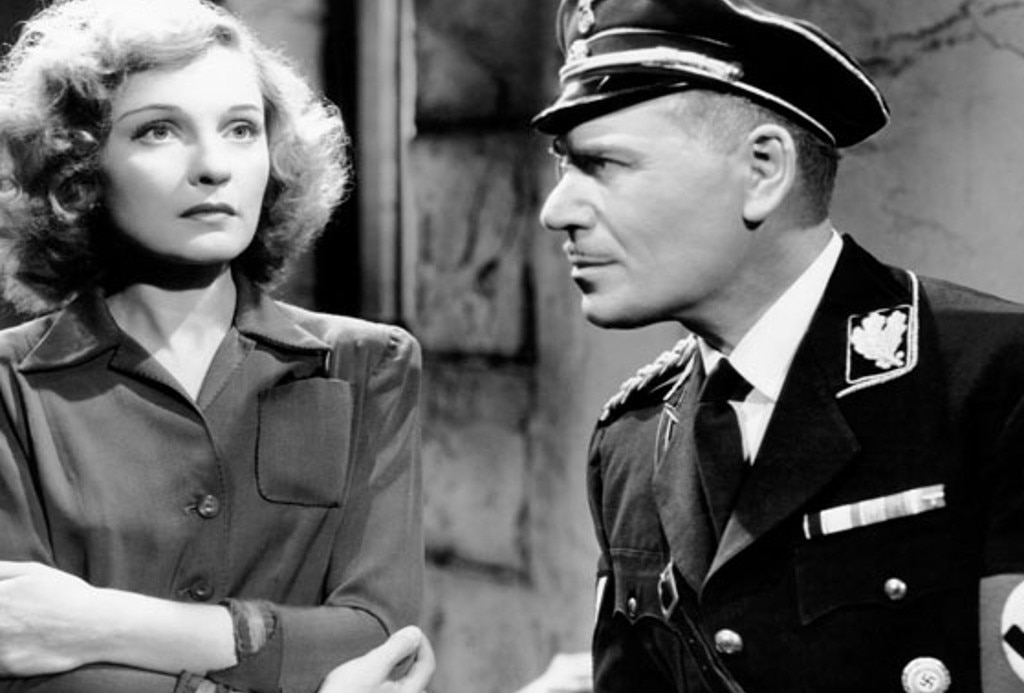
Not that his troubles are over. When he returns to his hotel, his room is invaded by a confused and indignant Sten, widow (although she doesn't know it) of the man Carl is impersonating. It's not a large role, but Sten makes it count. Her German-accented English carries her past the speech barrier and her volatility breathes a bit of fire into the decidedly tepid proceedings. When she goes to the Gestapo to turn Carl in, she's foiled by Carl, who anticipating danger, beats her to the Gestapo commandant's office and discredits her. When she shows up, the commandant decides she's mentally unbalanced and imprisons her. Sten must negotiate a difficult tonal change. When she shows up unannounced in Carl's hotel room, the exchanges play like bedroom farce. But after the widow tells the commandant off, things get dire, then grim, as Carl's smoking jacket is replaced by a smoking gun.
The stereotypes and clichés pile up until they threaten to topple the entire enterprise, and finally do when Carl's FBI boss (Ward Bond, of John Ford repertory company fame) pays Carl's sputtering father a visit and tells him that Carl is really on a secret mission for the FBI and not the traitor the old man thought him. It almost costs Carl his life, but moments after disembarking on the beach at Amagansett, Long Island, he blows the U-boat to bits, too. The film also takes the lazy way out, presenting Carl's German-born parents (Ludwig Stoessel, Elsa Janssen) in the most cliché-ridden terms. And Dennis Hoey, as Carl's commanding officer, delivers one of the crudest performances of any Hollywood actor who ever yelled "Schweinhund!" In an acknowledgment of post-9/11 sensibilities, the box on the Fox Archive DVD release has junked the original poster, dominated by the Brooklyn Bridge being blown to bits, and replaced it with a picture of Sanders, in Nazi gear, with one arm cradling Dur and the other a sub-machine gun. They Came to Bomb America has its patriotism in the right place, but not much else.
By Jay Carr
They Came to Blow Up America
by Jay Carr | March 08, 2014
SIGN UP FOR OUR NEWSLETTERS

CONNECT WITH TCM