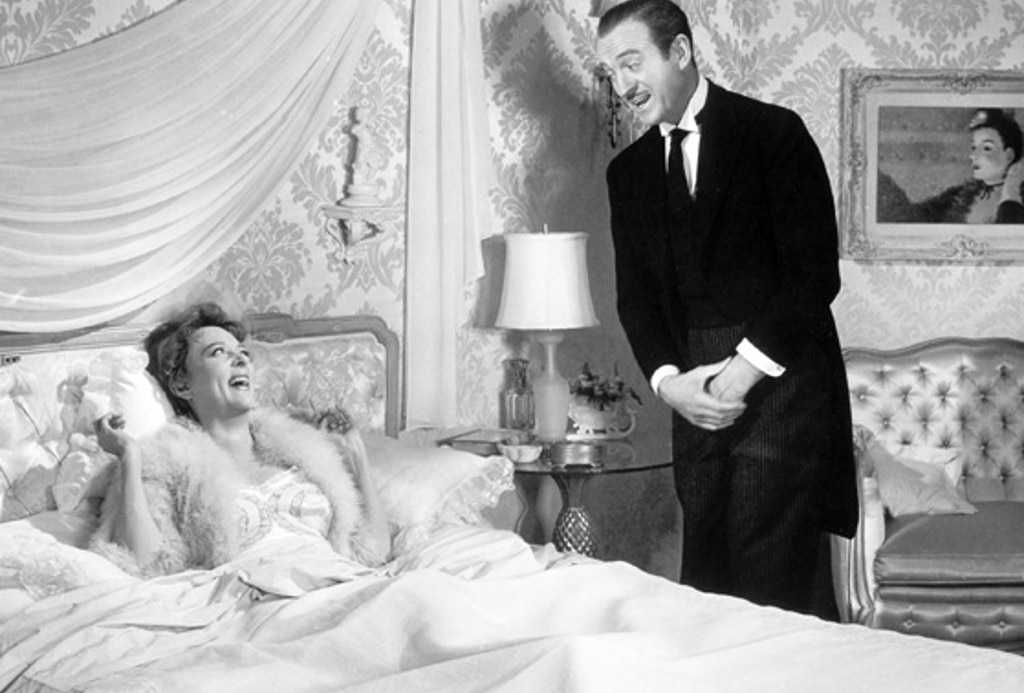
When Carole Lombard and William Powell made My Man Godfrey in 1936, they helped to create a classic screwball comedy. Twenty-one years later, Lombard had died and Powell had retired, but My Man Godfrey (1957) returned to theaters. This time, instead of being a Boston blue-blood causality of The Great Depression, Godfrey was an Austrian WWII refugee in the United States illegally. The role was played by Lombard's friend, David Niven, who had appeared on radio with Lombard and Powell in the Lux Radio Theater version of My Man Godfrey in 1938. For the 1957 film, June Allyson had Lombard's role of dim-witted socialite Irene Bullock.
Perhaps to give the film its own identity, My Man Godfrey had the working title of Her Man Godfrey before reverting to the original. Casting underwent some changes as well - Doris Day had been up for Irene, but she wanted more money than Universal was willing to pay. Eva Gabor tested for the role of Irene's sister, Cordelia (played in the 1936 film by Gail Patrick), but it was Martha Hyer who ended up with the part. Gabor was given the role of Francesca Gray (the female version of Alan Mowbray's original character of Godfrey's college pal, Tommy Gray). David Niven had not been the first choice for Godfrey - that role was to have gone to actor O.W. Fischer, who had been Germany's top salaried actor, co-starring with Maria Schell in a string of hits. Fischer came to Hollywood, but according to director Henry Koster, he was "one of the most craziest men I've ever worked with and the most conceited." Fischer was known to like cats, so to make him feel at home in Hollywood, his agent, Paul Kohner, rented him a small bungalow at the tony Bel Air Hotel in Beverly Hills, complete with a beautiful white angora cat. Instead of being grateful for their kindness, Fischer threw a tantrum, demanding that the cat be removed or he would not move into the hotel, telling Kohner that he refused to be "a traitor" to his own cats at home. Finally, Fischer's behavior became even more bizarre - some sources claim he "lost his memory" - that he reportedly walked off the film. Universal sued and the matter was eventually settled out of court. He was replaced with the markedly less dramatic David Niven, who began work on February 22, 1957.
.
Although none of the original writers contributed to the 1957 script, Peter Berneis, William Bowers and Everett Freeman's screenplay had many similarities with the original - oddball socialite Irene hires a homeless man to be her butler and falls in love with him. Unbeknownst to the entire family, Godfrey comes from a wealthy background, and his manners put theirs to shame. Playing Irene's parents were Jessie Royce Landis and Robert Keith.
Any film that tries to remake a classic will invariably suffer in comparison, and My Man Godfrey was no exception when it opened in New York in October 1957. The Sunday Herald called it a "hoked-up and updated version of the Hollywood depression-era hit of the same name [that is] just forced enough to throw the whacky story off the balance it barely retained in the original." The New York Times' veteran critic Bosley Crowther mused that "Maybe times have changed. Maybe June Allyson and David Niven are just not Miss Lombard and Mr. Powell. Anyhow, the remake of that picture, which has Miss Allyson and Mr. Niven as its stars, just doesn't seem as funny as that first one."
By Lorraine LoBianco
SOURCES:
Crowther, Bosley "Screen: 'My Man Godfrey' Returns; Blase Butler's Story Is Told by Universal June Allyson, Niven in Comedy at Roxy" 12 Oct 57
Fowler, Karin J. David Niven: A Bio-Bibliography
The Internet Movie Database
Koster, Henry Henry Koster
Milberg, Doris The Art of the Screwball Comedy: Madcap Entertainment from the 1930s to Today
"My Man Godfrey" The Sunday Herald 26 Jan 58
http://www.tcm.com/tcmdb/title/84365/My-Man-Godfrey/notes.html
My Man Godfrey
by Lorraine LoBianco | March 08, 2014
SIGN UP FOR OUR NEWSLETTERS

CONNECT WITH TCM