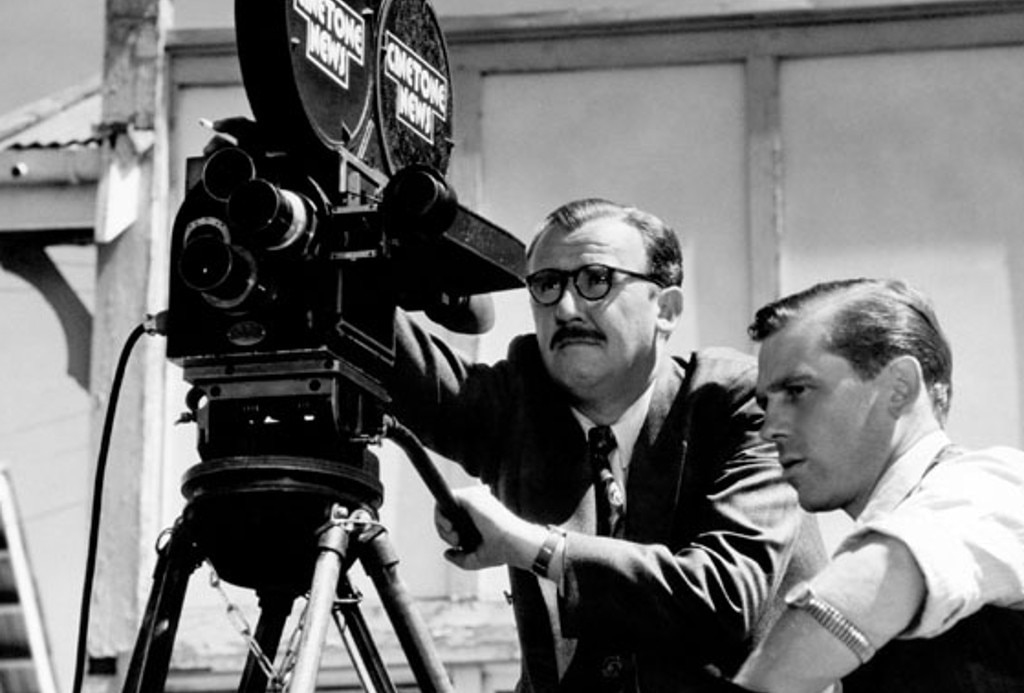
Newsfront (1978), from smack in the middle of Australia's film resurgence, charts the profound changes through which the country hurtled with barely enough time to blink as it moved from remote semi-provincial status to claim a place on the world stage. It's Phillip Noyce's breakthrough film and if you didn't know his age (b. 1960) ruled it out, you'd think it autobiographical. It's a loving, respectful genuflection to the vanished newsreel photographer. Through the late 1940s, newsreels at theaters were Australians' only way of seeing themselves at work, at play, at war, and being orated to by politicians. TV elbowed newsreels into oblivion fast. Why should people wait a week, or more, to see images of newsmakers when TV supplied them the same day?
The film is bookended by images of the same theater in 1946, when it was filled with people soaking up images of Australia at war. These include the now iconic sequence of a brave photog filming a Japanese sniper in New Guinea moments before the sniper shot him to death. The marquee of the same theater 10 years later spells out what happened. A decade later, it's showing Brigitte Bardot in And God Created Woman (1956). No more newsreels. Noyce has set up the story in classic fashion, centering it on two brothers working for Australia's rival newsreel networks, and following divergent paths. Len Maguire, played by the late, great Bill Hunter, is the one walking past the repurposed theater, not liking when he sees.
Skilled and intrepid, he's good at his job, is totally devoted to it, and has a broken marriage to show for it. He's not in denial. He knows what's coming. Still, he can't bear TV, can't abide its cheap, shoddy, sensationalizing ways and its lowering of journalistic ethics. His brother, Frank (Gerard Kennedy), is the worldly one. For starters, he works for management, not in the field. He's one of the first to read the handwriting on the screen, boards a ship to Los Angeles and doesn't stop climbing until he's a TV and movie producer. He tries to place Len in the not so brave new world. But Len won't have it. As the film ends, he's getting ready to shoot the 1956 Melbourne Olympics, Australia's first, marking its emergence among nations. Even though he's wearing a smile, it may be his last hurrah, and he knows it.
The cast also includes the recently deceased Wendy Hughes, whose second in command thinks she should be boss, sleeping first with Len and later with Frank to see that her career agenda happens. Also in a small but flavorful role: Bryan Brown, who soon would headline his own movies. The durable Chris Haywood makes his presence felt as Len's happy-go-lucky cameraman, performing an act of heroism during their coverage of the lethal Maitland Flood of 1955. This is probably the place to say that the footage shot depicting those designed to personalize the story and generate emotion is in color, set against loads of newsreel footage. A curious thing happens, though, as the film proceeds. Perhaps trying to go Hunter's route and internalizing, the others seem to fade in presence until by the end there's a sense that Noyce should have turned the flame under them higher.
By Jay Carr
Newsfront
by Jay Carr | March 08, 2014
SIGN UP FOR OUR NEWSLETTERS

CONNECT WITH TCM