The basis for the film version of The Black Stallion was a novel of the same title by American author Walter Farley, who grew up in Syracuse, N.Y., and New York City. He began work on the book, his first, while still a student at Brooklyn's Erasmus Hall High School and Mercersburg Academy in Pennsylvania, and finished it as an undergraduate at Columbia University. Farley was 26 when the book was published by Random House in 1941 and was enthusiastically received by youngsters everywhere who made clear their desire to read about more adventures of the young hero, Alec Ramsey, and "the Black," the magnificent Arabian stallion he comes to own after the two are shipwrecked on a desert island.
Farley's writing career, however, was interrupted by World War II and his service in the U.S. Army for five years. Upon his return he wrote two sequels, The Black Stallion Returns (1947) and Son of the Black Stallion (1949). He then created a new fictional boy/horse duo, Steven Duncan and Flame, in The Island Stallion. Farley continued to write novels about the two stallions (who encounter each other in three of the books), the Black's offspring and other horses. By the time of the movie's release in 1979, Farley had published 19 novels in his equine series including the fictionalized biography Man o' War (1962), about the great American race horse. Throughout the 1940s and '50s Farley's novels consistently placed near the top of The New York Times' annual list of best-selling children's books.
Despite the near-legendary status of Farley's book, The Black Stallion had never been adapted for the screen until producer/director Francis Ford Coppola purchased the rights as part of a plan to produce a series of classic children's movies. (The series did not entirely materialize, although a second installment, The Secret Garden, was released in 1993.) Among the screenwriters was Melissa Mathison, who would later marry Harrison Ford and win an Oscar® nomination for E.T. The Extra-Terrestrial (1982). Coppola chose Carroll Ballard, his former UCLA classmate, to direct The Black Stallion. Ballard had never before directed a feature, although his documentary Harvest (1967) was nominated for an Oscar®. Author Farley agreed to be a consultant on horse matters for the film.
Kelly Reno, the 13-year-old son of Colorado cattle ranchers, was cast as Alec despite the fact that he had never acted before and wasn't a particular fan of movies or television. In The New York Times of September 30, 1979, he did acknowledge that he had seen Star Wars twice. "As for TV, I don't watch it much, except for Soap," he added. But Reno had persuaded his parents to drive him to Denver for an audition for boys who could ride. Producer Tom Sternberg later said that "We'd considered all sorts of professional child actors. Then we began to search for boys who may not have acted, but who might be right for the role. We eventually interviewed several hundred around the country and tested 100." Reno went to Los Angeles for a screen test, and his equestrian skills and natural manner, along with his quizzical, freckle-faced charm, got him the role.
In a nod to another great child-and-horse film, 1944's National Velvet, Mickey Rooney was cast Henry Dailey, the horse trainer and former jockey. He had also played a jockey in Down the Stretch (1936), Thoroughbreds Don't Cry (1937) and a memorable episode of TV's Twilight Zone series, The Last Night of a Jockey. In his memoir, Life Is Too Short, Rooney recalled receiving a call from Coppola offering him the role of "a former jockey called out of retirement by a little boy with a beautiful black Arabian horse and a dream about winning a race." Rooney's sarcastic response when asked if he thought he could play the role: "Gee, I don't know. I never played a jockey before."
Teri Garr, enjoying a career high after roles in Young Frankenstein (1974) and Close Encounters of the Third Kind (1977), was cast as Alec's mom, with singer/actor Hoyt Axton (1938-1999) in the small but key role of Alec's dad. In what would be his last role, pioneer actor/filmmaker Clarence Muse (1889-1979) played Snoe, an elderly horse owner who befriends Alec once the boy and the Black are back in New York.
In the crucial casting of the title role, Ballard looked at horses in Morocco, Tunisia and Egypt - countries on the path of the fictional steamer in Farley's story as it left Bombay, picked up the Black in Arabia and sank off the coast of Portugal. Ballard also traveled to England and Spain but failed to find a suitable candidate in any of these locations. Back in the U.S. he was impressed with an Egyptian-born Arabian racehorse named El Mokhtar, but his owners declined all offers. (Later the studio bought out the syndicate of owners, and El Mokhtar was used for some scenes in the 1983 sequel, The Black Stallion Returns.) At the Jack Tone Ranch in California, Ballard spotted another Arabian stallion, Fae Jur, and liked his spirit and "touch of madness" but was concerned that the horse was too small.
Meanwhile author Farley had been doing some scouting of his own and, in San Antonio, located a gorgeous Texas-bred Arabian named Cass Ole that surpassed all his competition in matching the fictional horse's beauty and character. He was a true champion, having won more than 600 ribbons in local, national and regional competitions. For two years (1975-76) he had won American Horse Show Association's Horse of the Year award. With his noble head, expressive eyes, quick intelligence and responsive temperament, Cass Ole quickly won the role of the Black.
Cast as the old white horse named Napoleon, who becomes the Black's friend in the later part of the film, was Junior, who had previously appeared as Trooper, the horse of Neidermeyer (Mark Metcalf) in National Lampoon's Animal House (1978). Before filming began, the horses used in the film, including stunt doubles, were trained at a California ranch for several weeks by noted trainers Corky, Glenn and J.R. Randall. Corky Randall had trained Trigger for Roy Rogers, Silver for the Lone Ranger films, and all the horses in the chariot-race scene in 1959's Ben-Hur. Cass Ole had special sessions with young Reno so boy and horse could establish a believable rapport.
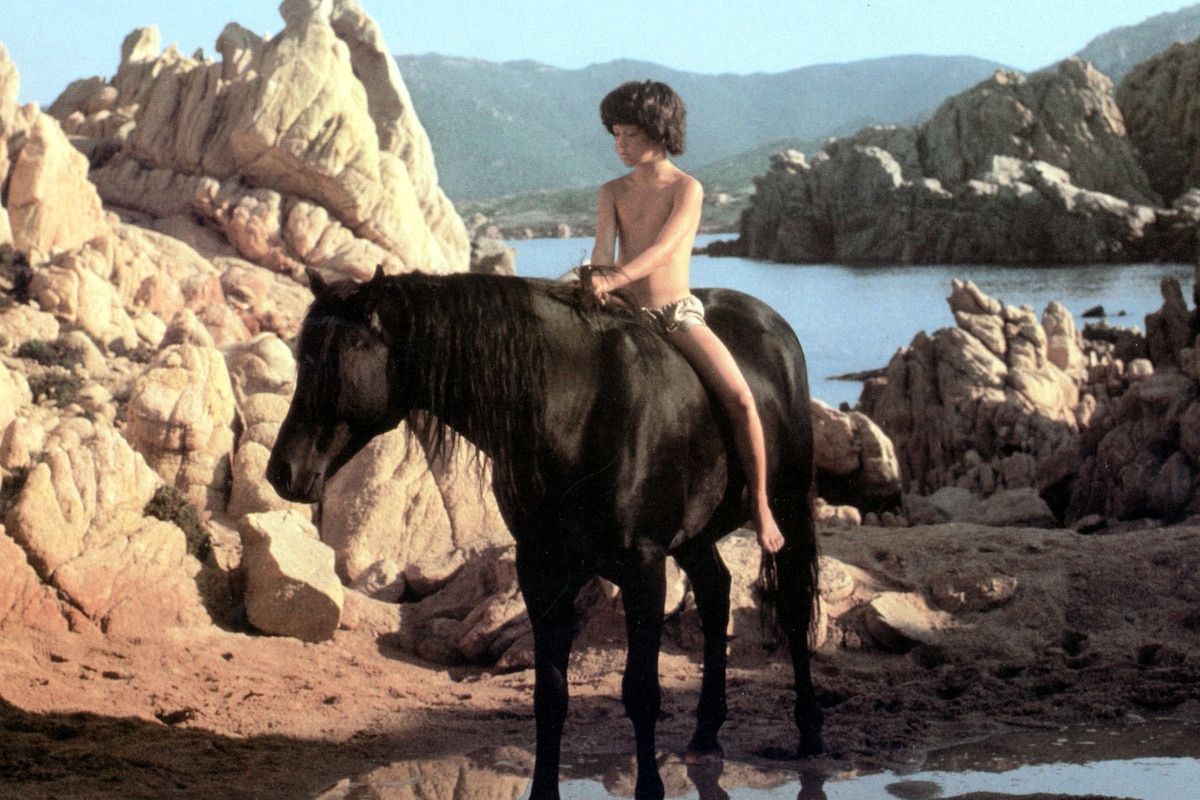
After extensive scouting of locations, Sardinia was chosen for the island sequences because of its remote and spectacular scenery; and Toronto, Canada, was picked to represent the Eastern seaboard of the U.S. in the 1940s. Separate art directors and production managers were assigned to the two locations, one with an Italian crew and the other with a Canadian one. To represent the farm of Mickey Rooney's character, two bucolic locations were found near Toronto; one of them featured a 100-year-old abandoned barn that was refurbished by art director Earl Preston. Two racing tracks were required; the one where the Black trains secretly at night was represented by Woodbine Racetrack in Toronto, and Fort Erie Racetrack, on the Ontario border near Buffalo, N.Y., was used for the match race.
By Roger Fristoe
The Big Idea-The Black Stallion
by Roger Fristoe | March 05, 2014
SIGN UP FOR OUR NEWSLETTERS

CONNECT WITH TCM