For the striking opening sequence in which the audience first gets a glimpse into Séverine's masochistic fantasies, Buñuel originally wanted to use an entirely different location. "...my only regret about Belle de Jour was that the proprietor of the famous Train Bleu at the Gare de Lyon refused to allow me to shoot the opening scene on the premises," Buñuel said in his 1983 autobiography. "It's a spectacular restaurant on the second floor of the railroad station, designed around 1900 by a group of painters, sculptors, and decorators who created a kind of opera-house décor devoted to trains and the countries they can take us to."
Instead of filming at the Train Bleu, Buñuel ultimately shot the memorable opening sequence outdoors near a country estate. It was during the very first day of shooting this opening sequence that Buñuel heard about some complaints from his actors. "An assistant came over to tell me the actors wanted to talk to me," said Buñuel. It concerned the syrupy dialogue between Jean Sorel's character Pierre and his bride Séverine before the violent sexual attack. "Sorel had crossed out his lines and had written 'his' dialogue over them," Buñuel continued. "'What have you done?' I asked him. Very politely, he said, 'Excuse me, sir, doesn't this seem ridiculous to you?' 'Yes,' I told him, 'but don't you know what happens afterwards? After this banal dialogue, you begin to beat her with a whip, to drag her through the mud. Just deliver it as it is written.' And that's how he said it."
Buñuel's directing style, as always, was loose and instinctive. "I don't use any particular technique when I work," he said in his autobiography. "My direction depends entirely on how good the actors are, on what they suggest, or the kind of effort I have to make if they're not suited to their roles...all direction depends on your personal vision, a certain something you feel strongly but can't always explain."
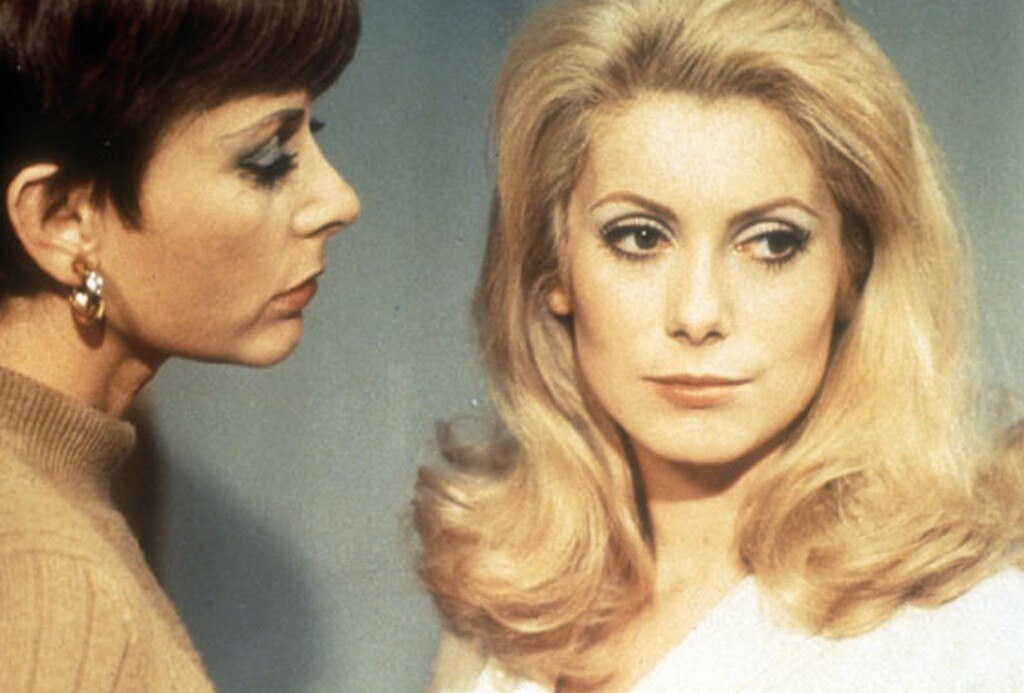
While the film was shooting, actress Catherine Deneuve said publicly that she was enjoying making Belle de Jour. Other than remarking that shooting some of the brothel scenes could be "difficult," she said at the time that she was "in awe" of Buñuel and called him "wonderful to work with; kind, understanding, very sweet, very human."
However, Deneuve was much more unhappy while making the film than she originally let on. In a 2004 interview she revealed that making the film "wasn't a terribly positive experience" for her. She felt that Buñuel had been isolated from the actors by the producers, and there had been a breakdown in communication as a result. She felt "very exposed in every sense of the word," she said, "but very exposed physically, which caused me distress; I felt they showed more of me than they'd said they were going to...There were moments when I felt totally used. I was very unhappy."
Buñuel knew that she was unhappy, but he felt that it was mostly because she didn't understand his working style and the reasons behind his choices. "She didn't want her breasts to be seen," he recalled, "and the hairdresser put a strip of fabric around her. She had to appear nude for a moment, putting on a stocking to keep her breasts from being seen during that movement, she bound them up in a taffeta band."
Before the film was released, Buñuel was pressured to make some cuts for the censors, which he later came to regret. "The Hakims told me, 'By letting the censors cut one thing, you keep them from cutting even more,'" said Buñuel. He was especially bothered to have to cut the scene between Séverine and the Duke (Georges Marchal). Originally, the scene had Séverine lying in a coffin in a private chapel after a Mass with a "splendid" copy of one of Grünewald's Christ paintings clearly visible on the wall. "The suppression of the Mass," he said, "completely changes the character of this scene." The scene, he said, "had more value with the painting of the Grünewald Christ, which is the most terrible image of Christ...It was painted in a ferociously realistic style. This image was important because it prepared the audience for the next scene." An edited version of the scene stayed in the film, but to Buñuel, it lacked the same impact without the original imagery.
Belle de Jour went on to win the Golden Lion - the grand prize - at the 1967 Venice Film Festival. Pushing the usual buttons of shock and confusion that Buñuel's work often did, the film garnered considerable praise and attention upon its release. "It was my biggest commercial success," he said, "which I attribute more to the marvelous whores [in the film] than to my direction."
The film also generated a great deal of discussion and debate among audiences about its meaning and what scenes were real versus being part of Séverine's fantasies. Buñuel, as usual, didn't feel the need to explain his work, which only added to the film's mystique. This blurring of reality and fantasy, he said, was "what stimulated me to film the story. By the end, the real and the imaginary fuse. I myself cannot tell you what is real and what's imaginary in the film. For me they form the same thing."
One scene in the film that audiences obsessed over was the one in which an Asian client entered the brothel with a mysterious box containing an unknown object that is never revealed. When he opens the box to show the prostitutes what is inside, Séverine is the only one who agrees to an encounter while the others turn away in horror. Buñuel found that the most common question people asked him about the film later concerned the contents of the box. It was a question he found "senseless...I can't count the number of times people (particularly women) have asked me what was in the box, but since I myself have no idea, I usually reply, 'Whatever you want there to be.'"
As for the famously ambiguous ending that audiences debated endlessly, Buñuel said, "I don't understand it. This is my lack of certitude. It's the moment when I don't know what to do, I have various solutions and I can't decide on any one of them. Finally, I end up putting in my own uncertainty...I can only say that in life there are situations that don't end, that have no solution."
As he often did when he completed a film, Buñuel claimed after 40+ years of filmmaking that his latest work would be his last. "No more cinema for me--not in Spain, not in France, nowhere," he said at the time. "Belle de Jour is my last film." As was also his habit as a driven and inspired artist, his words went out the window as he was back at work in no time on his next film, The Milky Way (1969).
Catherine Deneuve decided that because of her negative experience on Belle de Jour, it was important to her to work with Buñuel one more time as a way to challenge herself and clear the air. Just a few years later she and Buñuel collaborated once again on the well-received Tristana (1970), which turned out to be a much happier experience for Deneuve.
Working on a second film with Buñuel, along with the passage of time, helped Deneuve make her peace with Belle de Jour. In a 2009 interview she said, "I prefer to be associated with Belle de Jour than a lot of other things, frankly. I think it's a great film."
Following its initial release in 1967, Belle de Jour wasn't seen again for many years due to some rights issues with the Hakim brothers' estate. The absence of the film from circulation--including home video--for so long only helped build up its mystique for a new generation who had not yet seen it.
It was Academy Award-winning director Martin Scorsese, a longtime fan of the film, who helped spearhead the effort to get Belle de Jour a limited high profile release in 1995 through Miramax Zoë, a subsidiary company created by Miramax to acquire and distribute French films in the U.S. As a result, the film found itself in the spotlight once again and soon became easily available to be discovered and appreciated by new generations.
by Andrea Passafiume
Behind the Camera-Belle de Jour
by Andrea Passafiume | March 05, 2014
SIGN UP FOR OUR NEWSLETTERS

CONNECT WITH TCM