Belle de Jour had its origins in the 1928 novel of the same name by French author Joseph Kessel. In 1966 the producing team of brothers Raymond and Robert Hakim approached Luis Buñuel about making a film adaptation of the book.
Buñuel at the time was in his mid-60s and in the midst of one of his most creative and productive phases as a director. The Spanish born Buñuel was a pioneering filmmaker, iconoclast, artist and provocateur. Having begun his career steeped in the surrealist movement of the 1920s, Buñuel became one of the most prominent international filmmakers working in France, Spain, the United States and Mexico. His films, which included Un Chien Andalou (1929), Viridiana (1961) and Diary of a Chambermaid (1964), were known for their vivid and often shocking imagery as well as being highly critical of bourgeois values and institutions.
Buñuel demanded "total freedom" from the Hakim brothers before agreeing to make Belle de Jour. "I especially objected to a clause [in the contract]," recalled Buñuel, "that gave the producers the right to intervene in the final cut to protect their investment."
Buñuel decided to team up with his friend and frequent writing collaborator Jean-Claude Carrière to adapt the novel into a screenplay. The pair had first worked together on Diary of a Chambermaid (1964) and would ultimately make six films together.
Buñuel knew that he wanted to put his own creative stamp on the novel's story when writing the screenplay, especially when it came to exploring Séverine's inner life. "The novel is very melodramatic, but well-constructed," he said in his 1983 autobiography My Last Sigh, "and it offered me the chance to translate Séverine's fantasies into pictorial images as well as to draw a serious portrait of a young female bourgeois masochist. I was also able to indulge myself in the faithful description of some interesting sexual perversions."
The writing process and collaboration with Jean-Claude Carrière went "smoothly," according to Buñuel. Carrière called the process of working with Buñuel "a fantastic adventure."
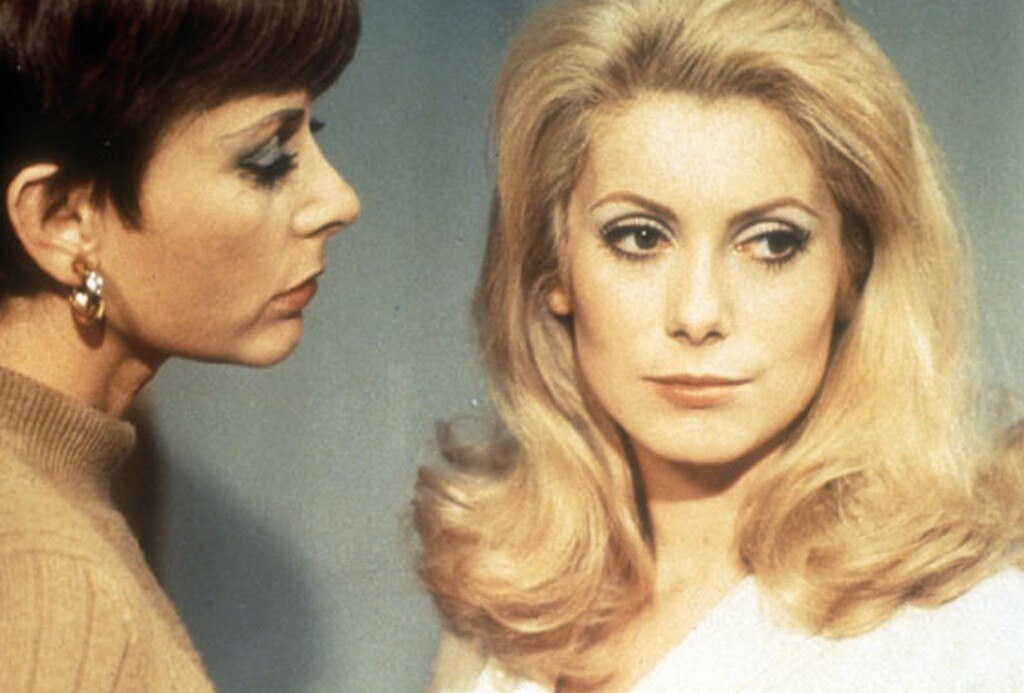
The producers had already hand-picked actress Catherine Deneuve to play the role of Séverine by the time Buñuel came on board. The stunningly beautiful Deneuve was already a film veteran in her early 20s, having been appearing in movies since the age of 13. However, she had only recently achieved international stardom through her breakout performances in Jacques Demy's heartbreaking musical The Umbrellas of Cherbourg (1964) and Roman Polanski's thriller Repulsion (1965).
Deneuve's substantial talent as an actress, along with her image as an icy enigmatic beauty, made her the ideal choice to play Séverine. However, even though the Hakim brothers had already made their preference clear, Buñuel still had veto power over her casting. "If I don't have that freedom," he said, "I don't make a film." After meeting with Deneuve, however, he easily agreed that she would be right for the part.
After agreeing to use Deneuve, Buñuel hired Jean Sorel to play Séverine's oblivious husband Pierre. To round out the cast, Buñuel added a number of talented actors including Geneviève Page as Séverine's chic madame, Michel Piccoli as the predatory Henri and Pierre Clementi as Séverine's menacing client Marcel.
Buñuel hired skilled cinematographer Sacha Vierny to shoot Belle de Jour, which would be his first color feature. Vierny had photographed a number of films for director Alain Resnais and would go on to another lengthy period of collaboration with director Peter Greenaway.
by Andrea Passafiume
The Big Idea-Belle de Jour
by Andrea Passafiume | March 05, 2014
SIGN UP FOR OUR NEWSLETTERS

CONNECT WITH TCM