Against the studio's modest expectations, the film became a big hit and the sixth biggest moneymaker of the year.
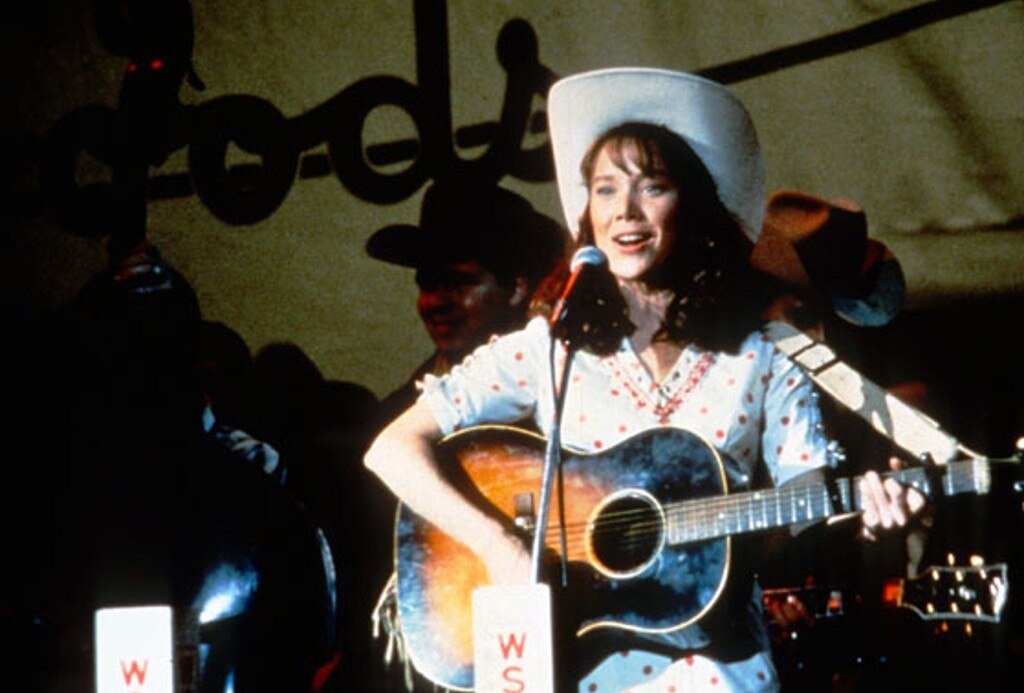
Sissy Spacek won a Best Actress Academy Award for her work. The film received five other nominations: Best Picture, Best Adapted Screenplay (Thomas Rickman), Best Cinematography (Ralf T. Bode), Best Art Direction-Set Decoration, Best Sound, and Best Film editing.
The movie won Golden Globe Awards for Best Motion Picture Musical or Comedy and Best Actress in a Musical or Comedy. Tommy Lee Jones and Beverly D'Angelo were also nominated for their performances.
Although the British film academy failed to recognize its native son, Michael Apted, for directing, it did give nominations for Best Actress and Best Sound.
Spacek's performance also won her awards from the Kansas City, Los Angeles, and New York film critics associations and the National Society of Film Critics.
The National Board of Review named Coal Miner's Daughter one of its Top Ten films of the year and Sissy Spacek as Best Actress.
Thomas Rickman's screenplay was nominated by the Writers Guild of America.
"Tommy Lee should've been recognized in that movie. He wasn't nominated, and that was wrong." - Loretta Lynn
"There was only one song on the [soundtrack] album that I didn't think sounded as much like me. That song was 'Coal Miner's Daughter,' and it wasn't quite as good as the rest of them, even though [Sissy Spacek] tried real hard on it. But as far as I'm concerned, she done a great job." - Loretta Lynn
Director Michael Apted: "We were lucky with Coal Miner's Daughter because it was the right time. It was a good film, but it also hit the marketplace just at the time when country music was entering the culture, with Willie Nelson, Crystal Gayle, and Dolly Parton coming into the mainstream. It also hit perfectly for Sissy Spacek's career. Now if it had come out two years earlier or two years later, it might not have had the same heat."
"Coal Miner's Daughter is a thoughtful, endearing film charting the life of singer Loretta Lynn from the depths of poverty in rural Kentucky to her eventual rise to the title of 'queen of country music.' Thanks in large part to superb performances by Sissy Spacek and Tommy Lee Jones, film mostly avoids the sudsy atmosphere common to many showbiz tales and emerges as both a wonderful love story and a convincing portrayal of one woman's life. ... There is seldom a slow moment in the picture, although towards the end short shrift is given to Spacek's bout with drugs, nervous breakdown, marriage troubles and death of her best friend, Beverly D'Angelo, who turns in a stellar if abbreviated performance as country singer Patsy Cline. ... Both Spacek and D'Angelo deserve a special nod of credit for doing all of their own singing with style and accuracy." - Variety, February 1980
"I think it's one of those films people like so much while they're watching it that they're inclined to think it's better than it is. It's warm, entertaining, funny, and centered around that great Sissy Spacek performance, but it's essentially pretty familiar material (not that Loretta Lynn can be blamed that Horatio Alger wrote her life before she lived it). The movie isn't great art, but it has been made with great taste and style; it's more intelligent and observant than movie biographies of singing stars used to be. That makes it a treasure to watch, even if we sometimes have the feeling we've seen it before." - Roger Ebert, Chicago Sun-Times, 1980
Coal Miner's Daughter risks understating its story to make Loretta Lynn's biography part of a larger fabric, and the gamble pays off. ... Miss Spacek is luminous and lovely, easily outshining her previous work, good as it has been. ... Tommy Lee Jones, as her husband, Doolittle, has a strength and humor that brings the film's love story to life, and he, too, quite outdoes his past performances. Beverly D'Angelo...makes a brief but astonishingly sharp impression. And Levon Helm, playing Loretta's father, embodies all the quiet decency that gives this film its foothold." - Janet Maslin, New York Times, March 7, 1980
"You don't have to know anything much about Loretta Lynn in order to have a good time at Coal Miner's Daughter." - New Yorker, 1980
"Some of us keep asking for American movies that speak of the variedness of America. Much of the time, this picture does part of that job. It means a lot more to me than the bloated Nashville [1975], with its strain to be an All-American metaphor." - Stanley Kauffmann, New Republic, 1980
"For all the modern gloss, what with poverty and nervous breakdowns it's still highly conventional stuff, but lovingly constructed to produce unremarkable but heart-warming entertainment." - Geoff Andrew, Time Out
Loretta Lynn has said she can't watch the movie anymore because "there's too much real in it," as in the scene of Doolittle trying to get permission to marry her from her parents. She also said she had to turn away during her breakdown scene because it hurt too much to watch it.
By Rob Nixon
Critics' Corner-Coal Miner's Daughter
by Rob Nixon | March 05, 2014
SIGN UP FOR OUR NEWSLETTERS

CONNECT WITH TCM