Country music superstar Loretta Lynn was born Loretta Webb, the second child of a Kentucky coal miner, and raised in the little mining village of Butcher Hollow. She married while still a teenager (age disputed, see TRIVIA AND FUN FACTS) to Oliver Lynn, aka Doolittle, Doo, or Mooney (because he ran moonshine). When she was pregnant with the first of their six children, the couple moved to Washington state. Although as a child she had sung around the house as well as at church and small local shows, Loretta put family over pursuing her talent until her husband began to help and encourage her to perform publicly in the late 1950s. Her winning performance on a televised Tacoma talent contest in 1959 was seen by the owner of a Canadian record company who had her record four of her own compositions, the best-known of which was "I'm a Honky Tonk Girl." She signed a recording contract with the company in 1960, and she and her husband began touring the country to promote the single. By the time they reached Nashville, it was 14 on Billboard's country-western charts. By the end of the year, she was listed as the Number 4 Most Promising Female Country Artist. She began an association with the famous Grand Ole Opry in 1960 and shortly after became friends with Patsy Cline, whose crossover success made her one of the first country stars with mainstream hits. Despite marital difficulties, the demands of touring, problems with drugs and her health, personal tragedies, and a nervous breakdown, Loretta Lynn has remained at the top of her profession for decades. Her often controversial songs, tinged with feminism and touching on subjects foreign to country music, such as birth control and war, are seen as landmarks, winning her legions of fans and numerous awards and accolades.
In 1970, Lynn released the autobiographical song "Coal Miner's Daughter" about her childhood in Kentucky. It reached No. 1 on the Billboard country charts by the end of the year and was her first single to chart on the Billboard Hot 100, putting her in the same league as her good friend, crossover country artist Patsy Cline. An album of the same name also released in 1970 became a big hit.
In 1976, Lynn published her autobiography (with George Vecsey) named for her famous song.
Universal Pictures purchased the film rights to Lynn's book shortly after it was published, with the intention of producing it on a modest ($6 million) budget. The studio wasn't very convinced the movie would be much of a draw; instead they hoped to profit on Lynn's huge draw as a recording artist through the sale of a soundtrack album.
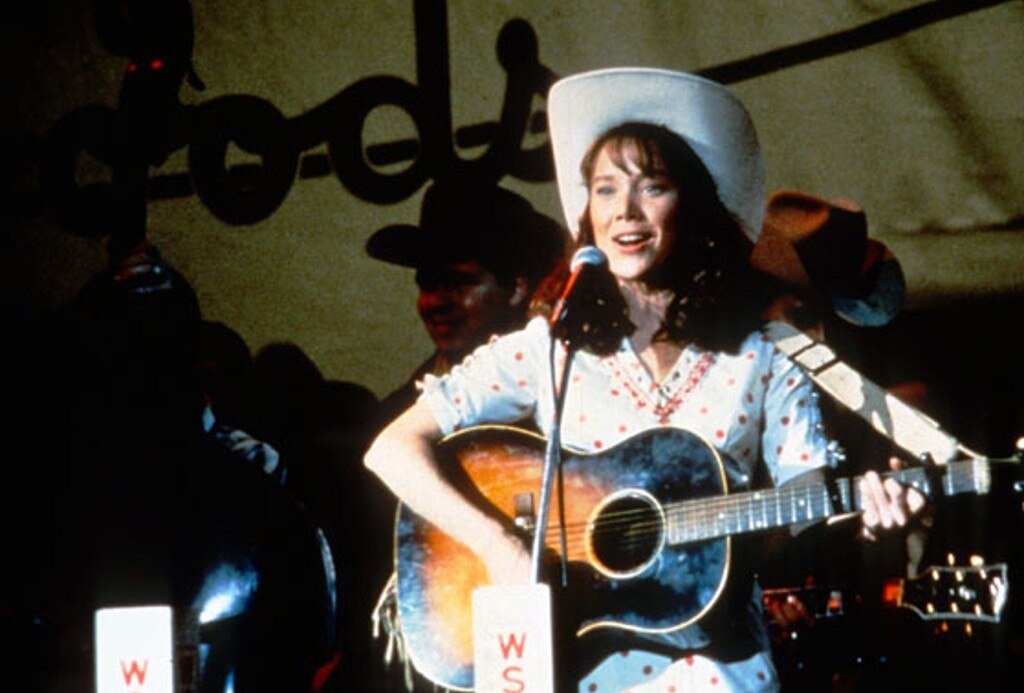
The studio presented Lynn with a stack of photos of young actresses asking her who she would pick to play her. She was struck by one woman's freckled face and insisted she was the one. It was Sissy Spacek, a 30-year-old Texan who had appeared several times on television and made a name for herself in several acclaimed movies, including Prime Cut (1972), Badlands (1973), Three Women (1977), and the hit supernatural thriller Carrie (1976), for which she received her first Academy Award nomination.
After deciding on Spacek, Lynn began to tell people quite publicly that the actress would play her on screen. In her autobiography, Spacek said she was "slightly dumbfounded because I'd never even met Loretta, and I'd certainly never agreed to be in her film." She had, in fact, been approached by Universal, but she knew very little about the project, and had serious doubts about getting involved. Still bearing traces of her Texas twang, Spacek was eager to shed any "country" image she had and open herself up to different kinds of roles. She was also afraid the studio would make something "clichéd and corny" out of Lynn's life story. Spacek also noted in her book that she had already committed to do a film with Nicholas Roeg, director of Don't Look Now (1973) and The Man Who Fell to Earth (1976), so she had high hopes of appearing in a "more artistic film" than a typical Hollywood biopic. (Spacek does not say what the film was; perhaps it was Roeg's 1980 release Bad Timing: A Sensual Obsession, which starred his future wife Theresa Russell.)
Spacek decided she would have to confront Lynn directly and tell her she wasn't doing the movie and ask her to stop telling people that. Spacek and her husband, director-production designer Jack Fisk, were in Texas visiting her parents when she found out Lynn was performing only a few hours away in Shreveport. Dressing as un-country as she could, she and Fisk drove toward the auditorium where Lynn was performing and turned on to Fisk Street, which she thought was a weird coincidence but decided to ignore it. They were approaching Lynn's tour bus when suddenly the door flew open and a tiny woman in a flowery dress stormed out, band members tagging sheepishly behind, while she exclaimed loudly, "BAM BAM BAM! I couldn't hear nothin' but them dat-gum drums a'beatin' in my ear!" At that moment, Spacek thought "Oh my God, I have to play this woman!"
Even though her impression of Loretta Lynn was favorable, Sissy Spacek continued to have misgivings about the project. She read the book and found it inspiring, but she was worried about playing a real person who was still alive, working, and very well known. She agreed to meet with the director attached to the production at that point. (Spacek and Lynn have often referred to the original director, but he has not been identified by any source we could find.) The meeting was brief and unproductive. She said later he simply pointed to Lynn's picture on Time magazine and said, "You don't look like her." Spacek was ready to quit at that point, but Lynn, producer Sean Daniel, and casting director Michael Chinich persisted.
Fisk Street wasn't the only sign Spacek would get about the project. While visiting Jack's mother Gerri in Washington, D.C., Spacek spoke about her confusion and reluctance to do the part, even though her manager and others were telling her she was crazy not to. Gerri Fisk suggested she ask God for a sign, which Spacek did jokingly. That night, she nearly screamed when she saw Lynn on TV again talking about how Sissy Spacek was going to play her. Her husband suggested they go for a ride in his mother's Cadillac, which was always tuned to a classical music station. As she flipped on the radio, Spacek heard Loretta singing the refrain to "Coal Miner's Daughter" and figured she had the sign she needed.
The original director's contract was bought out after Lynn expressed her feeling that he didn't really understand her life. She said she thought his films were good but that he would do her story "at her expense," fearing he might make fun of her. When Spacek signed on, the producers were already looking for another director. They screened as many pictures about musicians as they could find, including Daryl Duke's Payday (1973), about a fictional country star played by Spacek's cousin, Rip Torn. They were most taken with Stardust (1974), by the British Director Michael Apted.
In addition to having come from a coal mining area in England and directed documentaries that showed some feel for working class people, Apted also had the advantage of being a foreigner without a lot of preconceived notions and prejudices about Appalachian people. "Your mind wasn't already clogged up with stories," Lynn would tell him years later reflecting back on his work on the picture. As Spacek put it, "After meeting him, we were convinced he would see Loretta and her family and fans as real people, not cartoonish hillbillies."
"I got it by chance," Apted later recalled. "The studio never saw it as a big commercial film. I didn't have any baggage. I didn't know anything about country music or Loretta Lynn. Never heard of Appalachian white trash."
The adaptation of Lynn's book to screenplay was entrusted to Kentucky-born Tom Rickman, who had written the country music comedy W.W. and the Dixie Dancekings (1975) and two other Southern-set stories, the TV movies Home Cookin' (1975) and Delta County, U.S.A. (1977). Lynn later said, "We made Tom Rickman do it a few times, but he got it right."
Lynn, Spacek, and Rickman weren't the only Southerners involved with the project. For the part of Loretta's husband Doo, the producers' first choice was reportedly Texan Joe Don Baker, who bore a strong resemblance to the real-life Mr. Lynn, but they hired instead yet another Texan, Harvard-educated stage and screen actor Tommy Lee Jones, a supporting player for several years before drawing attention with his title role in the TV movie The Amazing Howard Hughes (1977) and as leading man to Faye Dunaway in Eyes of Laura Mars (1978).
Two other Southerners rounded out the principal cast. Tommy Lee Jones recommended Levon Helm, drummer for The Band, a folk-flavored rock group made up mostly of Canadians who learned about Southern culture and American roots music from Arkansas-born Helm. Although he had never acted before, Lynn approved of his background and also his uncanny resemblance to her father, the part he was cast to play; in fact, reportedly she nearly fainted when she first saw Helm in full costume and make-up. For the part of Loretta's mother, Helm suggested Phyllis Boyens, the daughter of West Virginia coal miner, folk singer, and trade unionist Nimrod Workman. Boyens often performed with her father; she can be seen singing with him in Harlan County, USA (1976), Barbara Kopple's Oscar®-winning documentary about a bitterly violent 1973 coal miner's strike in Kentucky in 1973.
By Rob Nixon
The Big Idea-Coal Miner's Daughter
by Rob Nixon | March 05, 2014
SIGN UP FOR OUR NEWSLETTERS

CONNECT WITH TCM