SYNOPSIS
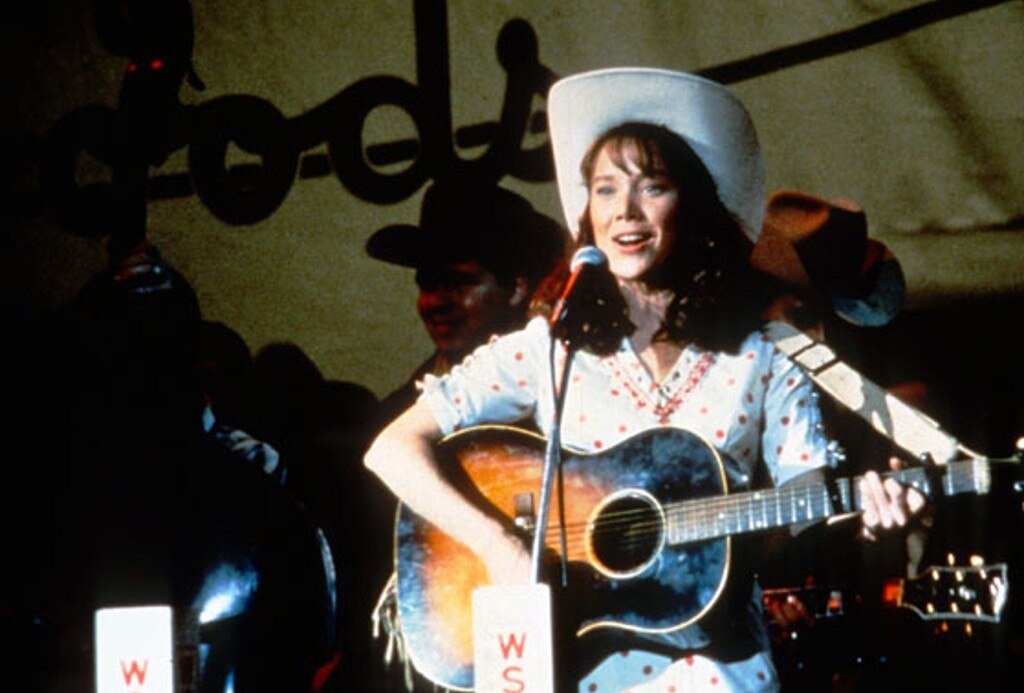
The life of Loretta Lynn is told in this acclaimed biography featuring some of the country superstar's best and most popular songs, among them "I'm a Honky Tonk Girl," "One's on the Way," "You Ain't Woman Enough (To Take My Man)," and the title tune. The story follows Loretta's life from her adolescence in a dirt-poor coal-mining village in the Appalachians through her marriage to Doolittle Lynn and the birth of their children and her early rise to stardom. The latter part of the movie details the pressures and difficulties of her years as the reigning queen of country music.
Director: Michael Apted
Producer: Bernard Schwartz
Screenplay: Tom Rickman, based on the autobiography by Loretta Lynn with George Vecsey
Cinematography: Ralf D. Bode
Editing: Arthur Schmidt
Production Design: John W. Corso
Music Supervisor: Owen Bradley
Cast: Sissy Spacek (Loretta Lynn), Tommy Lee Jones (Doolittle "Mooney" Lynn), Levon Helm (Ted Webb), Phyllis Boyens (Clara Webb), Beverly D'Angelo (Patsy Cline), William Sanderson (Lee Dollarhide)
Why COAL MINER'S DAUGHTER is Essential
Films achieve "essential" status for a variety of reasons: They advance the art of cinema and how we view movies; they define their times or characterize particular aspects of a culture at any given historical moment; they are the prime representatives of an important and familiar genre or style; or they simply stand above the crowd for their emotional, narrative, or aesthetic power. Then there are those immortalized primarily on the strength of the performances that drive them. Coal Miner's Daughter, for all its other virtues, fits most squarely into that category.
It's always thrilling, although too often rare, to watch an actor and a character merge as perfectly as they do in this film. When the character is a real person, not only still alive but well-known to an audience, a popular entertainer to boot, the thrill comes in the way the actor embodies the role not through simple impersonation (which provides little depth or insight) and beyond mere evocation (which tends to privilege the actor's interpretation over what we know of and expect from the real person being portrayed). Instead, we're in on the creation of a third persona, neither performer nor character but a vibrant life unfolding for us in a way that's both familiar and surprising. Sissy Spacek, in her Academy Award-winning performance as country music superstar Loretta Lynn, gives us that exhilarating experience.
Of course, Spacek studied Lynn hard over many months to perfect her vocal and physical mannerisms; the singer's fans wouldn't have looked kindly on anything less. But what about the non-fans? There's the measure of how satisfying this film is and why it became such a big hit. Loretta Lynn's followers were likely always going to see the picture, but Coal Miner's Daughter also captured the attention and admiration of those for whom Lynn was only a name they heard or a song snippet passing by on the radio dial. The movie did more than boost Spacek's career; it also brought even greater fame to Loretta Lynn, opening her music to new audiences and keeping the spotlight on her long after many of her country contemporaries had faded from the view of all but the most devoted fans of their music.
For all the attention focused on Spacek's work here, her performance did not exist in a vacuum. Although he portrays a character little known to the public (Lynn's husband Doolittle, aka Mooney), Tommy Lee Jones is as strong, multi-dimensional, and thoroughly believable as his co-star. Just as Doo supported and encouraged his wife's talents and career, Jones bolsters and helps shape Spacek's performance, perhaps too well--come awards season, his work was far overshadowed by hers. But the way the two play off each other, the spark between them, denies that this is a one-woman show.
The supporting performances are equally affecting, most notably that of the musician (and at the time acting novice) Levon Helm, so dead-on right as Loretta Lynn's father that the singer nearly fainted when she saw him in full costume.
As for those other virtues, director Michael Apted didn't try to jettison all the clichés and expectations of the typical rags-to-riches showbiz biography; they already existed in Lynn's story, at least as she told it in her autobiography of the same name. Apted made the world in which they exist so real and textured that it was easy for audiences to buy into them as reality, and he and his cast did it without distancing themselves from or condescending to the people who create country music and those who idolize them. This may well be due, as many have suggested, to Apted's Englishness. As a foreigner, he didn't have preconceived notions or prejudices about the poor, white, rural American South. It's an approach that made for an alive and engaging take on the Hollywood biopic genre and that keeps it so well liked and fresh more than three decades after its release.
By Rob Nixon
The Essentials-Coal Miner's Daughter
by Rob Nixon | March 05, 2014
SIGN UP FOR OUR NEWSLETTERS

CONNECT WITH TCM