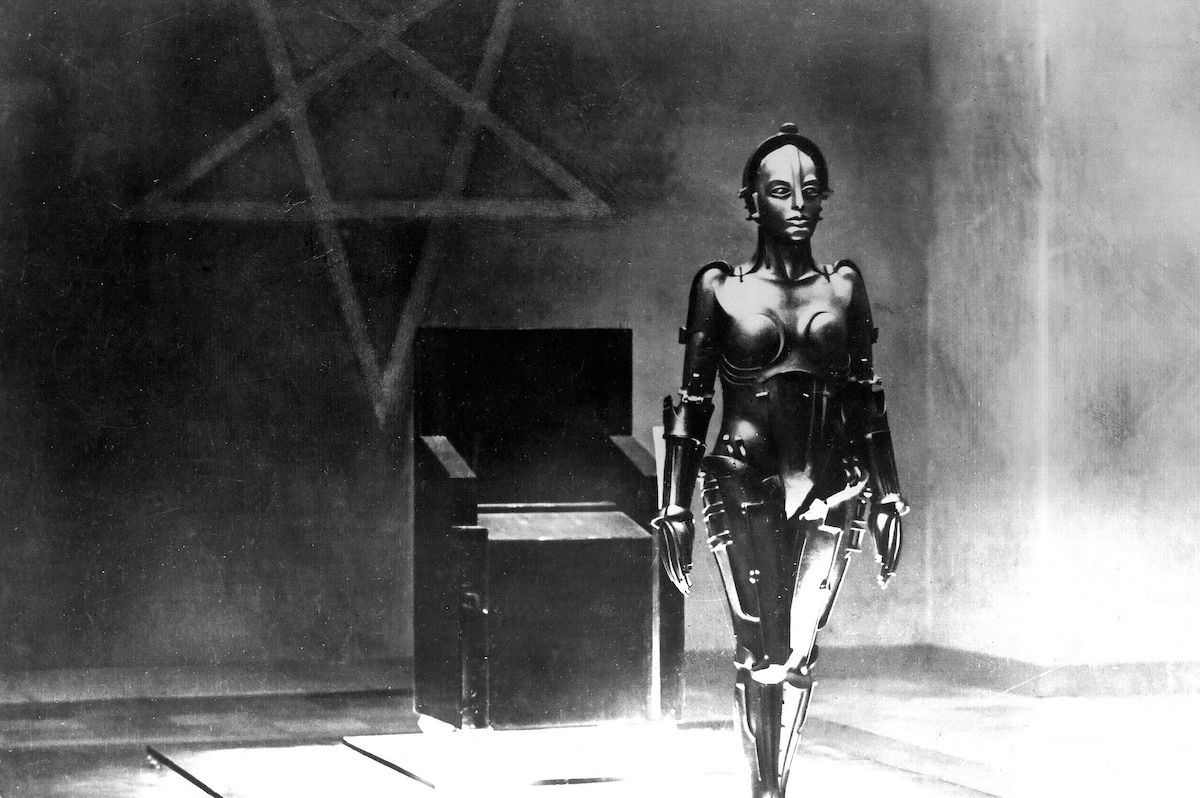
Metropolis, the great city of the future, is divided into two worlds, the high-rise towers in which live the wealthy and the subterranean depths that house the workers. When Maria brings a group of workers' children into the upper areas, Freder, son of the wealthy industrialist Joh Fredersen, falls in love with her. Before long, he's followed her into the depths of the city to try to understand the plight of the workers. At the same time, Maria's glimpse of the life of the privileged has inspired her to preach equality to her fellow workers. To prevent a revolution, Fredersen gets the eccentric scientist Rotwang to capture Maria and create an evil robot duplicate of her so he can use the workers' movement to his own ends.
SYNOPSIS
CAST AND CREW
Director: Fritz Lang
Producer: Erich Pommer
Screenplay: Thea von Harbou
Cinematography: Karl Freund, Gunther Rittau, Walter Ruttmann
Score: Gottfried Huppertz
Art Direction: Otto Hunte, Erich Kettelhut, Karl Vollbrecht
Cast: Alfred Abel (Joh Fredersen), Gustav Frohlich (Freder), Rudolf Klein-Rogge (C.A. Rotwang), Fritz Rasp (The Thin Man), Theodor Loos (Josaphat), Brigitte Helm (The Creative Man/The Machine Man/Death/The Seven Deadly Sins/Maria)
BW -153 m.
Why METROPOLIS Is Essential
Metropolis is the first feature-length science-fiction film and an epic that would set the style and themes for the genre for decades to come. No film before had created such a complete vision of a future world. It created the iconic image for cities of the future that would be reflected in such films as Just Imagine (1930), Alphaville (1965), Blade Runner (1982), The Fifth Element (1997), Dark City (1998), and Land of the Dead (2005), among many others.
The design for Rotwang's lab -- with its bubbling test tubes, arcing electrical currents and rings of light -- has influenced decades of science-fiction films as well, most notably The Bride of Frankenstein (1935).
Metropolis introduced to film the concept of the humanoid robot that would feature in The Creation of the Humanoids (1962), Blade Runner, A.I., Artificial Intelligence (2001) and numerous episodes of The Twilight Zone.
The film's mad scientist, Rotwang, is the prototype for many similar characters in films as varied as The Bride of Frankenstein, Dr. Strangelove or: How I Learned to Stop Worrying and Love the Bomb (1964), Goldfinger (1964) and Dr. Horrible's Sing-Along Blog (2008).
Thematically, Metropolis was a major work in the development of one of science fiction's most powerful themes -- that science without a conscience could become a great source of evil. The theme runs through any number of genre films and was one of the key elements of the series The X-Files.
The international success of Metropolis helped spread expressionism to global filmmakers. Unlike earlier expressionistic films like The Cabinet of Dr. Caligari (1920), however, which take us within the characters' nightmares, Metropolis uses the style's harsh angles, severe lighting and symbolic spectacle to create a physical world that is itself a nightmare. As such, it had a major influence on the use of expressionism in more commercial movies, particularly those in the United States.
The glittering skyscrapers of Metropolis helped popularize Art Deco.
By Frank Miller
The Essentials-Metropolis
by Frank Miller | March 05, 2014
SIGN UP FOR OUR NEWSLETTERS

CONNECT WITH TCM