Production began on Bus Stop on March 3, 1956, with filming in Phoenix, Arizona. Other locations would include Sun Valley and other spots in Idaho, with interiors shot at the 20th Century Fox studios in Los Angeles.
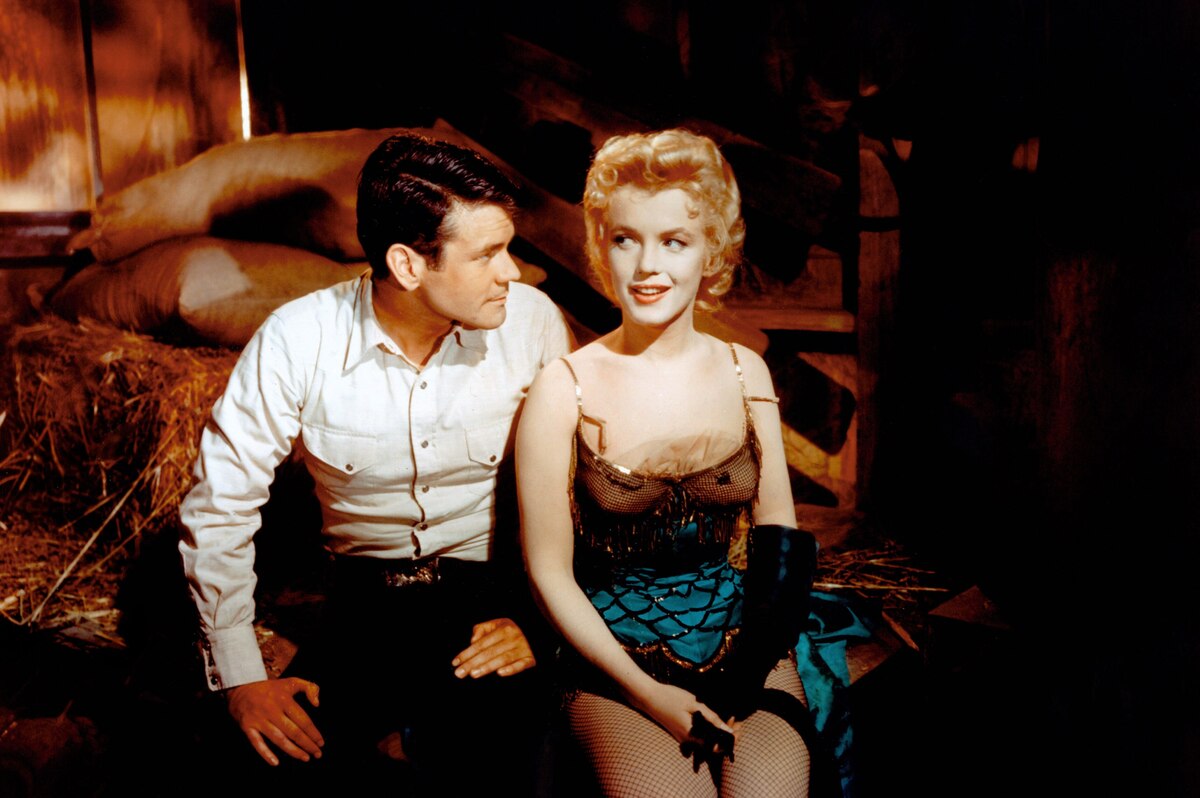
Monroe felt that Cherie, although she is a very sexual character, should have a slightly shabby look as a pale and cheaply costumed saloon singer. Working with Milton Greene, director Joshua Logan and her makeup artist, Allan Snyder, she opted for an almost-white facial and body makeup that made Cherie look washed-out and faintly unhealthy, as if she slept all day and avoided the sun. Hairstylist Helen Turpin changed Monroe's platinum-blonde hair to a subdued honey-blonde that offered more contrast to the white skin. Studio executives thought Marilyn should always be "honey-colored" all over, but she and Logan stuck to their guns. In subsequent films she would continue to favor a lighter, more luminous makeup even when her hair was once again platinum.
Monroe rejected most of the original costume designs by Travilla and rifled through the studio costume department to find things she thought suited the character. The black-lace blouse that she wears in the early scenes was originally worn by Susan Hayward in With a Song in My Heart (1952). Logan recalled how Monroe accepted the studio-designed outfit for her musical number, "That Old Black Magic," but then exclaimed to him, "You and I are going to shred it up, pull out part of the fringe, poke holes in the fishnet stockings, then have 'em darned with big, sprawling darns. Oh, it's gonna be so sorry and pitiful it'll make you cry!"
Monroe, who had seen and loved Kim Stanley's performance in the Broadway production of Bus Stop, patterned her accent on Stanley's and on those she had heard during her own time in the South. She worked diligently on the "hillbilly" twang, speaking quite differently than in other films, and subverted her natural singing talent to make it painfully clear that Cherie was not gifted in that department.
Despite her dedication and determination, however, Monroe remained hampered by her insecurities once the camera started rolling. Some of this she was able to channel creatively into the character's own confusion and uncertainty; at other times she had great difficulty in simply getting through a scene and remembering the lines. Screenwriter George Axelrod, although very fond of Monroe, was quite blunt about her problems in an interview with Pat McGilligan: "Poor Marilyn... She was a sad, sad, sad creature. She was sick. In a rightly ordered world, she would have been in a nuthouse. She was psychotic. Once you got to know her, one couldn't feel sexy about her. She was pathetic, sad. You just wanted to comfort her, cuddle her, father her, say, 'It's going to be all right, child.'"
When going up in her lines, Axelrod said, Monroe wouldn't improvise her way around them but would become emotional and leave the set. "She had reached a point in her neurosis where if anybody said, 'Cut!' she took it as an affront, burst into tears and ran to her dressing room. So director Joshua Logan stopped using the word and simply let the cameras run while he talked her back into the scene, with dialogue director Joe Curtis feeding Monroe her lines. "He was a huge man, Josh," Axelrod recalled, "so most of the time the screen was filled with Josh's behind and Marilyn's face, with this voice coming from the sky reading the lines that Marilyn would parrot."
Special problems were created in a scene on the bus, with Cherie pouring her heart out to Hope Lange's Elma as rear projection creates the illusion of a moving landscape. It took four days to shoot this scene, but Axelrod said it "cut together like a dream," partly because Lange behaved so professionally and was always prepared for a reaction shot that could cover Monroe's lapses. "Little pieces of what Marilyn would do were inspired, magical, but interspersed with tears and "Oh, ----!" and "What the ----!" and getting her back together - all of it with the camera running because you couldn't say cut. God, the goings-on!" Logan recalled, however, how brilliant Monroe was in the sequence, so involved with the emotions of her character that her skin visibly flushed and she shed real tears. As it turned out, much of this sequence was cut from the final film, deleting what Monroe felt were some of her best acting moments. She never quite forgave Logan or the studio for the cuts.
Don Murray also later remembered the difficulties of filming with Marilyn, who was essentially his boss on the movie. Paula Strasberg, Lee's wife, had replaced Natasha Lytess as Monroe's on-the-spot acting coach, and Murray recalled to Ezra Goodman that, while Strasberg was "polite," she constantly "huddled" with Marilyn and paid no attention to anyone else. Murray said that, because of Monroe's problems with lines, every scene with her was "difficult... On some scenes there would be 30 takes. The average film scene requires about five takes. If Marilyn was having trouble getting through a particular scene, and finally got it, they would print it. It did not matter how the other actors did. I had a feeling of relaxation doing the scenes she wasn't in... She was detached, into herself. On the set, she appeared frightened, worried. Just thinking about what she had to do. There was not much interchange."
There were, however, some lighter moments on the set when Monroe would tickle Murray with her unique perspective of matters. In another interview he recalled a scene in which director Logan wanted a "two-head close-up" shot, one of the first in the CinemaScope process being used for the film. Because of the width of the image, the top of Murray's head was out of the frame. "The audience won't miss the top of your head, Don," Marilyn explained. "They know it's there because it's already been established." Another laugh came when Murray mistakenly used the word "scaly" in a scene and Monroe told him it had been "a Freudian slip" because the scene had a sexual connotation. "You see," she continued, "you were thinking unconsciously of a snake. That's why you said 'scaly.' And a snake is a phallic symbol. Do you know what a phallic symbol is, Don?" Murray's reply: "Know what it is? Hell, I've got one!"
Overall, however, Murray's quoted reaction to Monroe was not one of amusement: "Like children, she thought the world revolved around her and her thoughts. She was oblivious to the needs of people near her, and her thoughtlessness, such as being late frequently, [was] the bad side of it." Once filming was over, the two never saw each other again nor had any other contact. As it developed, the warm and friendly Eileen Heckart was the only other actor in the film with whom Monroe appeared to have developed a close rapport off-camera.
Murray's view seems to have mellowed with time. At a tribute to Monroe in August 2012, he quoted Marilyn's famous line, "I don't care about being famous; I just want to be wonderful." He then called her "the most incandescently unforgettable star in the history of the movies. And if you see her as the talent-challenged singer in Bus Stop, you'll see that, while movie lovers like you have made her famous, she has achieved her greatest ambition and made herself wonderful."
Monroe's badly needed champion on the film was her director. Logan, who had studied with Stanislavsky in Russia, understood the needs of actors using "the Method" and had come to adore Marilyn's talent and to respect her native intelligence. "She made directing worthwhile," he said later. "She had such fascinating things happen to her face and skin and hair and body as she read lines, that she was... inspiring." Logan involved his star in script discussions and supported her efforts to "find" Cherie through experiments with makeup, costuming, hairstyles and - above all - intense identification with her character. By allowing the cameras to continue rolling, he gave Monroe every opportunity to find continuity in her role, and listened carefully when she made suggestions about her blocking and camera angles on this, her 24th film. As a friend of the Strasbergs who had directed their daughter, Susan, in Picnic, he was tolerant of Paula's presence and constant influence on Monroe's performance. He did, however, insist that she not be on the sets during actual rehearsals or filming.
Since Logan also was a hypersensitive soul bothered by insomnia and exhaustion, he was sympathetic to Marilyn's personal problems and creative struggles. In later years he described her as a great actress, a combination of Greta Garbo and Charlie Chaplin. "She was the most constantly exciting actress I ever worked with, and that excitement was not related to her celebrity but to her humanness, to the way she saw life around her." In a 1983 interview with Logan, this writer complimented him on his handling of William Inge's Picnic. "Oh, but didn't you like Bus Stop better?" he asked. "I did, because it had - Marilyn!"
By Roger Fristoe
Behind the Camera-Bus Stop
by Roger Fristoe | March 04, 2014
SIGN UP FOR OUR NEWSLETTERS

CONNECT WITH TCM