Bus Stop (1956) began as a Broadway play by William Inge, widely considered one of America's major playwrights and a dramatic poet of the Midwest in somewhat the same way that Tennessee Williams represented the Deep South. Inge, a native of Independence, Kansas, had a string of well-received plays in the 1950s that also included Come Back, Little Sheba, Picnic (for which he won the Pulitzer Prize) and Dark at the Top of the Stairs. Bus Stop was said to have been inspired by people observed by Inge during a visit to the Almeda Hotel in Tonganoxie, Kansas, which also included a diner and a bus stop. The play, directed by Harold Clurman, opened on Broadway on March 2, 1955, running for more than a year while racking up 478 performances. Kim Stanley starred as Cherie, with Albert Salmi as Bo and Tony nominee Elaine Stritch as Grace. The production also was Tony-nominated for Best Play, Director and Scenic Design.
Marilyn Monroe, at the height of her stardom at 20th Century Fox after her huge successes in the musical Gentlemen Prefer Blondes (1953) and the comedy The Seven Year Itch (1955), had resented some of the thankless vehicles Fox had selected for her, notably River of No Return and There's No Business Like Show Business (both 1954). Weary of her Hollywood image as none-too-bright sex symbol, she fled to New York, where she studied acting with Lee Strasberg of the famed Actors Studio.
Before returning to Hollywood Monroe was able to renegotiate her contract with Fox, signing a deal that allowed approval of story material, director and cinematographer on her films. This agreement gave her unprecedented creative control and set a new standard for film stars. In tacit recognition of her position as the studio's top box-office draw, Fox also raised her salary to $100,000 per film and agreed that she could appear in films with independent producers and other studios. Monroe signed her fourth and final contract with the studio on December 31, 1955. In the meantime she had formed Marilyn Monroe Productions in association with photographer Milton Greene; she was to star in films produced by the company and he was to attend to all related business matters. The first film the company produced for Fox was Bus Stop, which Greene had purchased expressly for Monroe.
Monroe returned to Hollywood in February 1956 to begin preparing for the film. At a press conference announcing the project, she seemed newly serious in an uncharacteristic dark suit with a high collar. Asked if her attire was part of an effort to present "a new Marilyn," she pertly replied, "Well, I'm the same person. It's just a new suit." Announced as director was Joshua Logan, then primarily known for his work on the stage with such hits as Mister Roberts and South Pacific, although he had made an Oscar®-nominated debut as a film director with Inge's Picnic (1955). Logan wrote in his memoirs that his initial reaction to the casting idea was "Oh, no - Marilyn Monroe can't bring off Bus Stop. She can't act." After working with his star, however, he had a complete change of heart and claimed that he "could gargle with salt and vinegar" over his words because "I found her to be one of the greatest talents of all time."
Inge's play was adapted for the screen by George Axelrod, a specialist in edgy comedy who would later win acclaim for his screenplays for Breakfast at Tiffany's (1961) and The Manchurian Candidate (1962). Axelrod had become a friend of Monroe while adapting his play The Seven Year Itch as a movie vehicle for her. He commented later that he saw a tragic element in both Marilyn and her Bus Stop character, and that he tried to bring shadings of pathos as he rewrote the role with her in mind. In his screenplay Axelrod both expanded and streamlined Inge's play, which had been set entirely in the bus stop diner. Axelrod included scenes at the Blue Dragon saloon and the rodeo, as well as on the streets of Phoenix and aboard the bus itself. To keep the focus more on Cherie and Bo, Axelrod eliminated one of the play's major characters - an aging, alcoholic college professor with a weakness for young girls.
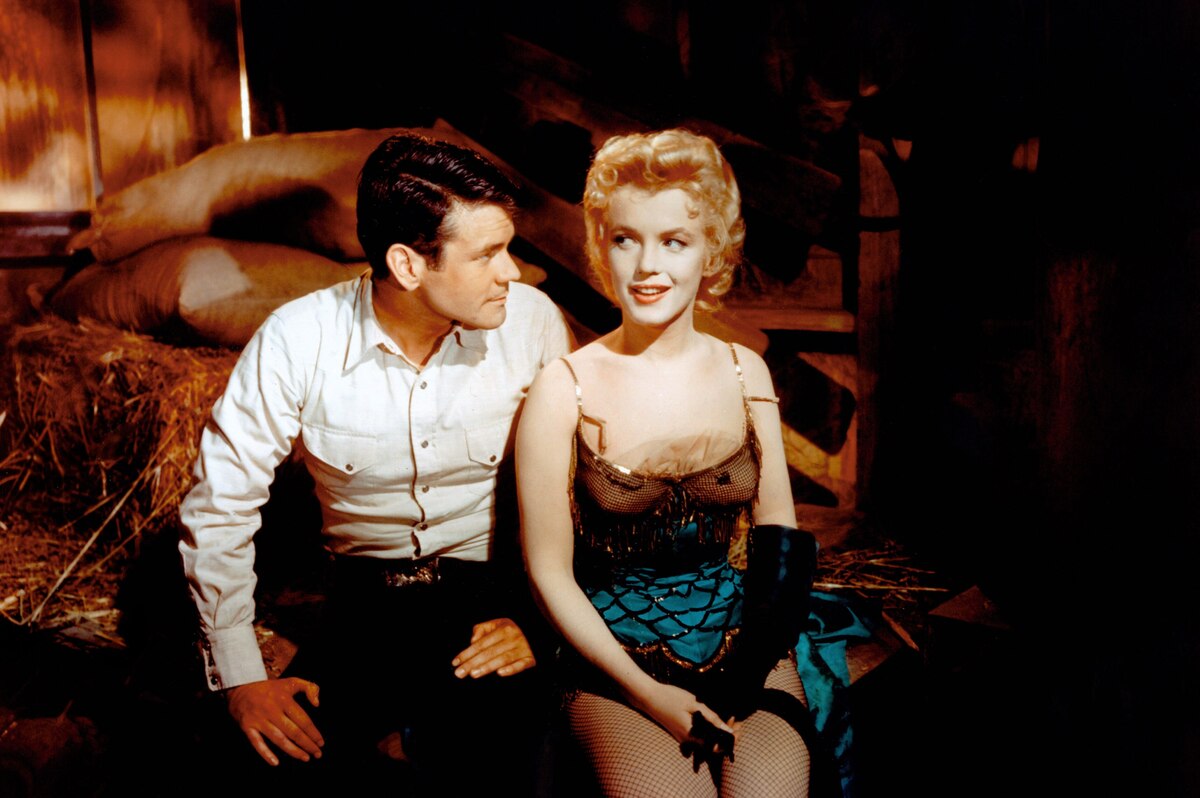
Don Murray, in his film debut at age 26, was cast as Monroe's love interest after Logan saw the then-unknown young actor performing in Thornton Wilder's The Skin of Our Teeth on Broadway. Hope Lange, then dating and later to marry Murray, also made her film debut in Bus Stop. For other key supporting roles Logan turned to two members of his cast for the film of Picnic, Arthur O'Connell and Betty Field. A new character, Cherie's confidante Vera, was invented by Axelrod for the early scenes, and the outstanding character actress Eileen Heckart was assigned the part.
From all reports, Monroe felt that this would be her most important role and provide a real stretch for her as an actress. She was eager to draw upon what she had absorbed from her studies of Method acting in playing her lonely and confused character, and to prove to her studio that they had made a good decision in giving her the artistic freedom to choose her own vehicles and colleagues.
By Roger Fristoe
The Big Idea-Bus Stop
by Roger Fristoe | March 04, 2014
SIGN UP FOR OUR NEWSLETTERS

CONNECT WITH TCM