SYNOPSIS
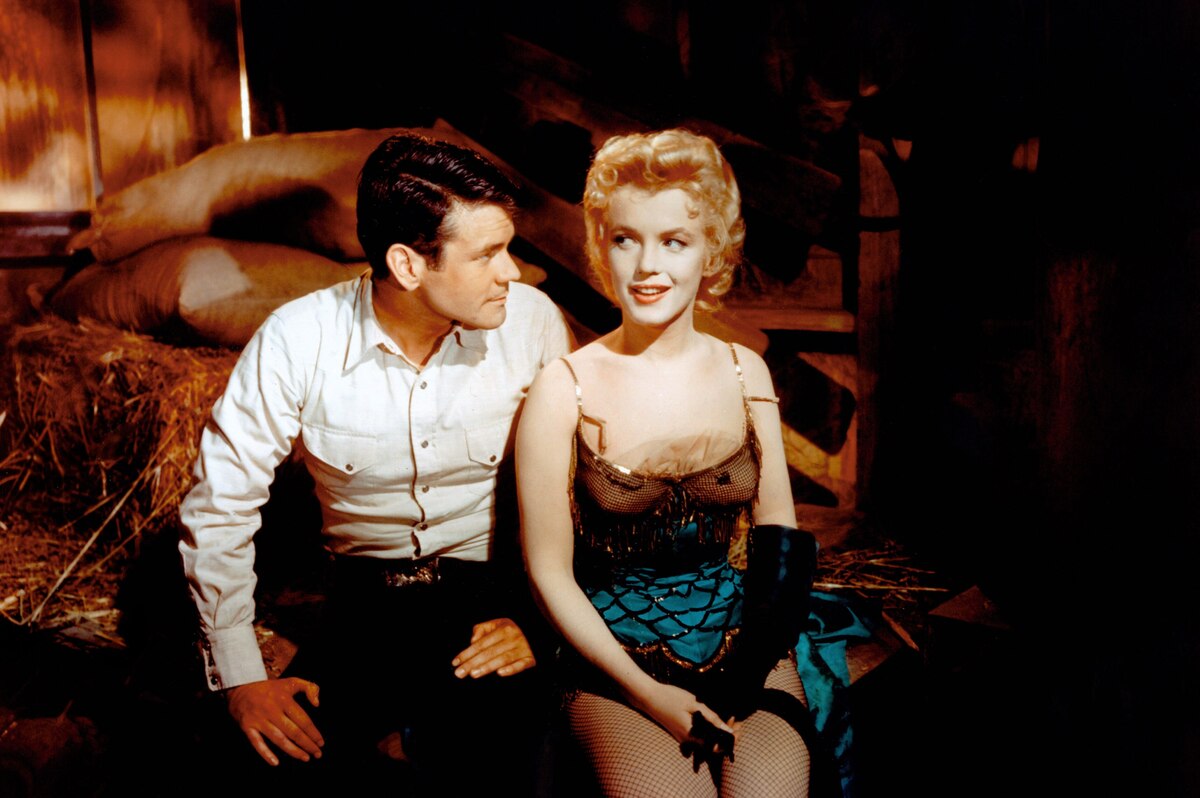
Cherie (Marilyn Monroe), a sexy but no-talent "chanteuse" from the Ozarks who performs in a tacky Phoenix nightclub called the Blue Dragon, captivates the hunky but rambunctious young cowboy Beauregard "Bo" Decker (Don Murray), who is in town for a rodeo. Cherie has dreams of heading to Hollywood and film stardom, but Bo forces her to board a bus with him and his father-figure buddy, Virgil Blessing (Arthur O'Connell), as they head home to Montana. Along the way, a snowstorm stalls the bus at a lonely roadside café where Bo continues his rowdy and unwanted wooing of Cherie; he considers her his "angel" and wants to marry her. Cherie is physically attracted to Bo but repulsed by his bad behavior until, with Virgil's coaching, he begins to treat her with more tenderness and respect. Other characters interacting during the enforced layover include down-to-earth proprietor Grace (Betty Field), her bus driver lover Carl (Robert Bray) and impressionable young waitress Elma (Hope Lange).
Director: Joshua Logan
Producer: Buddy Adler
Screenplay: George Axelrod, from the play by William Inge
Cinematography: Milton Krasner
Editing: William Reynolds
Art Direction: Mark-Lee Kirk, Lyle R. Wheeler
Original Music: Alfred Newman, Cyril J. Mockridge
Costume Design: Travilla
Cast: Marilyn Monroe (Cherie), Don Murray (Beauregard "Bo" Decker), Arthur O'Connell (Virgil Blessing), Grace (Betty Field), Eileen Heckart (Vera), Robert Bray (Carl), Hope Lange (Elma Duckworth), Hans Conried (Life Magazine Photographer), Max Showalter (Life Magazine Reporter, billed as Casey Adams)
Why BUS STOP Is Essential
The movie version of Bus Stop is an adaptation of an important Broadway play by William Inge, considered by most theater historians to be among America's top playwrights. The film marked the second Inge drama to be directed by Joshua Logan, following Picnic and further establishing the reputation of this former theater director as an important filmmaker. He would go on to create such films as Sayonara (1957), South Pacific (1958) and Camelot (1967). With Bus Stop Logan and cinematographer Milton Krasner offered a lesson in the imaginative use of the often-cumbersome CinemaScope process, utilizing a subdued color palette along with a mixture of panoramic landscapes and strikingly composed close-ups. The movie launched the careers of Don Murray and Hope Lange, who continued to be prominent in the realm of film and television for several decades, and showcases the work of such fine character actors as Arthur O'Connell, Betty Field and Eileen Heckart.
Most importantly, Bus Stop marked what is generally considered to be the outstanding performance of a true American icon: Marilyn Monroe. Marilyn had already proven herself as a sensational screen presence and delightful comedienne but, as Logan wrote, her studies at the Actors Studio "had opened a part of her head, given her confidence in herself, in her brainpower, in her ability to think out and create a character." It was an audacious move for Marilyn to dare and follow the highly regarded stage performance of a theater luminary such as Kim Stanley, in a role that required her to present herself as a bedraggled, no-talent wannabe whose dreams would always be bigger than anything she could actually achieve.
Monroe's gamble paid off in spades. Whatever difficulties in achieving it, her performance shines like a beacon through a film that otherwise may seem a bit dated for modern audiences. Her needy character would certainly have benefited from a healthy dose of modern feminism, but Marilyn fully realizes and inhabits the lonely, confused and desperate Cherie without losing her own natural radiance and sex appeal. Her deliberately bad rendition of "That Old Black Magic" manages to be both awful and artful - at once pitiful, funny and erotic. Some critics felt that Monroe surpassed Stanley's highly lauded turn on Broadway.
It's simply a great performance, one that grows more impressive with repeated viewings. There was no justice in the fact that, while Murray was Oscar®-nominated for his one-dimensional, at times almost cartoon-like portrayal, Monroe was not. This was a great disappointment to many including director Logan and Monroe herself. Logan, always an ardent supporter and defender of Monroe's talent, gets the last word: "Marilyn is as near a genius as any actress I ever knew. She is an artist beyond artistry. She is the most completely realized and authentic film actress since Garbo. She has the same unfathomable mysteriousness. She is pure cinema."
By Roger Fristoe
The Essentials-Bus Stop
by Roger Fristoe | March 04, 2014
SIGN UP FOR OUR NEWSLETTERS

CONNECT WITH TCM