Who's Afraid of Virginia Woolf? began as an explosive stage play written by Edward Albee. A big hit on Broadway when it opened in 1962 starring Uta Hagen, Arthur Hill, George Grizzard and Melinda Dillon, it went on to win five Tony Awards including Best Play.
Even though Virginia Woolf had been a highly praised award-winning success on Broadway, it was considered a highly unlikely prospect for a movie adaptation due to its raw subject matter and coarse language. The general feeling was that the play would have to be toned down and sanitized in order for Hollywood to come near it, especially with the Production Code still in place. The Code had been established in the 1930s as a way for Hollywood to create guidelines to determine what content was and wasn't acceptable for motion pictures. It was a way for the industry to self-regulate films without government interference. By the 1960s, however, modern attitudes were changing, and the Code was considered to be antiquated and in desperate need of updating. There was also a pervasive feeling that it was time for Hollywood to start taking more risks.
The one studio head who was brave enough to take on the challenge of turning Virginia Woolf into a movie was Jack Warner of Warner Bros.
When Warner approached Edward Albee about buying the rights to his play, he told him initially that he was buying it for actors Bette Davis and James Mason. That was a star pairing that Albee found exciting, and he agreed to let Warner Bros. make the movie.
Jack Warner brought in Ernest Lehman to act as both producer and screenwriter on the project. Lehman was well-established as a screenwriter in Hollywood, having written or co-written some of Hollywood's best films including Sabrina (1954), Sweet Smell of Success (1957), North by Northwest (1959) and West Side Story (1961). However, Lehman had never produced a film before. A producer/screenwriter was a rare hybrid in Hollywood, but Lehman looked forward to the opportunity to prove himself with the material that many others were too nervous to touch.
Lehman surprised Jack Warner when he announced that he wanted none other than Elizabeth Taylor to play the frumpy, vulgar middle-aged harridan Martha. It was a broad stretch of the imagination for anyone to picture her in the role. Taylor at the time was just 32 years old and considered one of the most - if not the most - beautiful, glamorous and admired women in the world. In addition, even though she had recently won the Best Actress Academy Award for her performance in Butterfield 8 (1960), she was still considered more of a movie star than a serious actress. Lehman had to sell the dubious Jack Warner on the idea, and he eventually came to agree that there was great box office potential in casting Taylor.
The next person that Lehman had to persuade that Elizabeth Taylor was the right choice for the film was Elizabeth Taylor herself. Taylor was at the height of her fame at the time and had been a frequent tabloid target, especially in the wake of her highly publicized affair with Cleopatra (1963) co-star Richard Burton while both stars were still married to other people. When they finally tied the knot in 1964, Taylor and Burton became the most famous movie star couple in the world.
Ernest Lehman sent Albee's play to Taylor to read while she and Burton were working on their third film together, The Sandpiper (1965). Both stars were very impressed with the drama, though Taylor, like everyone else, was surprised that Lehman would think of her for the movie. She admired the part of Martha, but wasn't sure she had the chops to play such a demanding role.
Richard Burton, however, believed she could do it and encouraged her to take on the challenge. According to Mel Gussow's 1999 book Edward Albee: A Singular Journey Burton told her, "...you've got to play it to stop everybody else from playing it."
Taylor and Burton met with Lehman to discuss her making the movie. "Every actress wanted to play the role," said Lehman at the time. "I was an open target for every agent. I had to barricade myself. Why do I think Elizabeth would be right? I sensed certain wavelengths in her personality akin to Martha. I don't mean she is a shrew or tears husbands to bits, but I think she has a deeply feminine vulnerability...People know how Uta Hagen played it. They certainly know how Bette Davis would do it, but they wonder how Elizabeth Taylor will do it."
In another interview Lehman explained, "I felt that of all the actresses I knew, no one in her public life and her public behavior was closer to Martha than Elizabeth Taylor, the actress, not the private woman...So I started getting very, very excited about the idea, which I kept a deep, dark secret, because everyone in town was playing the game of casting this picture."
After she agreed to make the film, Elizabeth Taylor told the press, "All my friends say I'm a fool to play the role. The more they tell me that, the more excited I am to play it."
For the role of George, Ernest Lehman had considered Arthur Hill from the Broadway production and even Henry Fonda for a time. However, according to Edward Albee, Fonda's agent never even made him aware of the interest.
It was Elizabeth Taylor who suggesting using Richard Burton to play George. Burton was considered one of the greatest living actors, but he, like his wife, did not seem like the obvious choice. He was known for playing strong, powerful, often heroic characters. However, he was intrigued with the challenge of portraying such a complex character so different from his usual roles. He agreed to sign on to the film without much coercion.
Having the famous Burtons co-star in a high-profile studio film didn't come cheap. However, Warner Bros. hoped that their combined star power would cause a sensation at the box office and send audiences swarming to see Who's Afraid of Virginia Woolf?. It would be the couple's fourth film together.
Playwright Edward Albee was disappointed with the casting of Taylor and Burton and still pulling for his ideal leads, Bette Davis and James Mason. "Elizabeth was twenty years too young for the role," he said in a 2006 interview, "and Richard was about five years too old." However, Albee did understand that casting the Burtons was part of the Warner Bros. business strategy to drum up interest at the box office.
Albee's opinion on the casting mattered little as he had no power over any of the film's production. By his own account, he had only a few brief conversations with key people involved with the film, never visited the set and never even met Taylor and Burton until after the production had wrapped.
Lehman seriously considered both John Frankenheimer (The Manchurian Candidate [1962]) and Fred Zinnemann (From Here to Eternity [1953]) to direct Virginia Woolf. Both were experienced film directors. However, Taylor and Burton had someone else in mind to direct--Mike Nichols. Nichols, however, had never directed a film before in his life at the time. Nichols had, however, built up an impressive list of credits as a theater director after getting his start in show business as an actor and comedian. Then in his early 30s and already a Tony-award-winner for directing the hit Broadway plays Barefoot in the Park (1964), The Odd Couple (1965) and Luv (1965), Nichols understood stage drama and had the confidence to tackle the tricky task of bringing a controversial play like Virginia Woolf to the big screen.
Taylor and Burton already had a social relationship with Nichols. Burton and Nichols had struck up a close friendship before Elizabeth Taylor entered the picture while they were both performing on Broadway in 1961 - Burton in Camelot and Nichols in An Evening with Nichols and May. When Burton got together with Elizabeth Taylor, the couple was impressed not only with Nichols' vast creative talents, but also his loyalty as a friend. When the couple became the number one tabloid target due to their romance, Nichols stood by them when many other friends distanced themselves. It was something that the Burtons would always appreciate.
"Elizabeth and I both suggested we get a fresh, young director," said Richard Burton, "because it's a young play, though it's about middle-aged people. Elizabeth suggested Mike and everybody was horrified. 'His first film,' they said. But we were in a pretty good position, because we had a veto on the director." Until Nichols was put at the helm, recounted Burton, "I was still convinced that I was too strong for the part and Elizabeth thought she was too young and not powerful enough for the searing dialogue."
Nichols was thrilled with the opportunity to direct his first film. He had been "knocked out" by the play and felt an instant connection to the material when he saw it performed on Broadway. "I thought it was the most exciting play and production that I'd seen with the exception of A Streetcar Named Desire," said Nichols. "I always thought it was Shakespearean in that the two main characters compete in recruiting the audience to their side, in a manner not dissimilar to Taming of the Shrew...I couldn't turn my back on this piece of material. To turn it down out of fear would be cowardice." He knew that directing a film would be different from theater, but he still wanted to meet that challenge head-on. "I just thought, 'I know what to do with this,'" said Nichols. "'I just hope I don't mess up with the camera.'"
Nichols first offered the supporting role of Nick to Robert Redford, whom Nichols had directed in the hit Neil Simon play Barefoot in the Park on Broadway. Redford, however, turned the part down. He felt the character was too weak and didn't like the idea of playing someone who is humiliated throughout much of the drama.
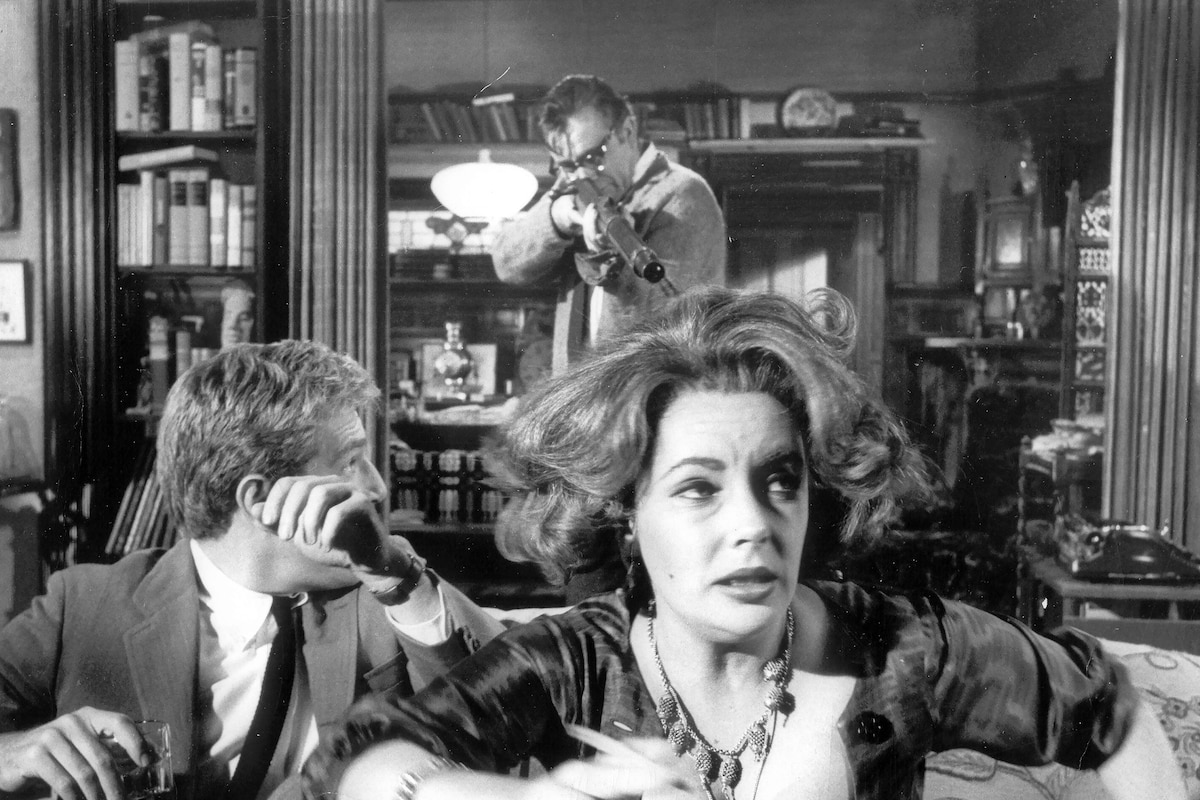
Nichols subsequently hired actor George Segal for the part. Segal had worked with Nichols in the hit Off-Broadway play The Knack, and both agreed that he would be able to bring something special to the role of Nick.
For the role of Nick's wife Honey, Nichols hired Sandy Dennis, a talented stage actress and two-time Tony award winner for her work in A Thousand Clowns and Any Wednesday.
Producer/writer Ernest Lehman worked to open up Albee's intentionally claustrophobic play and liberate the action in the screenplay a bit from George and Martha's living room. He added some exterior scenes as well as scenes set at a roadhouse that didn't exist in the play. At one point Lehman also tried to change George and Martha's imaginary child - a significant element in the story - into a real son who had committed suicide on his 18th birthday. However, this idea was quickly nixed since Nichols and others complained that it would change the entire essence of the drama.
In the end, Lehman's final screenplay adaptation remained very close to Albee's original words. "I was lucky because [Lehman] didn't screw up my text," Albee later said. "It was still pretty much there. There were cuts, but the film basically represented the play fairly."
Nichols made the decision early on to shoot the film in black and white. On one hand, it was an artistic choice that would help dramatize the story's dark, moody quality. In addition, it was also a choice made for the more practical reason that Elizabeth Taylor's middle-aged makeup looked far more believable in black and white than in color.
Nichols met with resistance from the studio over the choice to shoot in black and white, and it was a subject of much debate among the higher ups at the studio. Some executives thought that the film would lose commercial appeal if it was in black and white. However, Nichols fought hard for the issue and even threatened to walk off the film over it. Finally, Warner Bros. agreed to Nichols' wishes, knowing that if he left the project, he would most likely take Richard Burton and Elizabeth Taylor with him.
Meanwhile, Nichols prepared to direct his first film by watching scores of other films that he admired. He especially focused on works by European filmmakers such as Federico Fellini's 8 ½ (1963) since they had the visual look he wanted to emulate with Virginia Woolf.
Nichols originally hired experienced Oscar®-winning cinematographer Harry Stradling to be the Director of Photography on the film. To prepare, Nichols had him watch some of the European films that he admired to get an idea of how he wanted Virginia Woolf to look. Nichols told him that it would be his job to figure out how to achieve this particular visual style. When Stradling suggested that they shoot the film in color and print it in black and white, Nichols fired him.
Nichols then hired cinematographer Haskell Wexler to replace him. While Wexler's experience was mainly on smaller films and documentaries, he was very comfortable working with black and white and believed that he would be able to capture the specific look that Nichols wanted on film.
To serve as editor on Virginia Woolf, Nichols chose Sam O'Steen who had previously worked on the Frank Sinatra films Robin and the 7 Hoods (1964) and None But the Brave (1965). According to O'Steen, Nichols would have preferred to have someone else from the outside cutting the film, but he was obligated to use a Warner Bros. editor. "The reason he picked me," O'Steen explained in the 2001 book Cut to the Chase, "was that most of the Warner editors were 65, 70 [years old], and I was the youngest. But he was still dead set against me."
Nichols softened to O'Steen once he actually had a chance to talk with him about the film. Nichols wanted to use a lot of overlapping dialogue in Virginia Woolf, which was considered "against the rules" of movie making at the time, and most editors were uncomfortable with the idea. However, O'Steen was not. "Editors would always say you can't overlap lines when you're in a two-shot because it doesn't cut," he said. "Baloney. Most editors would butt the lines together as close as possible or they would loop both actors and then put their lines on separate tracks whenever they mixed it. But in either case it's not the same, it's not really overlapping...Mike, coming from the stage, knew the value of it. There's a reality to it, because in life we overlap constantly."
For the woman considered by many at the time to be the world's most beautiful movie star, Elizabeth Taylor was remarkably comfortable with shedding her glamorous image for the role. She purposely put on 20+ pounds and was relieved to not have the pressure of maintaining her legendary looks for the camera. "We shot makeup tests 'til they were coming out of our ears," said Sam O'Steen. "First they put lines every place, and she looked old enough, but you saw the pencil lines. Mike sweated that out quite a bit, but in the end they didn't put much make-up on her. She did gain weight for the part, and had a double chin, which helped...She was really into it. She even picked this one blouse that bunched up so her stomach would show. And she would make sure she smeared her lipstick so it would match the previous shot...She really didn't care about how bad she looked, she was a pro."
Before cameras rolled on Virginia Woolf, Mike Nichols held three weeks of intense rehearsals. It was sound training from his theater background that helped establish confidence among the cast and crew as the production moved forward.
With a young first-time film director at the helm of a black and white production with two of the world's biggest stars whom many thought were miscast in a drama that many believed to be too controversial to film, Who's Afraid of Virginia Woolf? was a high risk proposition for Warner Bros. The stakes were high for everyone involved. However, Mike Nichols believed strongly that he had all the ingredients to make a wonderful film, and the studio supported his vision. It was one of the most anticipated films of the 1960s.
by Andrea Passafiume
The Big Idea-Who's Afraid of Virginia Woolf?
by Andrea Passafiume | March 04, 2014
SIGN UP FOR OUR NEWSLETTERS

CONNECT WITH TCM