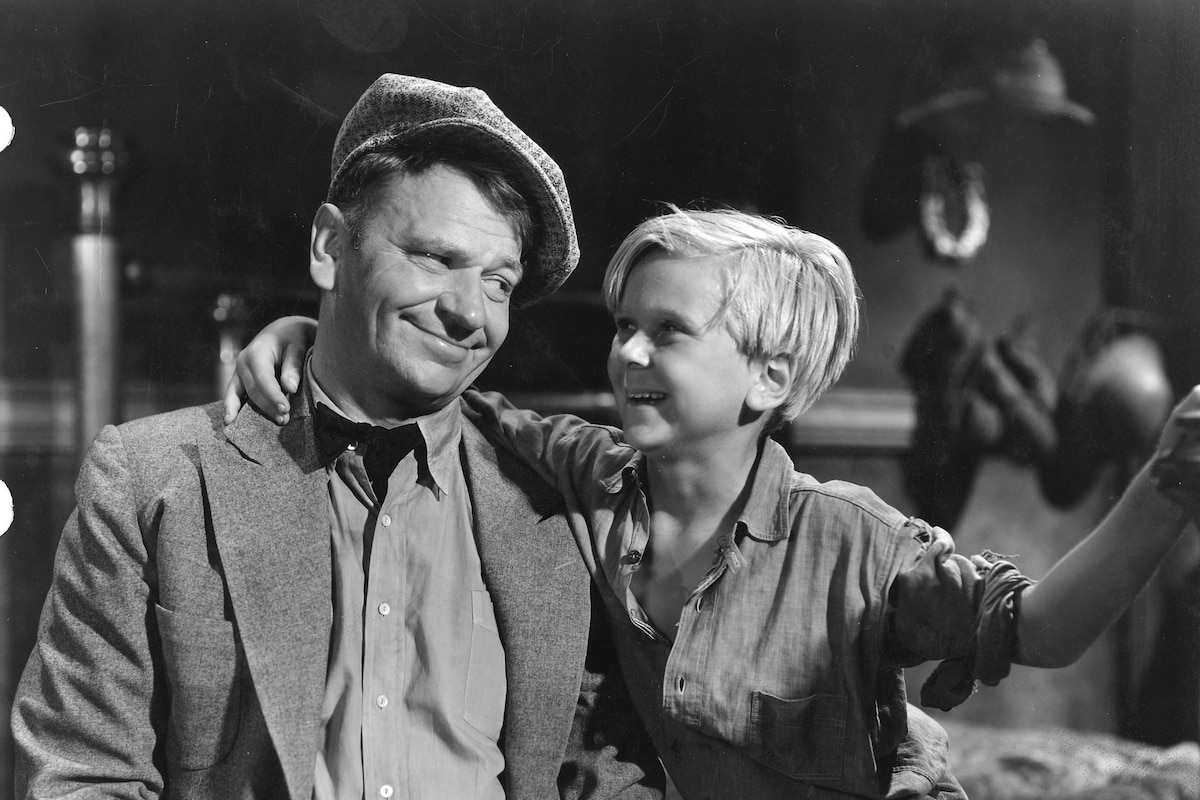
With The Champ in the can, MGM bought Jackie Cooper's contract from Paramount Pictures. He was the studio's first child star, to be followed by Freddie Bartholomew, Mickey Rooney, Judy Garland, Margaret O'Brien, and Dean Stockwell, among many others.
Six weeks after the film's premiere, Cooper put his foot and handprints in cement in front of Grauman's Chinese Theatre. Beery had already been commemorated there along with Marie Dressler in conjunction with the premiere of Min and Bill (1930).
The Champ's popularity made Beery one of MGM's biggest stars of the early '30s, leading to roles in such classics as Grand Hotel (1932), Dinner at Eight (1933) and Viva Villa! (1934).
After seeing how effortlessly Cooper stole scenes from him, Beery informed the press he would never work with the young actor again. Under the terms of his studio contract, however, he could not refuse assignments without going on suspension and forfeiting his salary. The two would reteam in 1933 for The Bowery and go on to make two other films together.<
The father-son relationship in The Champ inspired Yasujiro Ozu's classic Passing Fancy (1933), about a struggling widower whose son resents his father's interest in a young woman.
MGM reissued the film in 1938.
Beery reprised his role twice for the Lux Radio Theatre, first in 1939 and again in 1942.
MGM remade the film as The Clown in 1953, with Red Skelton as a faded comic raising his son (Tim Considine) by Jane Greer.
Stan and Jan Berenstain have credited the film as the inspiration for the relationship between Papa and Brother Bear in their best-selling series of books, The Berenstain Bears. The series debuted in 1962 with The Big Honey Hunt and has gone on to inspire 300 books along with numerous television shows, a stage show, a feature film and profitable toy lines.
In 1979, Franco Zeffirelli directed a big budget remake starring Jon Voight and Faye Dunaway, with Ricky Schroder making his film debut as their son.
By Frank Miller
Pop Culture 101-The Champ
by Frank Miller | March 04, 2014
SIGN UP FOR OUR NEWSLETTERS

CONNECT WITH TCM