In April 1966 director Michelangelo Antonioni assembled his cast and crew for Blow-Up in England to begin shooting. Even though the film was set in London, Antonioni was adamant that the story wasn't necessarily about London. "I was hoping," he explained, "that no one in seeing the finished film would say: Blow-Up is a typically British film. At the same time, I was hoping that no one would define it exclusively as an Italian film."
Blow-Up would be Antonioni's first film in English and his second in color. Antonioni brought along skilled cinematographer Carlo Di Palma as his Director of Photography to help him achieve the particular look he wanted for the film. Di Palma had also shot Antonioni's first color film Red Desert (1964), which had been highly praised for its stunning atmospheric landscapes and use of color.
Star David Hemmings was "nervous as hell, but disguising it" according to his 2004 autobiography Blow-Up and Other Exaggerations. To loosen things up, he decided to start the production with a bang. Literally.
"In those days, when the money involved in making a picture was a lot less than it is now," said Hemmings, "it wasn't an uncommon opening ritual to test the mettle of a director [on a new production] by winding him up a little. In this case, we thought it would be a good wheeze to blow up a beautiful Mulliner Park Ward convertible Rolls-Royce. In one of the earliest shots, my character, Thomas...drives the Rolls away from a dosshouse where he's spent the night, snapping the run-down inmates. Thinking fast and with most of the crew ready to help, we suspended a pair of large steel plates under the engine and loaded them with nuts and bolts and any other oily metal objects we could find that looked like bits of engine. We also wired in under the bonnet a small, harmless bomb that would explode with a loud bang and a dense cloud of smoke."
Having carefully planned the prank with the prop master who had a "wicked" sense of humor, Hemmings prepared for the first shot with the cameras rolling. "I drove the car round the corner into view and Props gave me the nod," he recalled. "I pulled a lever that had been rigged up for me under the dashboard and, instantly, a muffled explosion echoed off the walls of the drab brick buildings, immediately followed by a metallic clatter of detritus tumbling onto tarmac and a plume of blue-grey smoke spewing from under the bonnet of the vehicle. I snapped off the motor and came to a screeching halt."
"An ominous silence followed the bang and the last rattle of metal. In the mirror I saw what looked like an entire engine scattered along the street behind me. It was so convincing, I almost believed the car had blown up."
"Pierre Rouve, the producer, stood rigid at the roadside, as if paralyzed by cardiac arrest," Hemmings continued. "He had bought the car for the production from Jimmy Savile and I guess he was planning to keep it for himself afterwards. Now it looked like a write-off. The Maestro [Antonioni] himself barely winced. With a few tidy strides, he walked up to the sick-looking Roller, beckoning a spark to open the bonnet. He peered inside. Everyone on the set was laughing."
"Antonioni slowly straightened his back and looked up at me where I still sat, pale and shamefaced, in the driver's seat. There was a shrewd, angry glint in his eye. 'Che cazzo fai?' he rasped icily. 'Stronzo! You have to learn now, David, this is not a picnic. We are here to work!' He knew perfectly well we'd been trying to wind him up, but now, a little late and with a nasty hollowness in my gut, I realized he was a very serious man indeed, entirely his own master, accountable to no one. And one of the greatest directors I ever worked for."
As filming continued, Hemmings was annoyed to see that Antonioni was still shaking his head back and forth in the gesture that he had interpreted as negative during his audition process. However, he soon realized that the gesture was simply a tic and had no negative meaning at all. "Once the mystery was solved," he said, "I was prepared to love him; and I never told him about the week of hell he'd put me through as a result of his affliction."
Antonioni said that with Blow-Up he was aiming for a sense of "cold, calculated sensuality." He tried to help capture that feeling by using what he called "enhanced" or the "hardest and most aggressive" of colors. It was part of his vision to "recreate reality in an abstract form. I wanted to question 'the reality of our experience,'" he said. "This is an essential point in the visual aspect of the film, considering that one of its main themes is to see or not to see the correct value of things."
Acknowledging that he liked to convey "reality in terms which are not entirely those of realism," Antonioni had definite ideas about how the film should look. "I wanted a gray sky...rather than a pastel-blue horizon. I was looking for realistic colors, and I had already given up, for this film, on certain effects I had captured in Red Desert. At that time, I had worked hard to ensure flattened perspectives with the telephoto lens, to compress characters and things and to place them in juxtaposition with one another. In Blow-Up, I instead opened up the perspective, I tried to put air and space between people and things. The only time I made use of the telephoto lens in the film was when I had to--for example in the sequence when Thomas is caught in the middle of the crowd."
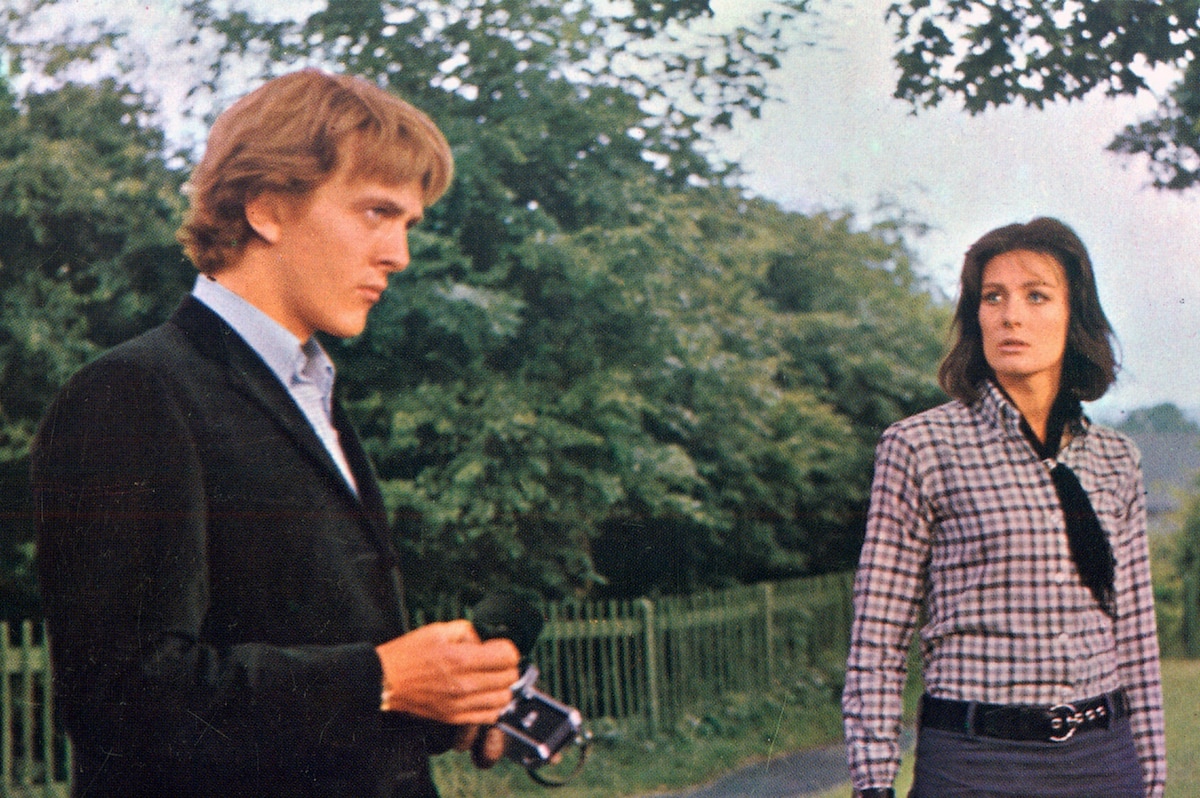
To help translate his vision of a specific heightened reality, Antonioni altered certain visuals by painting trees, streets, grass and houses in order to get the look he wanted on film. "[Antonioni] was feverishly attentive to detail," said David Hemmings. "A massive Alitalia sign in the Elephant and Castle was painted black and whole streets in Brixton were sprayed red. When he told Di Palma, 'I want every tree in the park painted green,' Carlo understood. But the British set designer, Michael Balfour, gazed at him with puzzled horror. 'They are green.'"
"'The trunks are brown. I want them green, too,' the Maestro ordered lightly, as if it were a perfectly reasonable request, 'to match this fence. And I want all the paths sprayed black.' Some deferential gofer on the crew was dispatched to find the paint; the rest of us sat in the White Horse on a corner near an entrance to Maryon Park, while the crew improved upon nature by spraying all the vegetation in the park a vernal green. It was soon made clear that cutting corners to save money had no place in Antonioni's film-making."
To Antonioni, this tinkering with nature was essential. "It's untrue to say that the colors I use are not those of reality," he said. "They are real: the red I use is red; the green, green; blue, blue; and yellow, yellow. It's a matter of arranging them differently from the way I find them, but they are always real colors. So it's not true that when I tint a road or a wall, they become unreal. They stay real, though colored differently from my scene. I'm forced to modify or eliminate colors as I find them in order to make an acceptable composition."
Antonioni felt that Blow-Up marked a "radical" departure from his previous films. "In my other films," he explained, "I have tried to probe the relationship between one person and another--most often, their love relationship, the fragility of their feelings, and so on. But in this film, none of these themes matters. Here, the relationship is between an individual and reality--those things that are around him. There are no love stories in this film, even though we see relations between men and women. The experience of the protagonist is not a sentimental nor an amorous one but rather, one regarding his relationship with the world, with the things he finds in front of him. He is a photographer. One day, he photographs two people in a park, an element of reality that appears real. And it is. But reality has a quality of freedom about it that is hard to explain. This film, perhaps, is like Zen; the moment you explain it, you betray it. I mean, a film you can explain in words, is not a real film."
While there was always a screenplay to work from, Antonioni allowed himself plenty of freedom for the creative process to be organic. "I depart from the script constantly," he said in a 1969 interview. "I may film scenes I had no intention of filming; things suggest themselves on location, and we improvise. I try not to think about it too much. Then, in the cutting room, I take the film and start to put it together, and only then do I begin to get an idea of what it is about."
During production, the actors had to trust Antonioni. "We had really no idea where we were going, and how it was going to make any sense," said David Hemmings, "but from the start, without a moment's uncertainty, Antonioni conducted the whole movie with the ruthless authority of a Thomas Beecham. He had the backing of a gang of key operators he'd brought from Italy. They'd worked with him many times and had learned his moods and whims...I understood clearly now that he didn't consider it his job to enlighten or educate his actors; to him we were like the colors on an artist's palette. When people have been kind enough (and I mean that) to tell me I was good in Blow-Up, I've often felt that I'd done no more than a dab of yellow paint in Van Gogh's Sunflowers."
Antonioni shot some of the scenes in the real-life studio of famed London photographer John Cowan, one of the main figures who had influenced the character of Thomas in the script. Cowan rented out his space to Antonioni and acted as an advisor to him on certain details to help provide an authenticity to the world of high fashion photography.
According to one of the models who appeared in the film, Jill Kennington, the famous scene between Thomas and real-life fashion icon Veruschka as he whips her into a sensual frenzy while snapping her picture was quite authentic. "[That] scene for Blow-Up was pure Cowan," she told Vanity Fair in 2011. "Antonioni must have seen him working--I never saw anyone else take pictures quite that way. The shooting on the floor downwards, completely fluid, unhindered by tripods, etc., was typical Cowan."
Actress Vanessa Redgrave had to work double duty while filming her role as the inscrutable Jane in Blow-Up. She would shoot with Antonioni during the day in London while at the same time starring every night, plus two matinees a week, in the title role of The Prime of Miss Jean Brodie on stage. Despite the rough schedule, however, Redgrave found it very rewarding to work with Antonioni. "With Michelangelo the camera angle, its movement, the frame, their color, position, and movement, whether human or inanimate, told his story," she said in her 1991 autobiography. "The dialogue was of no great significance, or certainly of secondary importance. Trained as a dancer, I was able to appreciate this. I learned to look sharply and precisely at the shapes and colors around me. Exact positions, angles of the body, the head and shoulders, exact tempo of movement, were vital to him. I had never encountered such an eye in the cinema. In English and American films, colors and shapes were part of the decoration, appropriate, but only as background to the action. In Michelangelo's films they were the action."
To Redgrave, Blow-Up was a film that was as much about listening as it was seeing. "...Michelangelo's ear, not for dialogue but for the sounds of nature and normally inanimate objects," she said, "was as subtle as his eye."
Throughout the shooting, according to David Hemmings, Antonioni and Director of Photography Carlo Di Palma argued constantly. "There was also a sense that Di Palma was pretender to the Maestro's throne, Carlo's Iago to Antonioni's Othello, which may have added to the palpable tension between them," he said. "He certainly had no qualms about challenging his boss. Antonioni, being the Maestro, never let him have his way completely but, in the end result, it was clear that their explosive rapport produced astonishing images. In achieving this, though, there were these moments of quite alarming aggression, which never perhaps reached their natural conclusion, inasmuch as the two men never hit each other, but a great deal of shouting, arm waving and surrogate kicking went on - fireplaces, ladders, tables, anything. Kick, kick, kick."
Hemmings was amazed at Antonioni's energy and stamina throughout the production. "I was an energetic 25-year-old - probably more so than most - and I was fascinated by the way Antonioni, at 54, could operate around the clock and still sustain a momentum he needed to get him through the production," he said. "It seemed that, however late he'd gone to bed the night before, he appeared on the set each morning as bright-eyed as a bantam cock, and just as well-groomed...For a man of his age, he was impressively eager for new experiences. I think perhaps he was a little in thrall to the idea of 'swinging London' and even once shooting had started, he spent a great deal of time hanging around in search of oscillation, often with photographers and models. Perhaps he considered it all research, but in his quest he raved ceaselessly, night after night in clubs and discotheques, in the company of the new goddesses of the fashion world, with his fierce eyes shining intensely in the dark, grave face as he drank grappa till his ears bubbled and tried to extract every last ounce from the swinging city - a man from Rome, a modern Bellini, determined to leave his mark in the middle of the liberated new world."
When shooting was complete, Antonioni moved into post-production and watched all the elements of Blow-Up start to come together in the editing room. One of the finishing touches he added to the film was the modern jazz score by composer Herbie Hancock. It was the first film score composed by the famed innovative musician who was emerging at the time as a successful solo artist in addition to being a part of the legendary Miles Davis Quintet.
MGM was prepared to release Blow-Up when it was finished. However, it was hindered by the refusal of the Production Code office to issue its seal of approval. The office had a particular objection to the scene in which Thomas has a playful Ménage à trois with two giggling young aspiring models that featured uninhibited nudity and sexuality. The Production Code had been established in the 1930s as a way to set detailed guidelines for what was and was not acceptable content for films being shown in America. Beginning in 1934, all films released in U.S. theaters were required to obtain a certificate of approval to indicate that they met the code's strict guidelines. The Code was not created or regulated by the government, but the Hollywood executives who created it wanted to have a form of self-regulation in order to avoid any threat of government censorship down the line.
By the 1950s, however, the grip of the Production Code was beginning to loosen when Hollywood was faced with competition from television and European art house cinema. More and more films were dealing with previously taboo subject matter. American cultural attitudes had also begun to change, and the Code no longer had the power it once did to keep audiences away by withholding its seal of approval.
MGM decided to release Blow-Up without the Production Code office seal of approval through a subsidiary company they created called Premier Productions. It was a sign of the times that changes were needed regarding film content regulation.
Blow-Up was a hit on the art house circuit when it was released and caused a sensation with its enigmatic narrative and vibrant frank depiction of the swinging London scene. It became Antonioni's first (and only) commercial success, eliciting high praise from critics along the way. For some, Blow-Up was the most accessible work of Antonioni's career.
The film's cryptic and inconclusive ending challenged viewers and was highly open to interpretation. Viewers, critics and scholars made a pastime out of assigning meaning to it. Some offered theories about the illusory nature of art and life, the idea that reality is a construction and the relationship between the real and the imaginary. Some saw the film as Antonioni's depiction of his personal experience being an artist and filmmaker, while others saw it as a commentary on hedonism and alienation. In the end, no definitive solutions were offered, which only added to the film's allure. It was a mystery with no resolution that made the audience think. "Blow-Up is a performance without an epilogue," said Antonioni, "comparable to those stories from the twenties where F. Scott Fitzgerald showed his disgust with life."
Antonioni offered little in the way of insight into his intentions with the film, and was always clear that meaning wasn't meant to be spelled out. "By developing with enlargers...things emerge that we probably don't see with the naked eye...," he said. "The photographer in Blow-Up, who is not a philosopher, wants to see things closer up. But it so happens that, by enlarging too far, the object itself decomposes and disappears. Hence there's a moment in which we grasp reality, but then the moment passes. This was in part the meaning of Blow-Up."
Vanessa Redgrave offered her take on the film in her autobiography. "Blow-Up was about the unity and difference of essence and phenomena, the conflict between what is, objectively, and what is seen, heard, or grasped by the individual."
The film made David Hemmings a star, though he could never pinpoint what exactly about the film spoke to so many people. "Certainly for me, there has been no escaping Blow-Up," he said. "And that's OK. Much talked about, much vaunted, the definitive film of London in the 'swinging sixties'. There's no question that it has found a certain resonance with several generations and still stands as a cult strip of celluloid that is forever a part of sixties folklore. But why? It is not, in my view, such a great movie; perhaps not even a good one. It's confusing and offers no solutions to the problems it creates. But it's certainly beautiful...I don't know that anyone can truly define Blow-Up; not Antonioni himself, nor Carlo Di Palma, his director of photography, nor even the elegant Piers Haggard, who spent a lot of time patiently scratching his head as the official interpreter of the script."
Blow-Up went on to collect a number of awards and honors, including the prestigious Palme d'Or at the Cannes Film Festival. It also received two Academy Award nominations for Best Director and Best Screenplay.
The film went on to become a modern art house classic and influenced a generation of artists and upcoming filmmakers including Francis Ford Coppola, Brian De Palma and Martin Scorsese. The success of the film without the Production Code office's seal of approval helped usher in a new era for modern cinema in which the Code was soon eliminated altogether in favor of the more up-to-date MPAA ratings system. As Time magazine's Richard Corliss said in a 2007 article, "[Blow-Up] grossed $20 million (about $120 million today) on a $1.8 million budget and helped liberate Hollywood from its puritanical prurience."
Blow-Up's success also helped usher in an exciting new era of modern art house cinema in which films often challenged the traditional "rules" of narrative and embraced fresh new ideas that often pushed the boundaries of conventional cinema. "For about a decade, thanks to Antonioni," said Richard Corliss, "Hollywood movies had permission to be enigmatic, unflinching and adult."
Blow-Up continues to this day to inspire new critiques, interpretations and analysis. In 1969 Antonioni said, "In Blow-Up, a lot of energy was wasted by people trying to decide if there was a murder, or wasn't a murder, when in fact the film was not about a murder but about a photographer. Those pictures he took were simply one of the things that happened to him, but anything could have happened to him: He was a person living in that world, possessing that personality...Blow-Up is a film that lends itself to many interpretations because the issue behind it is precisely the appearance of reality. Therefore, everyone can think what he wants."
by Andrea Passafiume
Behind the Camera-Blow-Up
by Andrea Passafiume | March 04, 2014
SIGN UP FOR OUR NEWSLETTERS

CONNECT WITH TCM