The Haunting all began with the publication of Shirley Jackson's chilling bestselling novel The Haunting of Hill House in 1959. A finalist for the National Book Award, Jackson's novel was an instant hit and went on to become one of the most highly regarded ghost stories in modern literature.
Director Robert Wise, who had already built up an impressive list of film credits including Somebody Up There Likes Me (1956), I Want to Live! (1958) and Oscar®-winning Best Picture West Side Story (1961) for which he also won the Academy Award for Best Director, first heard about The Haunting of Hill House when he read a review of the novel in Time magazine. He was so intrigued with the description of the book that he decided to read it while he was in the midst of making his acclaimed 1962 Robert Mitchum/Shirley MacLaine drama Two for the Seesaw.
One day as Wise was reading the book in his office, he was so engrossed in a particularly chilling passage that when a colleague entered, he was so startled that he jumped out of his chair. It was then that he knew Jackson's book would make a wonderful film. If it had that effect on him, he thought, just think what a powerful effect it could have on movie audiences!
Wise asked screenwriter Nelson Gidding to collaborate with him on adapting Jackson's novel into a screenplay. Wise and Gidding had worked together on the hard-hitting drama I Want to Live! that resulted in an Oscar® win for star Susan Hayward and nominations for both Gidding and Wise.
As Gidding worked on the screenplay, he began to examine the story of Hill House more thoroughly. As he explained in the foreword he wrote to Sergio Leeman's 1995 book Robert Wise on His Films, "The Haunting is a genuine ghost story. The house is honestly haunted. No cop-outs. Bob [Robert Wise] didn't waffle or blink. He never does. I blinked. Halfway through the script, I began to think that Jackson's novel wasn't a ghost story at all. We had missed the point of the book. It's about a mental institution, a private sanitarium, where the heroine, Eleanor, is confined. What could be more obvious?"
"The doors in the house mysteriously open and close," Gidding continued, "as they would appear to a sensitive, disturbed person, like Eleanor, in a locked facility. Dr. Markway, the professor conducting an experiment in the supernatural, is, of course, the medical doctor in charge of the institution. Eleanor's lesbian friend, Theo, is a fellow patient. Mrs. Markway, who appears disastrously at the end, is the head nurse; the cavalier Luke, a male nurse. The terrifying noises that Eleanor hears in her head are the result of medication. The thunderous bangings and explosions emphasize the violence of the shock treatment that Eleanor is undergoing. The cold spot and freezing sensation that Eleanor feels on occasion are the aftereffects of shock treatment."
Gidding was becoming convinced that he and Wise had misinterpreted the book and needed to rewrite the story from the angle of Eleanor being mentally ill. Wise decided to settle the matter by going straight to the source. Wise and Gidding traveled to Bennington, Vermont to pay Shirley Jackson a visit at her home.
In Vermont, Gidding and Wise had lunch with Jackson to discuss the book. Gidding took the opportunity to offer his theory on the story in detail and ask her if indeed Hill House was meant to be a sanitarium rather than a haunted house. "Shirley Jackson said, no, that wasn't at all what she meant," said Gidding, "but it was a damn good idea. Much relieved, we continued with our no-holds-barred, honest-to-God ghost story."
On the same visit, Robert Wise also asked Jackson if there had ever been any alternate or rejected titles for the novel since he and Gidding were trying to decide what to call the film adaptation. She answered that there had only been one other title she had seriously considered for The Haunting of Hill House, and that had been simply The Haunting. Wise liked the shortened version and decided to use it.
United Artists had been the studio that originally purchased the rights to The Haunting of Hill House for Wise to direct, but, according to him, UA "got a little cold on it and put it in turnaround." His agent reminded him that when he had settled an earlier contract with MGM in 1957, they had made him promise to deliver one more picture at some point in the future. Wise therefore decided to see if MGM would be interested in making The Haunting with him acting as both producer and director.
MGM did like The Haunting, but they were unwilling to give Wise the budget he requested to do a proper job of bringing Shirley Jackson's acclaimed novel to life. They wanted him to make the film for $1 million, but no matter how hard he tried, he couldn't find a way to make that budget work.
However, when Wise discovered that there was an MGM Studios in England outside of London in Borehamwood, he decided to offer them the project. When they agreed to give him a sufficient budget, Wise decided to shoot the film at the Borehamwood studios, though he would keep the American story set in New England.
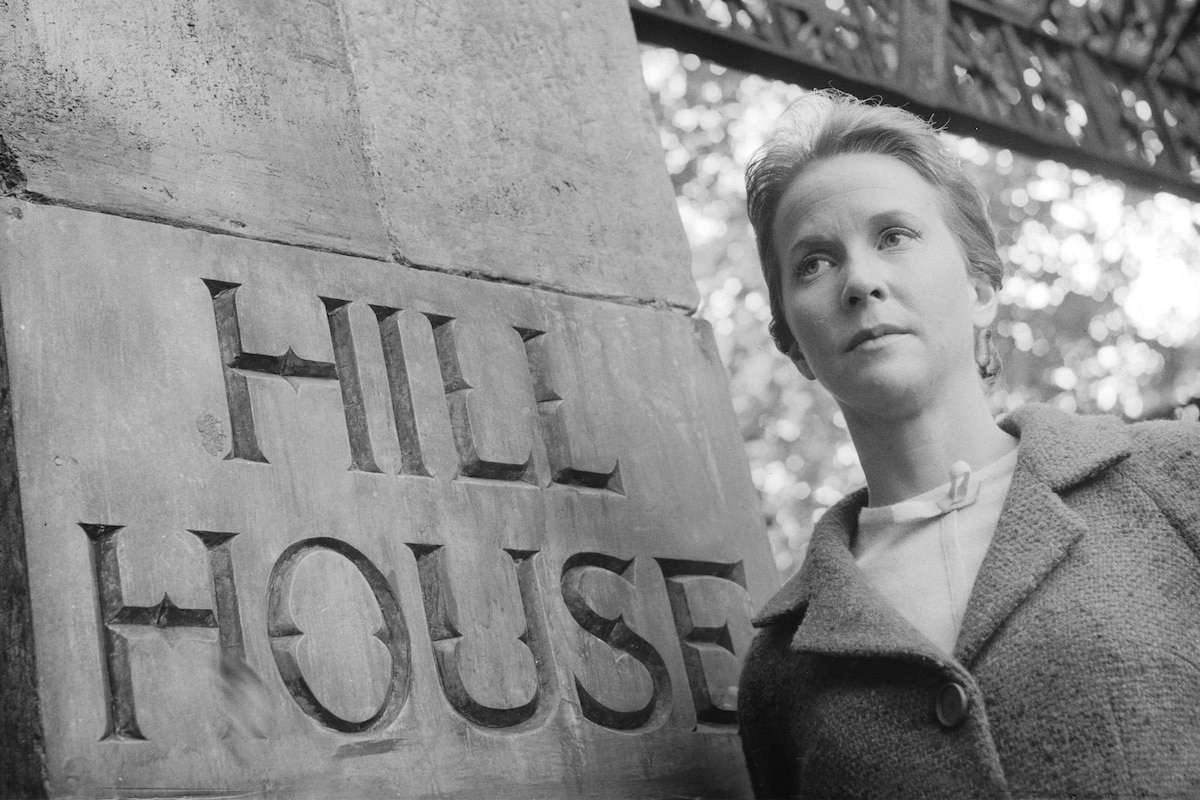
The casting for The Haunting was extremely important. There were very few characters in the story, but each made a significant contribution to the drama. Wise thought that the brilliant versatile Oscar®-nominated actress Julie Harris (The Member of the Wedding [1952], East of Eden [1955]) would be perfect for the key role of the emotionally unstable Eleanor.
Claire Bloom, whose previous credits included Look Back in Anger (1959) and The Wonderful World of the Brothers Grimm (1962), was cast as the confident and worldly Theodora.
For the role of Dr. John Markway, the anthropologist who brings the group together at Hill House, Wise cast distinguished British actor Richard Johnson, who had previously starred with Frank Sinatra in the 1959 drama Never So Few.
Rounding out the main cast was young Russ Tamblyn as the story's lone skeptic and heir to Hill House, Luke Sanderson. Tamblyn had already made a splash with his acrobatic dancing skills in Seven Brides for Seven Brothers (1954) and had even been nominated for an Academy Award for his work in Peyton Place (1957). He and Wise had also recently worked together on West Side Story in which Tamblyn had played the Jets' gang leader Riff.
Tamblyn initially turned the role down, however. He admitted years later that he saw the character of Luke as "jerky" and was unable at the time to appreciate the big picture of the wonderful story that Wise would be telling. After some gentle pressure from MGM, the studio at which Tamblyn was under contract at the time, he was convinced to take on the project.
by Andrea Passafiume
The Big Idea-The Haunting
by Andrea Passafiume | March 03, 2014
SIGN UP FOR OUR NEWSLETTERS

CONNECT WITH TCM