In the fall of 1954, Fox studio chief Darryl Zanuck tried to talk Sam Fuller into directing Soldier of Fortune with Clark Gable or The Left Hand of God with Humphrey Bogart. Fuller was not interested, saying they weren't original enough for him. (Both ended up being directed by Edward Dmytryk.) Then Zanuck said, "What about Japan? Would you like to shoot a picture there?"
"Holy mackerel, Darryl, now you're talking!"
Zanuck explained that the movie he had in mind was to be a reworking of The Street With No Name (1948), a semidocumentary film noir about an FBI agent infiltrating a criminal gang. Fuller rewrote Harry Kleiner's original script as House of Bamboo (1955), keeping the original structure but incorporating an idea that Fuller had unsuccessfully tried to sell to MGM years earlier. That story was about a group of war buddies who form a gang after WWII and "take Fort Knox using the same military maneuver with which they knocked out a pillbox on Omaha Beach." With House of Bamboo, Fuller made the criminal gang former GIs who work with military precision. He "moved the entire shebang to Tokyo, added stuff about Japanese contemporary life, threw in some sexual exploitation and interracial romance, and then, for some unexpected pizzazz, wrote a violent love scene between two hardened criminals. The core of the movie was about betrayal. Zanuck loved it, even the homoerotic scene with the two gangsters, which at the time was very daring."
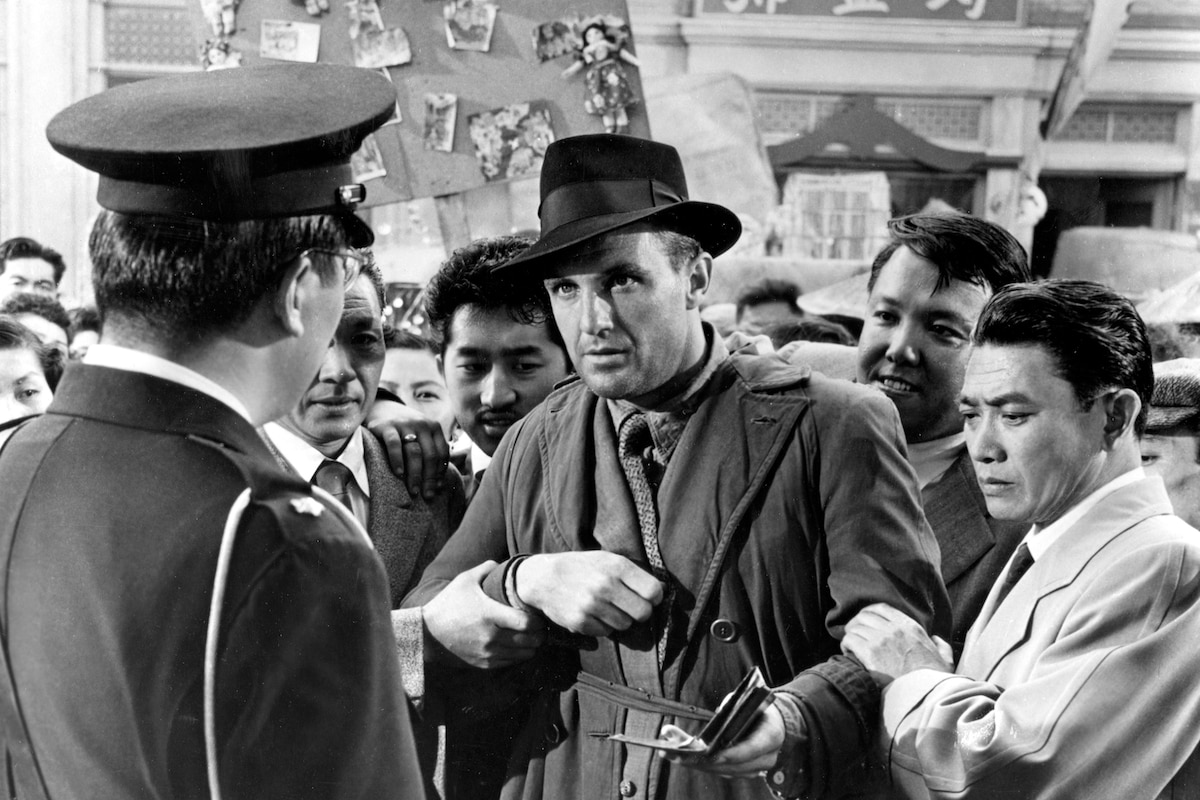
Deciding not to use Gary Cooper because he would be recognized everywhere on location in Tokyo, Fuller instead cast Robert Ryan - largely because he was tall. Fuller wanted tall American actors so that they would contrast with the Japanese characters and look strangely out of place. For the FBI agent, Fuller cast Robert Stack on the suggestion of Fuller's good friend Budd Boetticher, who had just directed young Stack in Bullfighter and the Lady (1951). Fuller would later introduce Stack to his future wife, Rosemary. Shirley Yamaguchi, a Japanese actress whom Fuller said was a New York socialite at the time, played the female lead and Stack's love interest. (The actress was a huge singing star in Japan and later was elected to Japanese parliament.) A very fine supporting cast includes Cameron Mitchell and Sessue Hayakawa, one year before his Oscar®-nominated turn in Bridge on the River Kwai. (Hayakawa's voice was here dubbed by Richard Loo.)
With the resources of Twentieth Century Fox, House of Bamboo became the first Hollywood movie to shoot in post-WWII Tokyo. As Fuller later wrote, "I wanted to capture a certain mood in House of Bamboo that I hadn't seen in either Japanese or American films: the clash between our culture and theirs." Working in CinemaScope and color with cameraman Joe MacDonald (who also shot The Street With No Name), Fuller created a stunningly beautiful picture full of evocative locations, from pachinko parlors and dilapidated waterfronts to the Great Buddha and a rooftop amusement park. The constant visual clash between American gangsters and the Japanese architecture surrounding them indeed created a surreal and unique effect.
"Making a movie in Japan is a grand experience," wrote Fuller. "The light there is unique and wonderful. Colors come out looking postcard crisp. Even their blacks and whites are different, sharper and purer." House of Bamboo's opening sequence of a train hijacking with Mt. Fuji in the background reveals Fuller making full experimental use of these blacks and whites. In a 1969 interview, he explained that he chose to begin the movie with white-on-white visuals, then added a black train to create "a flavor of grim bleakness." As the titles started, he had the frame take on more and more color, little by little, until it filled the frame.
While Stack may be the movie's good guy, House of Bamboo is far and away Robert Ryan's film. He commands the screen whenever he appears, and despite his ruthlessness he also commands the audience's sympathy. To create this, Fuller used "humor. We introduce Ryan when Stack is hit through a paper wall, and these gangsters are sitting there. Ryan starts to laugh. That's the beginning of my sympathy for the heavy. I also told Ryan to never say 'my father' but to say 'pappy.' Right away you have to like any guy who says 'pappy.'"
Fuller would look back on House of Bamboo with great satisfaction. "What made me proudest," he wrote, "was that it broke race barriers implicit in American movies at the time. In the fifties, a white man still didn't fall in love with an Asian woman in Hollywood. In those rare films with interracial couples, the ending was usually tragic. I wasn't going to yield to that hypocrisy."
Fox's widescreen DVD is stunning. The film's colors are transferred with startling vividness and the print is clean and clear. Commentary by film noir historians Alain Silver and James Ursini is informative and intelligent, though Ursini tends to repeat himself quite a bit.
Look for an uncredited DeForest Kelley (of future Star Trek fame) as one of the gang.
For more information about House of Bamboo, visit Fox Home Entertainment. To order House of Bamboo, go to
TCM Shopping.
by Jeremy Arnold
House of Bamboo - Sam Fuller's 1954 Film Noir
by Jeremy Arnold | June 30, 2005
SIGN UP FOR OUR NEWSLETTERS

CONNECT WITH TCM