In the years immediately after World War II, film stock was hard to come by in France, so Henri Alekan had to shoot on whatever type of film was available, much of it scraps. Director Jean Cocteau would later say the changes in visual quality this caused added to the film's poetic effect. At the same time, he regretted the fact that the harsh post-war conditions made it impossible to shoot the film in color, as he had originally planned.
Those weren't the only problems with film production immediately following World War II. Most of the available cameras were old and worn, often jamming during filming. The electrical supply at the studio was inconsistent, with frequent blackouts to divert power to other parts of the district. The studio and locations were so cold that the cast huddled around the lights between shots to keep warm. Costumes had to be made from fabric scraps, and the props department had trouble finding sheets without patches for the laundry scene. With fabric in short supply, the crew often arrived at the studio to find Beauty's bed-curtains had been stolen during the night.
Initially, Cocteau and Alekan clashed over the filming style. Alekan wanted to use soft focus to create his version of what a fairy tale would look like. Cocteau, however, insisted a more hard-edged style would make even the most fantastic scenes seem grounded in reality. After the first few days of shooting, Alekan declared the rushes laughably bad. As Cocteau persisted in pursuing his personal vision of the film, the cinematographer gradually came around.
The House of Lanvin made all of the costumes, with resident designer Pierre Cardin supervising the men's wardrobe.
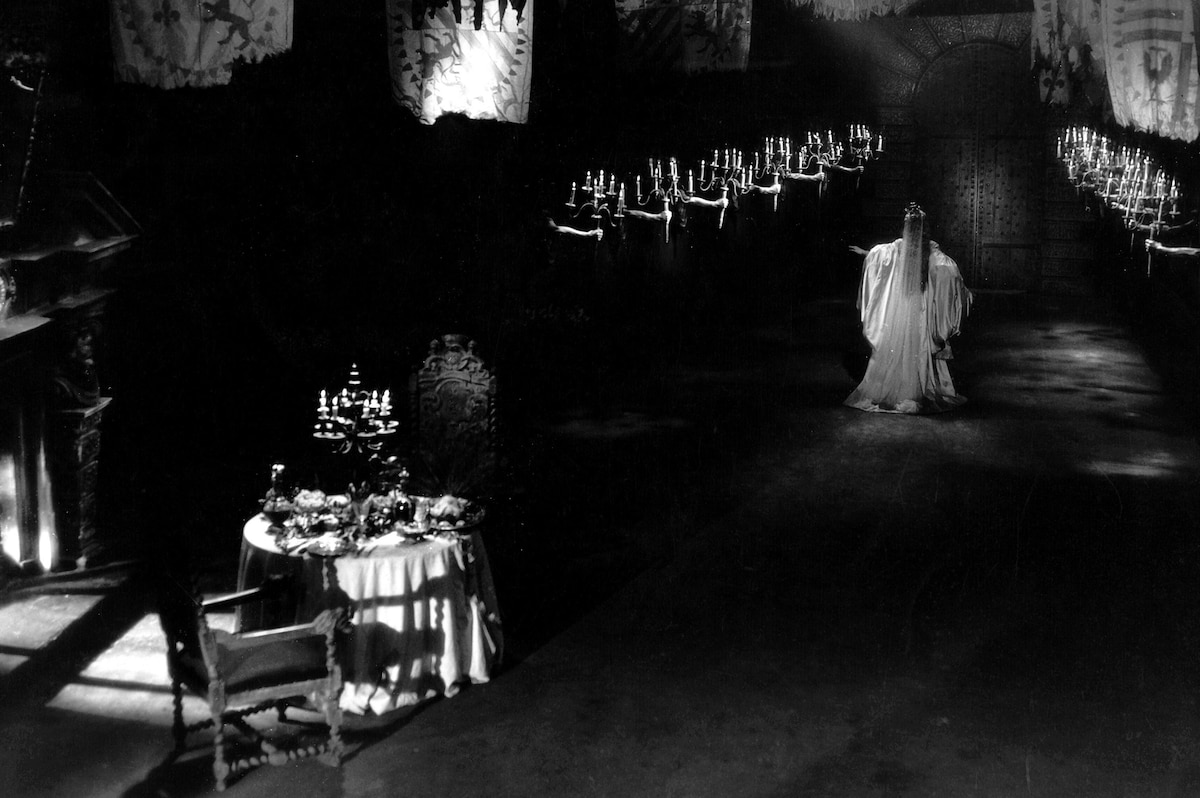
Exteriors for the Beast's castle were shot at the Chateau de Raray near Senlis. The strange statues in the castle's park, including a procession of hunting dogs, provided wonderful images for the film.
Jean Marais spent five hours in the make-up chair every morning to transform into the Beast. His face, hands and any other body parts not hidden by the costume were covered in animal hair. Once his fangs were in, he could not remove them, so he could eat nothing while filming except mush.
To create the living human carvings in the fireplace and other architectural elements in the Beast's castle, Cocteau hired local children who were made up with plaster to look like stone figures. At one point, the even had the faces in the fireplace breathe smoke.
The farmhouse scenes were shot on a farm outside Tours near an airfield. Although the commanding officer was happy to give the company permission to film there, he did not always keep track of the shooting schedule. As a result, takes were often ruined by the sound of training flights overhead.
Throughout filming Cocteau suffered from a severe case of impetigo. At times it was so bad he covered his face with a black paper veil, with holes cut out for his eyes and mouth. At one point he had to be hospitalized for that and jaundice, so director and technical consultant Rene Clement filled in, working from Cocteau's notes. Cocteau would later say the pain from his cracked skin could not compare to what Marais went through being made up for his role. After the film was finished, the pain of his skin problems would briefly lead him to take opium, a drug he had not touched in years.
The first screening took place before the staff of the studio at Joinville. Cocteau was so nervous, he invited his friend Marlene Dietrich, whose hand he held tightly as the film unwound. The response, however, was enthusiastic.
For the film's U.S. release conventional credits replaced the original ones, in which the credits were written in chalk and erased by Cocteau's hand. This also eliminated the film clapboard seen between the opening credits and the written prologue.
By Frank Miller
Behind the Camera-Beauty and the Beast
by Frank Miller | February 28, 2014
SIGN UP FOR OUR NEWSLETTERS

CONNECT WITH TCM