The traditional story, which some scholars say originates in Scottish folk lore, was first published by Jeanne-Marie Le Prince de Beaumont in 1757 in her fairy tale anthology Le Magasin des Enfants, ou Dialogues entre une sage gouvernante et ses eleves.
The classic fairy tale had been filmed four times as a silent film, starting with a French version in 1899.
Jean Cocteau became famous as an artist, poet, playwright and critic in the early years of the 20th century. In 1917, he collaborated with composer Erik Satie, choreographer Leonide Massine and painter Pablo Picasso on the ballet Parade. The premiere was a huge success, though it triggered a riot among classical music-lovers who objected to the use of everyday objects in the score (one of Cocteau's ideas) and a lawsuit when Satie and Cocteau got into a fight with a critic who had panned the show. It is now considered a major formative work in the development of Surrealism, although Cocteau disavowed any involvement with the movement.
Cocteau returned to directing at the suggestion of his partner, Jean Marais. An actor better known at the time for his good looks than his talent, Marais suggested a film version of the classic fairy tale as a vehicle for himself. He hoped that by covering his face with elaborate makeup, he would force audiences and critics to appreciate his acting.
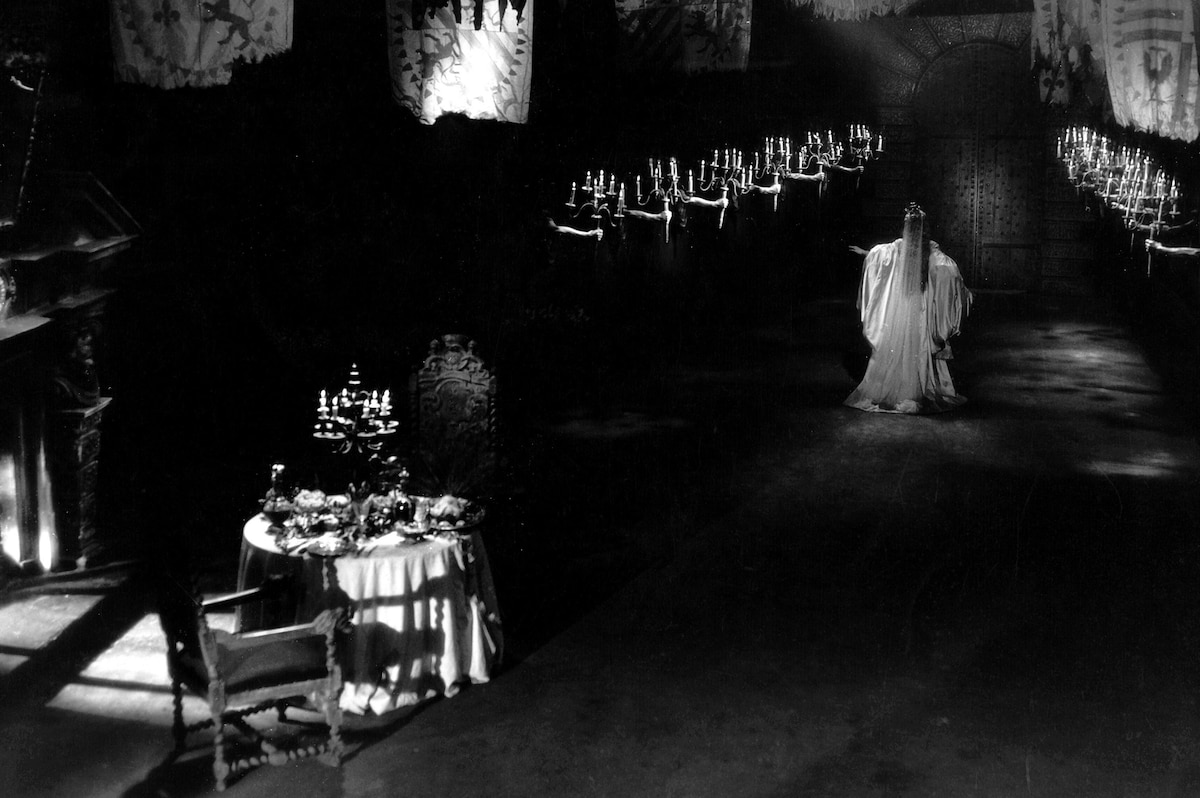
To flesh out the fairy tale, Cocteau added a subplot about Belle's scheming suitor, Avenant, also played by Marais. Avenant's attempt to steal the Beast's treasure added conflict to the story. He also borrowed a plot element from another French fairy tale, La Chatte Blanche by Marie-Catherine D'Aulnoy. In that story an enchanted princess's servants lose most of their bodies, retaining only the arms and hands necessary to perform their duties. This inspired the living candelabra and other animated statues throughout the Beast's castle.
Cocteau conceived the film's look as a tribute to 19th-century engraver Gustave Dore, noted for his illustrations for Don Quixote, Idylls of the King, "The Raven," the Bible, Paradise Lost and The Divine Comedy. He hired theatrical designer Christian Berard to oversee the film's sets, costumes and makeup.
The domestic scenes showing Belle and her family were modeled on the work of the Dutch painter Johannes Vermeer and the French artists Antoine, Louis and Mathieu Le Nain
Marais suggested the Beast have the head of stag, but Cocteau feared that would make him look funny. Instead, he asked for a more threatening appearance modeled on various carnivores. The work was done by veteran theatre make-up artist Hagop Arakelian, who built the mask like a wig, weaving animal hair on a base of webbing. The final make-up consisted of three parts: the top of the head down to the eyes, the area from the eyes to the upper lip, and everything down to the base of the neck. This construction allowed Marais numerous opportunities for facial movement. The shape and coloring of the animal hair was partly inspired by Marais's dog, who went with him on visits to test the make-up.
Since this was only his third film, Cocteau wasn't sure he had the technical ability to pull off the complicated production. He insisted on hiring experienced cinematographer Henri Alekan and also engaged director Rene Clement (1952's Forbidden Games) as a technical consultant.
By Frank Miller
The Big Idea-Beauty and the Beast
by Frank Miller | February 28, 2014
SIGN UP FOR OUR NEWSLETTERS

CONNECT WITH TCM