SYNOPSIS
In this tale as old as time, a beautiful young woman discovers that true love sees beyond surface beauty. Belle, the daughter of a failed merchant, is courted by the handsome but shallow Avenant. When her father unwittingly offends the powerful and mysterious Beast, Belle ransoms herself to the creature to save him. Instead of facing a death sentence, however, she develops a deep bond with the creature. The only thing that can separate them is the greed of Avenant and her sisters. Visionary filmmaker Jean Cocteau turns this simple story into a lustrous cinematic poem filled with unforgettable images capturing the archetypal fears at the root of this classic story.
CAST AND CREW
Director: Jean Cocteau
Producer: Andre Paulve
Screenplay: Cocteau
Based on the story by Jeanne-Marie Le Prince de Beaumont
Cinematography: Henri Alekan
Editing: Claude Iberia
Art Direction: Christian Berard, Lucien Carre
Music: Georges Auric
Cast: Jean Marais (The Beast/The Prince/Avenant), Josette Day (Belle), Mila Parely (Felice), Nane Germon (Adelaide), Michel Auclair (Ludovic), Marcel Andre (Belle's Father), Jean Cocteau (Voice of Magic)
BW -93 m.
OVERVIEW
Beauty and the Beast was the first feature-length adaptation of the classic fairy tale and the first with sound.
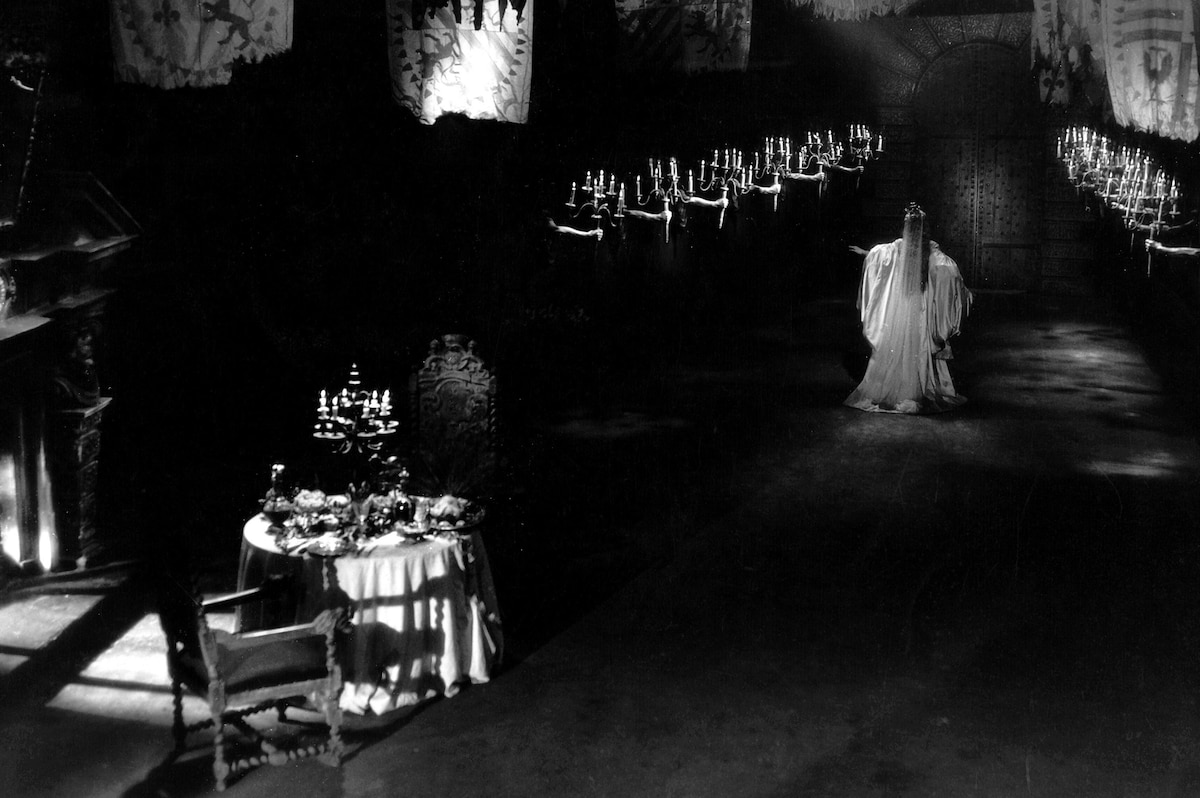
For film lovers, Cocteau's version of the story is considered the definitive fairy tale adaptation, creating a sense of awe and mystery rarely found in more prosaic attempts to bring these children's stories to the screen.
With its abundant dream imagery and Freudian symbology (note the knife Belle holds in her hands when she talks to the Beast), the film is considered one of the screen's most successful uses of Surrealism, an artistic movement that developed in France in the 1920s. Although he would later claim to have had no involvement in the movement, Cocteau was a key figure in its development and popularization through his work on the ballet Parade, the short play The Wedding on the Eiffel Tower and the avant-garde film The Blood of a Poet (1932).
Made 14 years after The Blood of a Poet, the film marked Cocteau's return to directing. Although his lifetime output was short - he directed just 11 films - it would have a major influence on French cinema. This film, along with Les Parents Terribles (1948) and Orpheus (1950), brought the avant garde into the highly commercial French cinema, inspiring a young generation of critics, including Jean-Luc Godard and Francois Truffaut, who would move into filmmaking to launch the French New Wave in the late 1950s and early 1960s.
Although made under strained circumstances in the years immediately following World War II, the film represents a triumph of French filmmaking, with outstanding work from some of the country's greatest film artists. Among them were production designer Christian Berard, composer Georges Auric, cinematographer Henri Alekan and costumer Marcel Escoffier.
By Frank Miller
The Essentials-Beauty and the Beast
by Frank Miller | February 27, 2014
SIGN UP FOR OUR NEWSLETTERS

CONNECT WITH TCM