How to Marry a Millionaire started shooting in March 1953. Even though Jean Negulesco was a solid director, producer/writer Nunnally Johnson decided to work very closely with the cast throughout the film. According to Johnson's daughter Nora's 1979 book Flashback: Nora Johnson on Nunnally Johnson, there had been complaints from actor Alec Guinness back on the 1950 film The Mudlark that Negulesco did not rehearse the actors enough and it had adversely affected the film.
As a result, Johnson decided to make a pre-emptive strike on How to Marry a Millionaire. "I made a deal with [Negulesco]," he explained according to the 1981 book The Letters of Nunnally Johnson co-edited by Johnson's wife Dorris. "I never heard of anybody making a deal like this, and I don't know if anybody else would have permitted it. I said, 'Hey, Jean, would you let me rehearse the actors and their lines before each scene?' He said, 'I'd be delighted.' So that's the way we did the picture...Although I am not an actor, at least I knew where the emphasis went, and I could give them something of the tempo."
Twentieth Century-Fox Production Chief Darryl Zanuck, meanwhile, was excited about using How to Marry a Millionaire and The Robe to introduce CinemaScope to the public in just a few short months. He wanted to utilize the new technology to its full effect in order to "wow" moviegoers. He watched the progress of both big budget productions closely and had definite ideas on how CinemaScope should be handled. "I see an enormous improvement in the rushes of How to Marry a Millionaire," he wrote in a memo to the production team dated March 25, 1953. "I am not speaking of the acting but of the handling of CinemaScope. In practically every instance of the six reels I ran last night you have perfectly sharp and clear photography with amazing lighting effects and in some instances with genuine 3-dimensional effect. Almost in all instances the composition has been vastly improved over previous material. The full figure shot of Bacall on the bed and the big closeup filling the screen of Monroe were unique examples of the new medium. I am still opposed to too much camera movement. I fully believe that while we have to occasionally move the camera we should put the emphasis on moving the actors. CinemaScope gives you a certain freedom of movement. Practically everything is lost if two people are huddled together in the center of the screen with nothing but wide open spaces on each end of the screen. If the people are spread out filling the screen then we are putting on film an effect that we cannot get on the old 35 mm...We must not forget the illusion of depth comes at least 25 percent from the stereophonic sound. Stereophonic sound is not effective when two people are face to face, unless of course they are in big closeups or a big 2-shot. The full value of stereophonic sound comes from the distance between the two people who are talking. If one person is planted at one end of the set and the other person is on the other side of the set then the sound has an opportunity to add the illusion of depth..."
In her 1979 memoir By Myself Lauren Bacall recalled what it was like to work with the new CinemaScope technology. "As CinemaScope was a new experiment for everyone," she said, "it was difficult. One had to keep the actors moving and not too close together, as the screen was long and narrow. You shot longer scenes in CinemaScope, five or six pages without a stop, and I liked that - it felt closer to the stage and better for me."
By all accounts How to Marry a Millionaire was a happy set, which may have been a disappointment to the naysayers who were certain there would be competitive infighting among its three glamorous stars. "The three girls are a good story," wrote Nunnally Johnson to film critic and friend Thornton Delehanty in a letter dated April 9, 1953. "Everybody went around with their fingers in their ears blabbering about what temperament there would be on the set, and needless to say, the gossip columnists, those lice, have done everything possible to foment trouble for us. They've printed all kinds of mischievous rumors, quoting one against the other, and printing out fictitious privileges given to one above the other two, in the most desperate effort you ever saw to create feuds. But it hasn't worked in the least."
As Johnson relayed in the same letter, Lauren Bacall (who was known as "Betty" to her friends) and Betty Grable became instant pals. "I don't think Betty Bacall and Betty Grable had ever met before," he said. "...But Betty Bacall fell in love with Grable and now thinks she's the funniest clown she ever had the pleasure of knowing. Which is not far from true. Miss Grable is a real hooligan, and is a fine salty, bawdy girl, without an ounce of pretense about her. In addition, she's giving a better performance than anything she ever did before."
If there was one person in the cast who was a challenge to deal with, it was by all accounts Marilyn Monroe. It wasn't because she was unpleasant, but rather her insecurity and total dependence on her personal acting coach Natasha Lytess for approval. "Betty Grable was a funny, outgoing woman, totally professional and easy," explained Lauren Bacall in her memoir. "Marilyn was frightened, insecure - trusted only her coach and was always late. During our scenes she'd look at my forehead instead of my eyes; at the end of a take, look to her coach, standing behind Jean Negulesco, for approval. If the headshake was no, she'd insist on another take. A scene often went to fifteen or more takes, which meant I'd have to be good in all of them as no one knew which one would be used. Not easy - often irritating. And yet I couldn't dislike Marilyn. She had no meanness in her - no bitchery. She just had to concentrate on herself and the people who were there only for her."
Even Monroe's co-star Alex D'Arcy, who played her dashing eye patch-wearing suitor J. Stewart Merrill in the film, noticed the destructive nature of her relationship with Lytess. "Natasha was really advising her badly," he said according to the 1993 book Marilyn Monroe by Donald Spoto, "justifying her own presence on the set by requiring take after take and simply feeding on Marilyn's insecurity."
In a gracious display of camaraderie, Bacall and Grable decided not to fight with her. "Grable and I decided we'd try to make it easier for her," said Bacall, "make her feel she could trust us. I think she finally did."
Johnson took notice of the actresses' generosity towards Monroe. "The two Bettys have gone out of their way to help, and make friends with Marilyn," said Johnson in a letter to Thornton Delehanty, "but Miss Monroe is generally something of a zombie. Talking to her is like talking to somebody underwater. She's very honest and ambitious and is either studying her lines or her face during all of her working hours, and there is nothing whatever to be said against her, but she's not material for warm friendship."
As the film was close to wrapping, everyone was confident that the filming had gone well and that they had made a delightful film. "We'll be through with the picture early next week and what I've seen of it looks pretty good in this new CinemaScope," wrote Johnson in a letter to Thornton Delehanty. "It's a larkish story, the girls look very beautiful, and its purpose is to see if something indoors and with just two or three people can look good on the new wide screen."
In the end, Johnson was convinced that his insistence on rehearsing the actors throughout the shoot helped the film tremendously. "The picture turned out about five times as good as anything Jean had done before," he said, "simply because somebody had taken the trouble."
Even though How to Marry a Millionaire was Fox's first completed CinemaScope film, the studio decided to release The Robe, which wrapped soon after, first. It was a calculated move. The Robe was a grand epic biblical tale with a huge cast and many exterior shots that would be an appropriately opulent introduction of the new widescreen technology. How to Marry a Millionaire would prove to audiences as well as theater owners that CinemaScope was just as effective with a small cast and a lighter comic story.
Before the film was released, Darryl Zanuck had a charming musical prologue added to the film that was entirely separate from the story's narrative. Before the opening credits, a scene was shot of composer Alfred Newman conducting the Twentieth Century-Fox Symphony Orchestra in a performance of Newman's "Street Scene", which had originally been written for the 1931 film Street Scene. It was a sequence meant to help draw attention to the widescreen wonders of CinemaScope in How to Marry a Millionaire and highlight the richness of the added stereophonic sound.
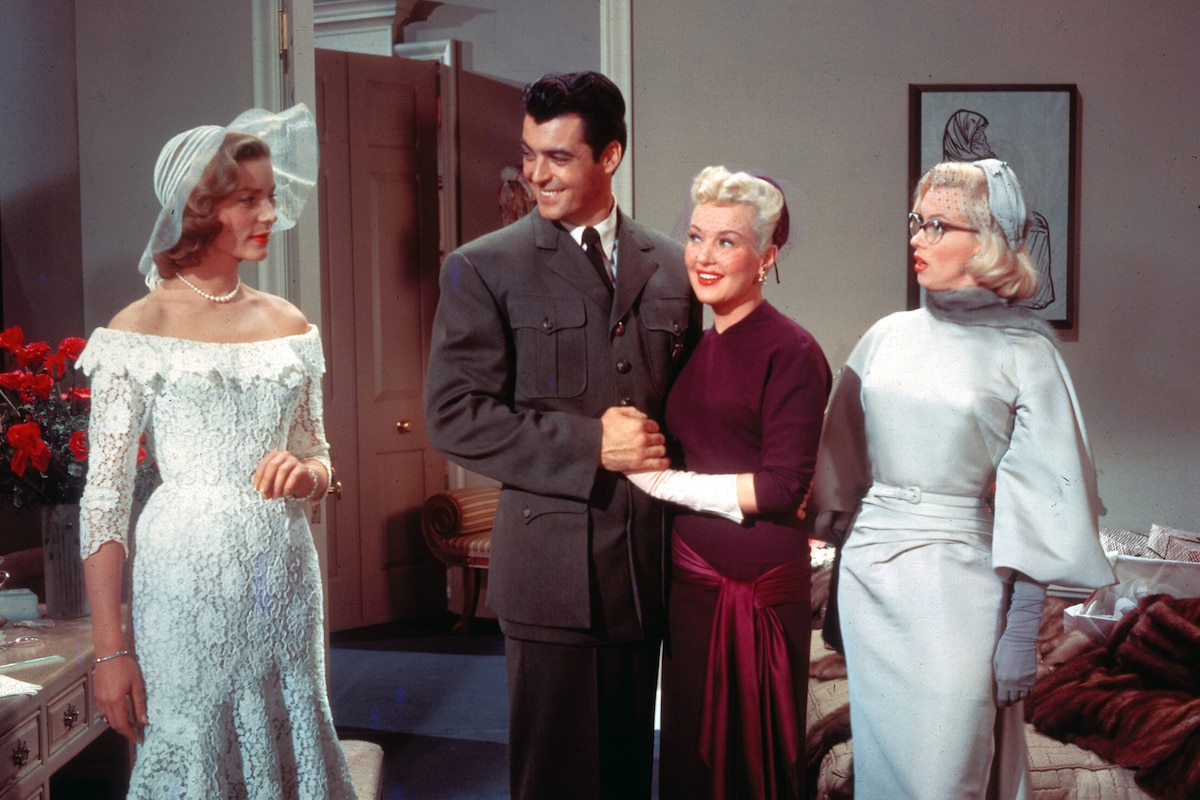
How to Marry a Millionaire opened in November 1953, right on the heels of The Robe, which had premiered in September. As expected, it was an immediate smash hit with audiences and garnered mostly positive critical reviews. The film also went on to receive an Academy Award nomination for Best Costume Design (Color) for its exquisite designs showcased on gorgeous Bacall, Monroe and Grable.
The success of the film made its impact in many ways. It helped make an auspicious introduction for Fox's CinemaScope process to audiences and usher in a new era of widescreen entertainment. Lauren Bacall was able to prove that she could indeed play comedy with panache, and it opened a whole new avenue in her illustrious career that made her just as in demand for comedies on stage and screen as she was for drama. Betty Grable, Fox's long-reigning Queen of the Lot, was able to leave the studio on a high note at the end of her long run, taking with her some of the best reviews of her life. She would return to make just one more film for Fox - this time as a free agent - in 1955's How to Be Very, Very Popular.
As Grable had earlier predicted, it was now Marilyn Monroe's time to shine. Although Monroe was already a star, How to Marry a Millionaire gave her the final push into the stratosphere of superstardom. The insecurities that she displayed to the cast and crew were invisible on the silver screen, and audiences adored her charming performance. She became a genuine sensation with a star that never faded, even after her untimely death in 1962.
by Andrea Passafiume
Behind the Camera-How to Marry a Millionaire
by Andrea Passafiume | February 27, 2014
SIGN UP FOR OUR NEWSLETTERS

CONNECT WITH TCM