The 1950s were a time of big changes for Hollywood. Movies, which had long reigned supreme for audience entertainment, now had to compete with the magic boxes that had recently begun to invade everyone's home: television.
In an effort to lure audiences away from their televisions and back into theaters, studios were having to dream up ways for movies to offer things that television couldn't. Televisions, at the time, were tiny black and white picture boxes with marginal sound quality. As a result, Hollywood fought back by emphasizing the size of the theaters' big screens and coming up with enticing new features like Technicolor and fun gimmicks like 3-D and Cinerama to enhance the movie going experience.
One of the new ways that Fox hoped to astound audiences and give them a more spectacular experience than ever before was through the brand new anamorphic widescreen process called CinemaScope. Spearheaded by studio president Spyros P. Skouras, Fox was the first movie studio to use CinemaScope in Hollywood.
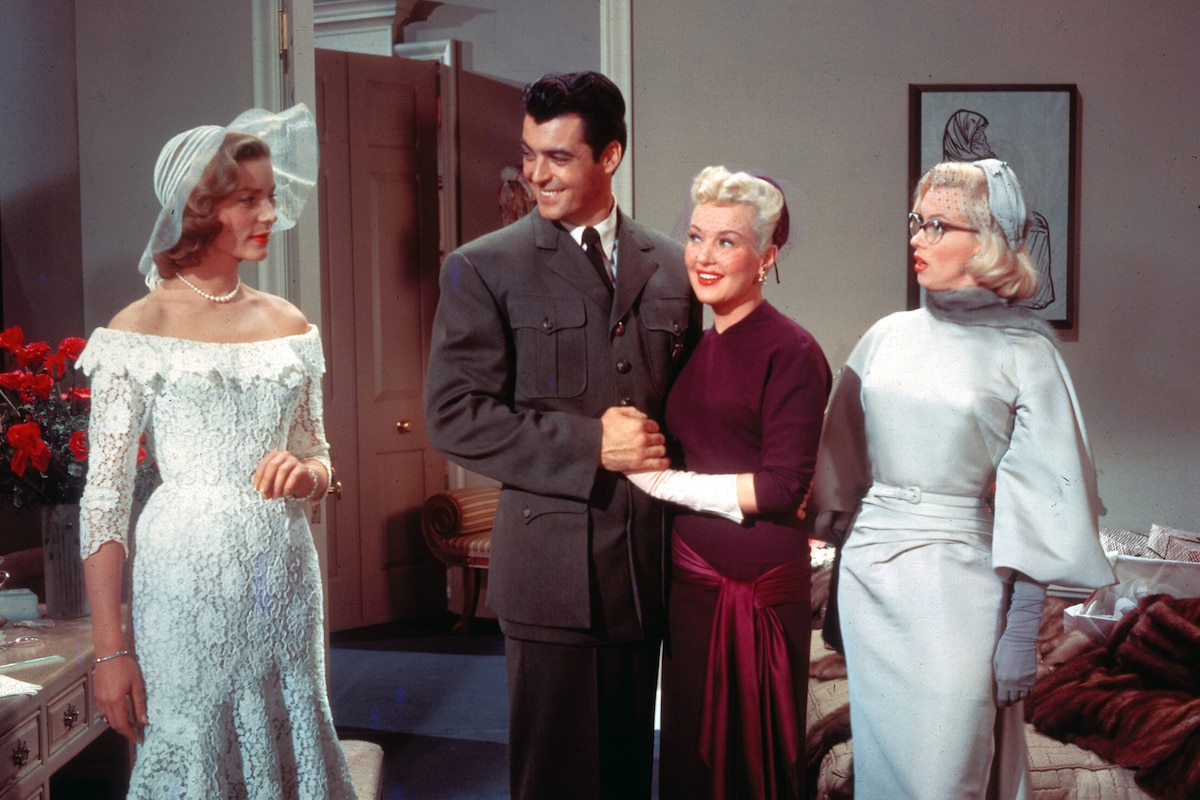
Fox Production Chief Darryl Zanuck was excited about CinemaScope and all the possibilities it would bring to the studio's films. He decided to immediately put two big budget films into production to help introduce the new technology to American audiences. One would be the grand Biblical epic The Robe (1953) starring Victor Mature, Richard Burton and Jean Simmons. The other would be How to Marry a Millionaire, a light comedy about three beautiful gold-diggers in New York who try to snare rich husbands.
How to Marry a Millionaire featured a screenplay by Nunnally Johnson, who would also serve as the producer on the film. Johnson's screenplay pulled elements from the 1930 play The Greeks Have a Word for It by Zoe Akins and a 1946 play called Loco by Dale Eunson and Katherine Albert. Jean Negulesco (Humoresque [1946], Johnny Belinda [1948]) was tapped to direct.
From the beginning, Nunnally Johnson was interested in having Lauren Bacall play the role of sophisticated ringleader Schatze. However, even though Bacall was already a big star, it had been three years since her last film - an eternity in Hollywood. On top of that, Bacall, who had gained fame playing sultry roles in serious dramas like To Have and Have Not (1944) and The Big Sleep (1946), had never played comedy before.
Bacall and her movie star husband Humphrey Bogart were close friends with Nunnally Johnson and his wife Dorris, but Johnson still felt Bacall needed to do a screen test to prove that she could handle comedy. The request was something of an insult to the well-established actress, but his tactfulness helped him convince her to do it. "He said, 'I know you can do it, honey, but they don't, they just have to see it on the screen, it will make Zanuck feel better,'" recalled Bacall according to Johnson's daughter Nora's 1979 book Flashback: Nora Johnson on Nunnally Johnson. "'I said to myself, Jesus, I made it eight years ago, I have to test? I always resented testing, it's very much the Hollywood syndrome...Nunnally knew it was a sensitive point, he didn't want to hurt my feelings and yet he wanted to make his point."
In her own 1979 memoir By Myself Lauren Bacall recalled that she found the script for How to Marry a Millionaire "funny, witty, even touching" and very much wanted to play the role of Schatze. The comic turn would represent a new direction for the stylish actress, and she passed the screen test with flying colors.
As plans for How to Marry a Millionaire began to take shape, Nunnally Johnson considered what CinemaScope would mean for the future of motion pictures. In a letter to film critic Thornton Delehanty dated February 7, 1953 he wrote, "This business is a mess. Every day it's something new - 3-dimension, 2-dimension, 1-dimension, round screens with no dimension. The producers here at Fox haven't any time to make pictures. They're buying Fox stock and sitting around in brokers' offices. My next picture, in which Mrs. Bogart will be one third of the stars, in 7-dimensions, is to be made in our version of Cinerama, which means that everything, even close-ups, will look like it's taking place on the old Hippodrome stage." When asked once how he tailored his screenwriting to the challenges of CinemaScope, Johnson famously quipped that he simply "put the paper in the typewriter sideways."
For the role of nearsighted lovable Pola, Johnson and Zanuck wanted their white-hot starlet Marilyn Monroe. The blonde bombshell had been building her career in Hollywood over the last several years, first as a bit player, and then steadily working her way up to featured roles. She worked hard on creating her iconic look, building her confidence and improving her acting skills by working with her own private coach. She had just made the smash hit film Gentlemen Prefer Blondes (1953) directed by Howard Hawks, which put her firmly in position to become Fox's biggest sex symbol and movie star. Both Nunnally Johnson and Darryl Zanuck were smart enough to know that CinemaScope plus Marilyn Monroe would probably equal big returns at the box office.
For the role of the third gorgeous roommate Loco, Johnson and Zanuck cast one of the studio's long-time favorites, Betty Grable. Grable had been Fox's greatest female star and box office draw throughout the 1940s in mostly musicals and light fare. She had also been the most popular pin-up girl of World War II in a photo that showcased her famous Lloyds of London-insured million dollar legs.
By the time How to Marry a Millionaire came along, however, Grable's star was fading, and she knew it. She was in her late 30s and nearing the end of her long-term contract with Fox. She knew that it would probably be her last film under contract, and she wanted to go out on a high note with a plum part in a hit film with Fox.
Betty Grable could also see the writing on the wall and knew that Marilyn Monroe was in line to take over the role she had once played at Fox as its number one blonde ingénue. Grable herself had once been the new girl in town at Fox, edging out early favorite Alice Faye as Queen of the Lot during the 1940s.
Because of this undercurrent of "out with the old and in with the new," there were worries that there could be tension between Grable and Marilyn Monroe on the set. It was a feeling not helped by the fact that Fox had originally intended the part of Lorelei Lee in Gentlemen Prefer Blondes for Grable, and instead it was the role that made Monroe a big star.
Meanwhile, Lauren Bacall worked to prepare for her role. She didn't know her two glamorous co-stars very well, and she hoped they would all get along and have a wonderful experience working together. Coming off a three year absence from the silver screen to concentrate on starting a family with Humphrey Bogart, it was important to her career that this film be a hit.
When all three actresses finally came together, any misgivings about tension on the set were quickly put to rest. Grable, always a class act, was extraordinarily gracious to new blonde in town Marilyn Monroe upon their first meeting. "Honey, I've had it," she reportedly said to Monroe with great generosity. "Go get yours. It's your turn now."
Rounding out the cast to play the ladies' unsuspecting male suitors were David Wayne, Rory Calhoun, Cameron Mitchell, Alexander D'Arcy, Fred Clark and William Powell in one of his final film roles as Bacall's primary target, oil man J.D. Hanley.
With cameras set to finally roll on How to Marry a Millionaire, no one was more excited than producer/writer Nunnally Johnson. As he wrote to director Jean Negulesco just prior to filming in a letter dated March 9, 1953: "At last the great day has come. You alone know how they have fought to keep us from making this picture. You alone know the jealously, the bitterness, the lack of faith in this project that you and I have dreamed of doing for years now. They said we were fools! They said we were dreamers! They said we were too artistic! But you and I, we have always had faith in this story! So now that the great day has come at last, and we have overcome all opposition, let us go forward and make this the finest picture that was ever turned out in the entire history of CinemaScope. Let's make them eat their words. Give my warmest, deepest, most emotional felicitations to every single member of the cast! And to yourself, God speed on this great crusade!"
by Andrea Passafiume
The Big Idea-How to Marry a Millionaire
by Andrea Passafiume | February 27, 2014
SIGN UP FOR OUR NEWSLETTERS

CONNECT WITH TCM