Universal scheduled the film for release the week before Memorial Day in 1989, in just a few theaters at first. It gradually opened wider over the summer and ran into December of that year, grossing $70 million at the box office.
The film received three Academy Award nominations: Best Film, Adapted Screenplay (Phil Alden Robinson), and Original Score (James Horner).
Field of Dreams received nominations from the Writers Guild of America (Phil Alden Robinson's adapted screenplay), Directors Guild of America (director Phil Alden Robinson), Academy of Science Fiction, Fantasy and Horror Films (Best Fantasy, Best Writing), American Cinema Editors (for editor Ian Crafford), Casting Society of America (Margery Simkin for best drama feature casting), Chicago Film Critics Association (Supporting Actress Amy Madigan), and a nod for Best Dramatic Presentation from the World Science Fiction Society's Hugo Awards.
The National Board of Review named the picture one of its Top Ten for the year.
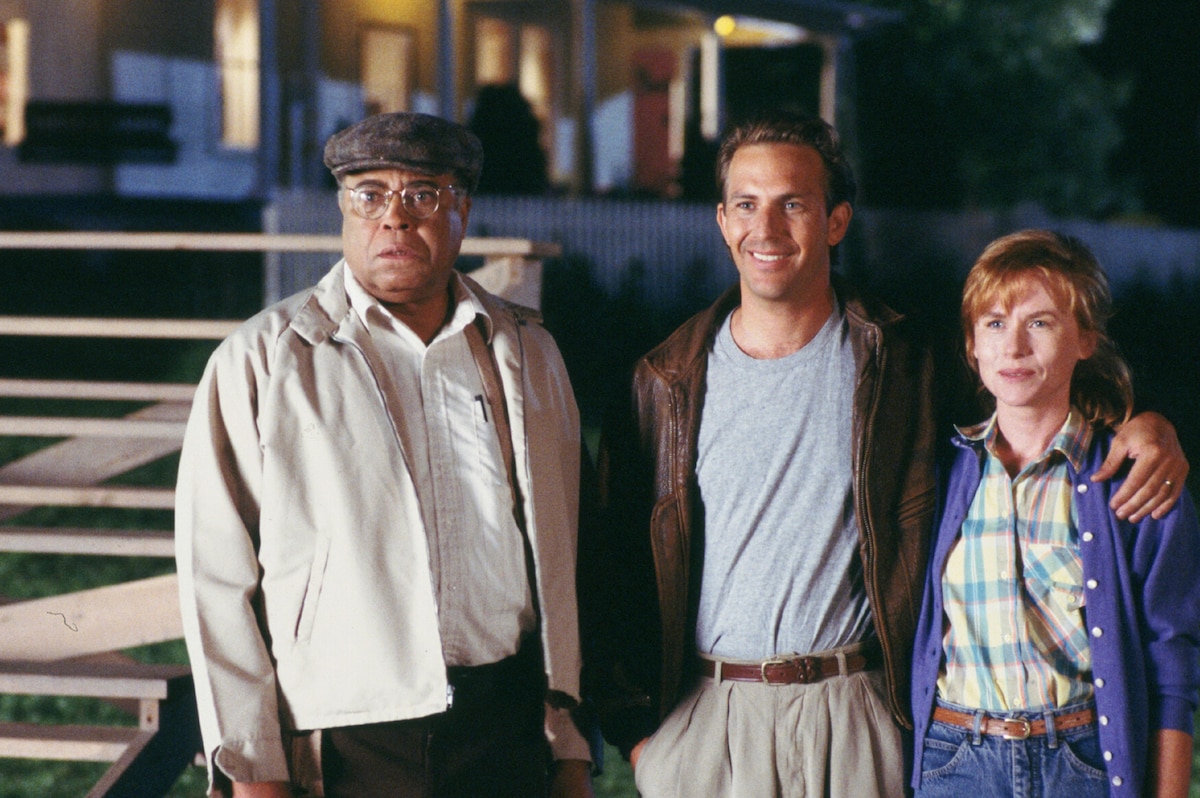
Gaby Hoffmann, who played the daughter of Kevin Costner and Amy Madigan, won a Young Artist Award for her supporting performance.
The film won Best Foreign Language Film from four different Japanese organizations: the Japanese Academy, Blue Ribbon Awards, Hochi Film Awards, and the Kinema Junpo Awards.
Composer James Horner won a Grammy Award for his soundtrack album.
The American Film Institute in 2008 ranked the film No. 6 in all-time Top Ten fantasy films. It was No. 28 in the AFI's 2006 ranking of the 100 most inspiring films, and the line "If you build it, he will come" was No. 39 in the 2005 list of 100 greatest movie quotes.
The now defunct entertainment magazine Premiere ranked this one of the "20 Most Overrated Movies of All Time." Others on the list included 2001 A Space Odyssey (1968), Gone with the Wind (1939), François Truffaut's Jules and Jim (1962), Robert Altman's Nashville (1975), and The Wizard of Oz (1939).
In a review of the movie for a Canadian publication, W.P. Kinsella gave it four stars out of five because he didn't think the character of Annie's brother Mark was villainous enough and because Gaby Hoffmann, in his opinion, did not look like she could be the daughter of Kevin Costner and Amy Madigan.
"I loved the finished movie. Most writers are unhappy with film adaptations of their work, and rightly so. Field of Dreams, however, caught the spirit and essence of Shoeless Joe while making the necessary changes to make the work more visual." - W.P. Kinsella, The Writing University website, January 5, 2012
"Movies are often so timid these days, so afraid to take flights of the imagination, that there is something grand and brave about a movie where a voice tells a farmer to build a baseball diamond so that Shoeless Joe Jackson can materialize out of the cornfield and hit a few fly balls. This is the kind of movie Frank Capra might have directed, and James Stewart might have starred in--a movie about dreams. ... It is very tricky to act in a movie like this; there is always the danger of seeming ridiculous. Costner and Madigan create such a grounded, believable married couple that one of the themes of the movie is the way love means sharing your loved one's dreams. Jones and Lancaster create small, sharp character portraits--two older men who have taken the paths life offered them, but never forgotten what baseball represented to them in their youth. Field of Dreams will not appeal to grinches and grouches and realists. It is a delicate movie, a fragile construction of one goofy fantasy after another. But it has the courage to be about exactly what it promises." - Roger Ebert, Chicago Sun-Times, April 21, 1989
"I won't spoil the outcome for those who know that, whatever the critics say, this is their kind of movie. To be honest, I started hearing things, too. Just when Jones was delivering an inexcusably sappy speech about baseball being 'a symbol of all that was once good in America,' I heard the words 'If he keeps talking, I'm walking.' Okay, it was just some disgruntled smartass behind me. But as Dreams drags on, that voice remains one well worth taking to heart." - Peter Travers, Rolling Stone, April 21, 1989
"Robinson has opted, commendably, for a straight-ahead, non-pyrotechnic approach, depending entirely on character oomph for his magical momentum. But Field of Dreams, you're no Bull Durham: The characters seem too transparent for the 'realistic' background they live in and the ghosts too fleshed in to be spectral. And none completely engages the heart, though you sort of like Costner and company (including Costner's wife Amy Madigan, Burt Lancaster as an old-time contender and Ray Liotta as the bright-eyed, intense 'Shoeless') for trying. This is one occasion when a little industrial-strength magic, Lucas-Spielberg style, actually might have helped--by lighting up the characters and making the otherworldly a little more wondrous." - Desson Howe, Washington Post, April 1989
"Director-writer Phil Alden Robinson certainly has his heart in the right place. He wants to make a film about loving your parents, chasing your wildest hopes, finding and accepting your past. He wants to heal all the wounds of the post-'60s, salve and soothe and bind them up. And he doesn't do any of this in a cheap or sensationalized way. Field of Dreams is about as heartfelt a movie as any major studio has given us recently. But there's something missing, something tentative and uncertain. In order to pull off a magic trick, you often have to distract the audience with smooth patter, clever detail or indirection. And this movie tries to play it so pure and unabashed that we can see right up its sleeves." - Michael Wilmington, Los Angeles Times, April 1989
"In spite of a script hobbled with cloying aphorisms and shameless sentimentality, Field of Dreams sustains a dreamy mood in which the idea of baseball is distilled to its purest essence: a game that stands for unsullied innocence in a cruel, imperfect world." - Variety, 1989
"Too idiosyncratic and witty merely to wallow in sentimentality, Field Of Dreams will surely stand as a classic update of what made Old Hollywood so magical. It's still a wonderful life." - Empire magazine, 1989
"A work so smartly written, so beautifully filmed, so perfectly acted, that it does the almost impossible trick of turning sentimentality into true emotion. ... Mr. Robinson, whose first film was last year's modestly charming In the Mood, is aware of the turns American ideals have taken since Jimmy Stewart's day, so he gives his story as much resistance and contemporary reality as a fable can bear. ... Audiences will probably believe in Mr. Costner's illusion or not, love or hate this film. It seems much easier to fall into Field of Dreams than to resist its warm, intelligent, timely appeal to our most idealistic selves." - Caryn James, New York Times, April 1989
"Taken in bare outline, the plot may appear faintly ridiculous, but this often beautiful film (John Lindley's cinematography is breathtaking)...embraces qualities which are skillfully amplified and not sentimentalized. Writer/director Robinson has embellished WP Kinsella's novel to examine the ideological conflict between the'60s and the '80s; together with moments of dry humour and fine performances, the political element lends the film gravity sufficient to counterbalance any sense of whimsy. Pure magic." - Collette Maude, Time Out, 2000
By Rob Nixon
Critics' Corner-Field of Dreams
by Rob Nixon | February 27, 2014
SIGN UP FOR OUR NEWSLETTERS

CONNECT WITH TCM