Still considered the greatest scandal in baseball history, the 1919 World Series made big news across the country when eight players from the Chicago White Sox, among them the great "Shoeless" Joe Jackson, were accused of taking money from big-time gamblers (rumored to be led by Arnold Rothstein, the basis for the Meyer Wolfsheim character in The Great Gatsby) to throw the series to the Cincinnati Reds. The extent to which each player on the team, nicknamed the Black Sox, was involved has never been clear, and they were acquitted of all criminal charges. All of them, however, were banned from baseball for life.
William Patrick (W.P.) Kinsella had been writing on and off since he was very young, but his formal education and career didn't really start until he was around 40. Although born and raised in Canada, he learned all about baseball from his Irish-American father, whose favorite player was Shoeless Joe Jackson. Kinsella used the story of Jackson and his Chicago "Black Sox" teammates as the basis for his first novel, Shoeless Joe. Kinsella had earned his master's degree in writing at the famed Iowa Writers' Workshop and fell in love with the state. He set his novel there, a fantasy about a farmer who follows the bidding of a mysterious voice to build a baseball field on his land. Once completed, the field brings back the ghosts of the disgraced team as well as those of a man who played only one pro game in his career before becoming a doctor and the protagonist's father. In the book, the main character also decides to kidnap reclusive real-life writer J.D. Salinger and take him to a baseball game because of an interview Salinger once supposedly gave about baseball. (An interview that never actually happened in real life). He also has a twin brother he tries to reconcile with their father.
While immersing himself in Salinger's writing as research for his book, Kinsella discovered Salinger had created a character named Ray Kinsella in one of his stories and another named Richard Kinsella who appeared in his most famous book, The Catcher in the Rye. Kinsella decided to name his main character Ray Kinsella and the troubled twin brother Richard Kinsella.
"I like to mix fantasy and reality to the point where I can't tell whether it actually happened or not," Kinsella has said. Shoeless Joe contained just such a mix, including a character named Archibald "Moonlight" Graham based on a real-life ball player who only got to play one game in his career before retiring at 30 to become a doctor.
It took Kinsella nine months to write the novel. Editors at Houghton Mifflin publishing company loved it and gave him their prestigious fellowship for first-time novelists of great promise. They released the book in mid-April 1982 to coincide with the start of baseball season. It was very well received critically and commercially.
A friend recommended the book to Phil Alden Robinson, a screenwriter who had recently made his directing debut with In the Mood (1987). He wasn't interested. "I'm a city boy. I don't believe in ghosts or any of that mumbo jumbo," he later said about the "zero percent chance" he would read the book and like it. When his friend mentioned the story also contained a kidnapping of J.D. Salinger, he was intrigued. He read the entire book in one night and decided he had to make a film of it.
Several studios rejected the book as completely wrong for the screen. They found the concept too fragile and thought the story would seem bloated and silly. Lawrence Gordon, an executive at 20th Century-Fox, loved it. The studio signed Robinson to write and direct.
Although he had written screenplays, Robinson had never adapted a novel for film. He began by tearing out the book's pages and pasting them into a notebook where he could make extensive notes. He found himself going to great pains to stay absolutely faithful to the book. When Fox executive Scott Rudin saw Robinson's first draft, he said, "Congratulations, you've just written Bill Kinsella's first draft of the screenplay. Now go write your first draft."
Robinson set about streamlining the book, with Kinsella's blessing, by putting the focus on the father-son relationship. First he got rid of the twin brother and made the Ray character the one who had a strained relationship with his father after a falling out over baseball and Shoeless Joe Jackson, his father's favorite player but a criminal in Ray's eyes. In the book, Ray wants that reconciliation from the very beginning, but Robinson decided to make the father's ghost a surprise at the end.
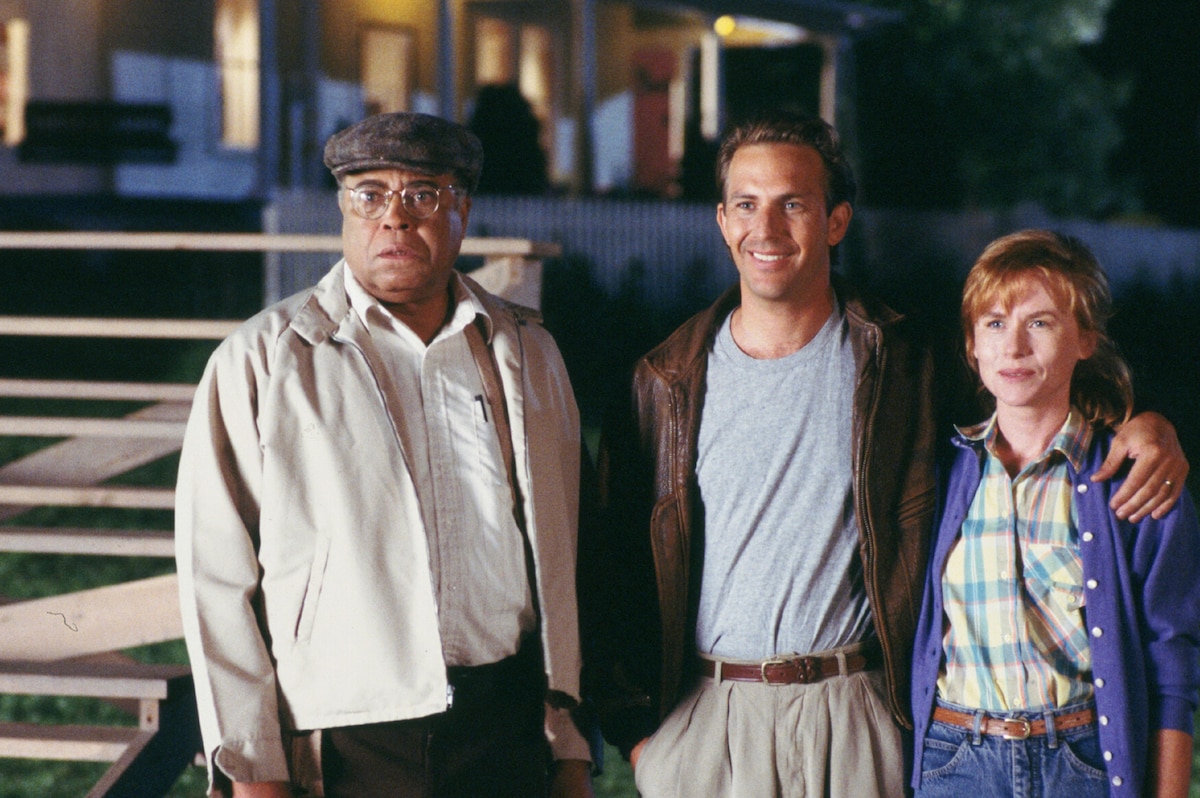
J.D. Salinger was very unhappy about Kinsella's fictional portrayal of him in the novel and threatened to sue, but did not have enough of a basis for litigation. Nevertheless, his lawyers let it be known that they would be "unhappy if it [the story] were transferred to other media." To avoid any problem, the Salinger character was renamed Terence Mann. At first, Robinson made him a thinly veiled version of Salinger. Then he saw James Earl Jones in the play Fences on Broadway. With Jones in mind, he created a new character, a disillusioned former 60s radical journalist who had withdrawn from the public eye.
Kinsella read the screenplay with tears in his eyes and thought if Robinson could get it to the screen, it would be something quite wonderful.
The script struck a particular chord with Fox executive Larry Gordon, whose own father had died suddenly before he could witness his son's success.
All together, Robinson spent five years on developing the project. Just when he felt ready to film it, there was a shake-up at Fox, and the studio was no longer interested. Larry Gordon, who had left Fox during the change, made it his personal project to get it done. He and Robinson tried to pitch it elsewhere but no one was interested. Paramount almost signed on, but they wanted Robin Williams in the lead. Then Universal chair Tom Pollock read it and cried. He gave it a $14 million budget.
Universal wanted Kevin Costner for the lead but were afraid he would turn it down, having just done another baseball movie, Bull Durham (1988). Robinson said he really couldn't think of anyone who would be more believable in the role. Costner decided to do it.
James Earl Jones was immediately drawn to the role created with him in mind.
Robinson thought the role of Ray Kinsella's wife Annie was the hardest to cast. He had created scenes for her that weren't in the book (such as the PTA meeting) to show her strength and conviction and add depth and complexity to her character. He needed someone who could be tough and soft, smart and funny, and an equal to her husband. He found her in Amy Madigan.
Robinson cast Ray Liotta as Shoeless Joe because "he could carry an air of mystery without trying too hard."
By Rob Nixon
The Big Idea-Field of Dreams
by Rob Nixon | February 27, 2014
SIGN UP FOR OUR NEWSLETTERS

CONNECT WITH TCM