Production began on January 15, 1973, and continued through June 1, with the film shot entirely on location in Texas.
Thinking he needed to give director Steven Spielberg a chance to get his feet wet on his first feature, producer Richard D. Zanuck instructed the production manager to start the film with relatively simple shots. He also decided to get to the location late that morning so that Spielberg could establish control of the set. When he arrived, however, he discovered the director had set up one of the film's most complicated shots, which he pulled off just fine.
During shooting, Spielberg and cinematographer Vilmos Zsigmond had breakfast almost every morning to discuss the work for that day. They agreed to give the film a documentary feel and screened numerous documentaries at night to find ways of solving problems on the set. Zsigmond's practice of using mostly natural lighting helped a great deal in that direction.
Spielberg shot the film in continuity. That made it easier to control production costs, as the size of the entourage following Lou Jean and Clovis grew steadily through the course of the film. It also helped the actors develop their characters more fully.
Spielberg shot the prison break where it actually took place, at the Jester State Prison in Sugar Land, TX, a pre-release facility.
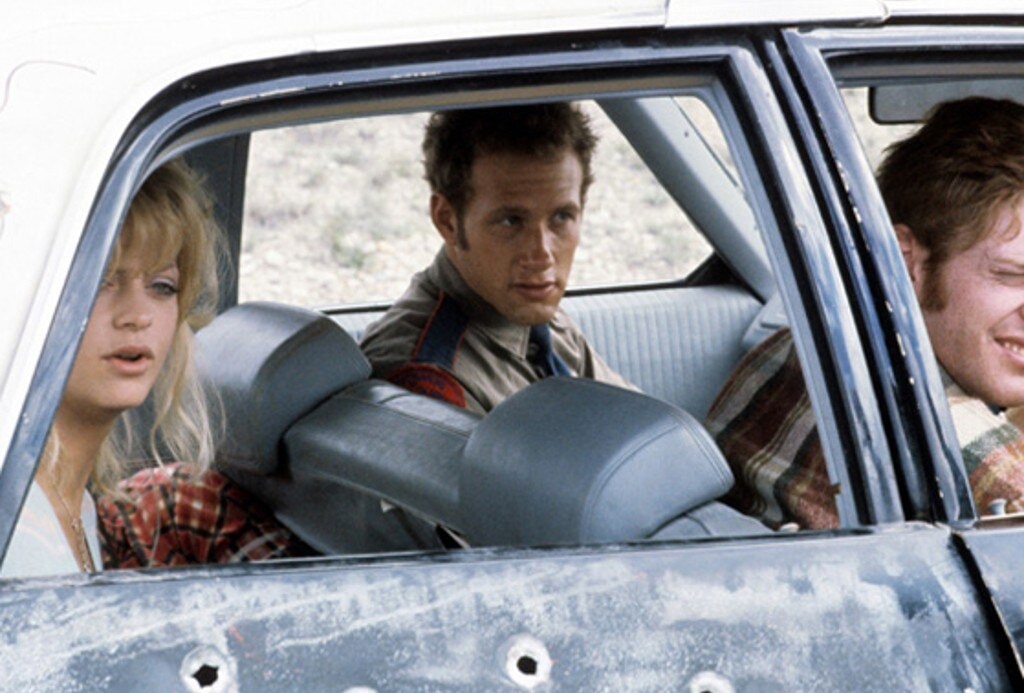
The Sugarland Express marked the first use of a compact Panaflex camera developed by Panavision Corporation. The smaller, lighter camera made it possible for Spielberg to capture complicated shots from within the police car. These included the first tracking shot from front seat to back and the first 360-degree pan within a car in film history.
One major challenge facing Spielberg was bringing together the acting styles of his leads, Goldie Hawn and William Atherton. The stage-trained Atherton got better with each successive take, but Hawn did her best work on the first two. She did, however, get a second wind if the scene went to 12 takes or more. Spielberg found it best to start with her close-ups. Then he would film Atherton's close-ups until Hawn started to rebound, at which point he could get two shots when they were both at their best.
Most of the smaller roles in the film were cast locally, many with non-actors. Not only did that save on transportation and housing expenses, but Spielberg was able to get memorable, authentic performances from the locals.
Stunt coordinator Carey Loftin imported the best stunt drivers he could find from Hollywood to make sure the film's car crashes could be filmed safely. The most difficult was the night collision in which a police car sideswipes the stolen police car, leading to a chain reaction as another car hits the sideswiping car and several other cars rear-end each other. Since there were no road lights at the intersection where they filmed, the art director built a tractor rental station on one side of the road and strung 200 50-watt light bulbs over it. That and the lights at a gas station nearby gave cinematographer Vilmos Zsigmond all the light he needed to capture the sequence. Spielberg then shot a master shot of the cars approaching each other, but with no collisions, as he couldn't afford any additional cars. Then they got the stunt with four cameras running simultaneously. Loftin drove the car that sideswipes the stolen police car and managed to hit it just right. If he hadn't, they would have had to buy another car for shots of the stolen vehicle.
Loftin also was the principal driver for the crash of the news van, which sends six reporters flying. The main stunt in that was performed by Ted Grossman, who managed to land head first in a two-foot-deep mud puddle.
It took an hour and a half to get each set-up for the highway scenes. First the Highway Patrol had to stop or reroute all traffic within two miles of the location site. After each shot, the cars in the film had to travel back to the starting point while the Highway Patrol let the waiting and, by then, angry drivers, through.
The Texas landscape was so flat that Spielberg had to place his camera above the road and use a long lens to get more than seven or eight cars within the frame.
To shoot the sequence in the used car lot economically, Spielberg had a six-foot scale model of the lot built by the art department so he could plan out the shots in advance.
Spielberg hired John Williams to score the film because he admired his scores for Mark Rydell's The Reivers (1969) and The Cowboys (1972). Originally, he wanted Williams to score The Sugarland Express symphonically, in the style of American composer Aaron Copland. Williams convinced him the film needed something sparser, working mainly with solo harmonica and a few strings.
Universal executives were thrilled with the rough cut until they previewed the film in San Jose, CA, on a double bill with Peter Bogdanovich's Paper Moon (1973). Audiences were with the film through the first act, particularly eating up Hawn's more comic scenes. When the sharpshooters turned up in the second half, and it became clear this was a more serious film, the mood changed. Some audience members left in tears. Others were angry.
The bad preview scared Universal out of its original release plans for the film. They had originally slated it for a late fall release in 1973 but then decided not to compete with other big films like their own The Sting. Instead, they pushed The Sugarland Express back to February 1974. They also abandoned plans to platform the film, which meant starting with just a few theatres in key cities and letting the audience build slowly. Not having faith in the picture, however, they switched to a wider opening, a sign at the time that they were just trying to burn it off quickly. Despite strong reviews, the film fared poorly because it didn't have the chance to build word-of-mouth with more discerning audiences. It turned a small profit, but did not do the kind of business they had expected for a film starring a top box-office star like Hawn.
Universal Pictures sold the film with the taglines "A girl with a great following" and "The true story of a girl who took on all of Texas...and almost won."
By Frank Miller
Behind the Camera-The Sugarland Express
by Frank Miller | February 25, 2014
SIGN UP FOR OUR NEWSLETTERS

CONNECT WITH TCM