In between his breakthrough starring roles in Raoul Walsh's The Big Trail (a 1930 failure) and John Ford's Stagecoach (a 1939 hit that led to superstardom), John Wayne was featured in many low-budget Westerns for Monogram Studios and serials made by Mascot Pictures Corporation. He also was the cowboy star of six Grade B Westerns at Warner Bros. during the 1932-33 movie season. The Telegraph Trail (1933) was one these Westerns, along with Ride Him, Cowboy (1932), The Big Stampede (1932), Haunted Gold (1932) Somewhere in Sonora (1933) and The Man from Monterey (1933).
In a partnership that foreshadowed Roy Rogers and Trigger, Gene Autry and Champion, these films teamed Wayne with a horse - in this case a magnificent white stallion, called Duke after Wayne's nickname and billed as "Duke the Wonder Horse" or "Duke the Miracle Horse." Duke had to be white because Warners used stock footage for the Wayne films from their earlier silent First National Westerns with Ken Maynard, and Maynard's horse, Tarzan, was white. (Some of the Wayne movies were actual remakes of Maynard Westerns.) In The Telegraph Trail the borrowed footage comes primarily from Maynard's 1927 movie The Red Raiders.
Duke gets prominent billing in these films; here he is listed second only to Wayne himself. He earned his star status with some clever tricks such as pulling up posts or trees to which he is tied in order to gallop to Wayne's rescue. In this movie, after Wayne and Duke have established rapport, Duke takes over as his regular steed by unsaddling another horse with his teeth and chasing it away. He is also smart enough to recognize Indian "villains" by their silhouettes inside a tent and deliver well-placed kicks.
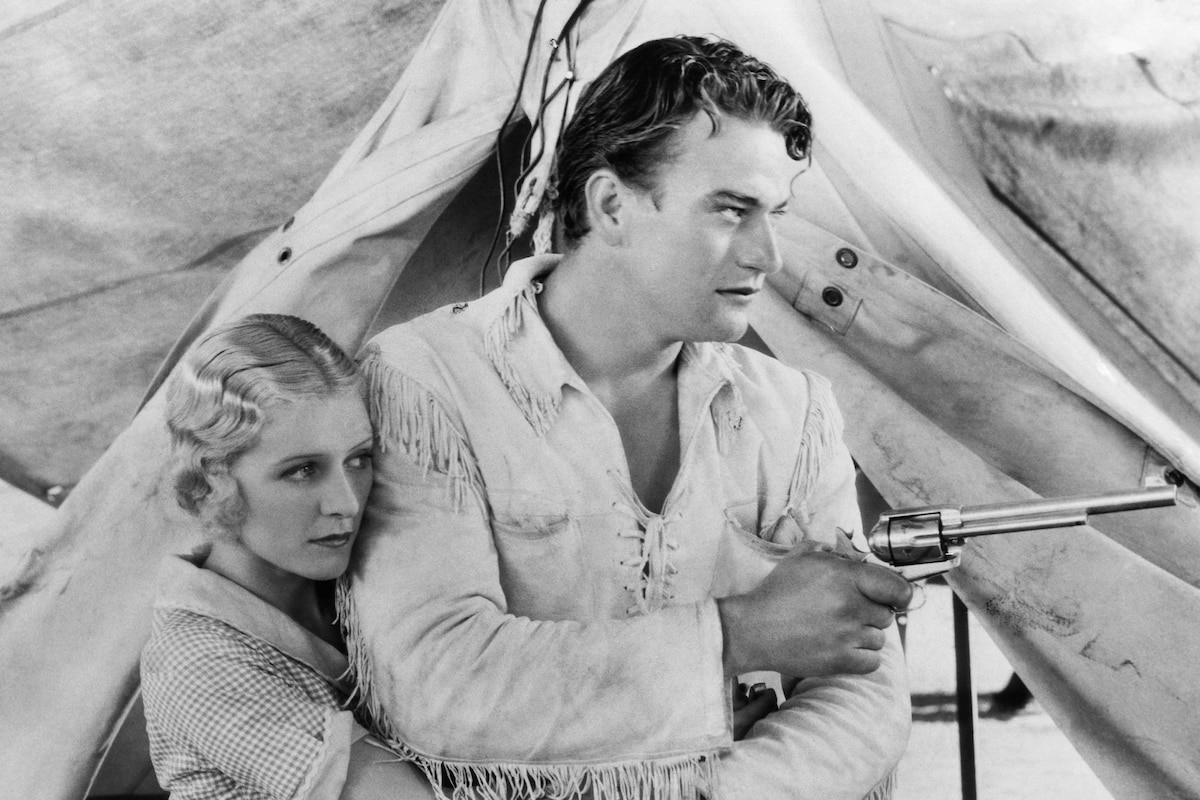
Wayne plays a different character in each of these Warner Bros. Westerns, but his first name is always John. In The Telegraph Trail he is John Trent, a U.S. Calvary scout in charge of completing the connection of telegraph wires across Indian territory of the Western plains. Trying to stop him is the villainous trader-turned-renegade Gus Lynch (Albert J. Smith), who enlists Indian chief High Wolf (Yakima Canutt) in starting an uprising against the telegraph workers.
On John's side are his sidekick Corporal Tippy (Frank McHugh), hard-drinking storekeeper "Uncle Zeke" (Otis Harlan) and winsome blonde Alice Keller, who seems at first to be in cahoots with Lynch. Alice is played by Marceline Day, in what some consider the best showcase of her career as a leading lady of B-Westerns. Jack Kirk and friends provide background music with such songs as "Mandy Lee" and "Oh, Susanna," with Wayne joining in on harmonica on the latter tune.
The movie, directed by Tenny Wright from a script by Kurt Kempler, was shot on locations in Lone Pine and Sonora, Calif. Western Union lent antique telegraph equipment to Warner Bros. for use in the film. In scenes featuring running horses, the film is speeded up to increase the sense of urgent action.
It was Wayne who suggested bringing in "Yak" Canutt, his pal from the Mascot serials, to play High Wolf and to handle the stunts in The Telegraph Trail. Canutt, a former champion rodeo rider, would become a legendary stuntman and second-unit director, noted especially for his handling of the chariot race in Ben-Hur (1959). He would win a special Oscar in 1967 for his contributions to film. He was a stunt double for Wayne through the 1930s, and the two became great friends. They enjoyed razzing each other, and Wayne kidded Canutt about his sparse hair by saying, "You'd better grease some color into your hair if you're doubling me!"
It is said that Wayne based his Western-hero character upon Canutt in some ways including that rolling swagger and the quiet, terse way of talking. Wayne biographer Mike Tomkies wrote that the actor also patterned his portrayal of anger after Canutt, telling him "I've seen you when you're really mad, and I know you're tough. It's a kind of smile and a straight way of looking at a guy and the voice drops low... I'm going to copy you when you really get mad." Canutt also helped Wayne refine his graceful style on horseback.
Together, Canutt and Wayne invented the "barroom brawling" technique that has been used by actors and stuntmen ever since, throwing punches that narrowly miss but seem real when the sound of the blow is added to the soundtrack. This painless technique replaced the old method in which actors would hit each other's shoulders, landing real blows that often left bruise marks. Fighting onscreen as frequently as Wayne did left him constantly sore until the new style was initiated.
Amusing footnotes to The Telegraph Trail: It is noted by Wayne historians as the only Western in which he wore double pistols (pearl-handled .45's) butt-forward in "Wild Bill" Elliott style. In Footlight Parade (also 1933) this is the film shown to James Cagney as an example of talking pictures - and the reason his career as a producer of stage spectacles is in jeopardy.
By Roger Fristoe
The Telegraph Trail
by Roger Fristoe | February 14, 2014
SIGN UP FOR OUR NEWSLETTERS

CONNECT WITH TCM